About Plato
From the intellectual ferment of ancient Athens emerged one of philosophy's most enduring voices, Plato, born around 428 BC into an aristocratic Athenian family and passing in 348 BC in the city he so profoundly shaped. His given name was Aristocles, with "Plato" likely being a nickname referring to his broad physique or intellect.
Born into a prominent Athenian family with connections to Solon and the Athenian aristocracy, Plato received a comprehensive education in music, gymnastics, and philosophy. His early years were marked by political turmoil in Athens, yet his true intellectual awakening came under the tutelage of Socrates. He became one of Socrates’ most devoted students, absorbing the rigorous questioning and ethical pursuit that defined his teacher’s approach and setting the course for his own philosophical contributions.
The unjust trial and execution of his mentor, Socrates, proved a pivotal event for Plato, compelling him to preserve Socrates’ memory and develop his own philosophical system through written dialogues. Writing in a period long before modern publishing houses, his works circulated among students at his Academy and through manuscript copies made by scribes who meticulously reproduced them. His earliest significant writings, often called Socratic dialogues, such as the *Apology*, directly present his teacher’s arguments and persona, establishing a unique literary form that combined dramatic interaction with profound philosophical inquiry.
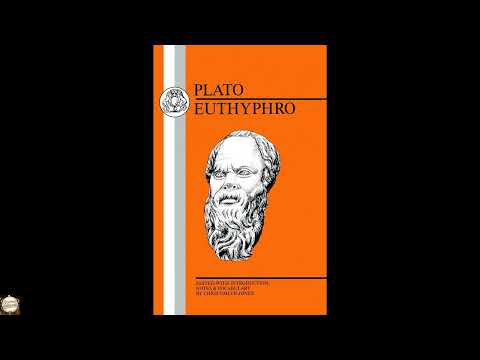
Plato's extensive output spans a range of philosophical subjects, with several dialogues standing as cornerstones of Western thought. In the *Republic*, he lays out his vision for an ideal state governed by philosopher-kings and theorizes on justice; the *Apology* recounts Socrates’ defiant defense speech before the Athenian court; the *Phaedo* documents Socrates’ final hours and presents arguments for the immortality of the soul; the *Symposium* gathers diverse perspectives on the nature of love; and *Crito* presents Socrates’ steadfast refusal to escape prison, prioritizing loyalty to the law. Even dialogues like *Euthyphro*, available here, interrogate the meaning of piety with Socrates’ incisive questioning.
Central to Plato's writing is the use of the dramatic dialogue, allowing differing viewpoints to clash and ideas to evolve through logical progression. His prose often blends myth, allegory, and rigorous argument, making abstract concepts accessible. A recurring method is Socratic irony, where Socrates feigns ignorance to guide interlocutors to deeper truths. Among his most famous philosophical contributions is the Theory of Forms, positing that non-physical, perfect Forms exist independently of the physical world and serve as blueprints for all reality. He returns consistently to themes of justice, virtue, the ideal state, the nature of knowledge, and the immortality of the soul. For example, the Allegory of the Cave, presented in the *Republic*, vividly illustrates the human condition of ignorance and the philosopher’s ascent to enlightenment, representing his vision of ultimate reality.
Plato’s enduring influence on Western thought cannot be overstated. He founded the Academy in Athens, often considered the first institution of higher learning in the Western world, where he taught Aristotle and countless others. His ideas laid the groundwork for political theory, metaphysics, ethics, epistemology, and aesthetics, shaping subsequent philosophical movements for millennia. From Neoplatonism to Renaissance humanism and modern political philosophy, his concepts of an ideal state, the nature of reality, and the pursuit of truth continue to resonate and challenge thinkers across disciplines. Listening to his profound discussions today offers a direct engagement with the foundational debates that continue to shape our understanding of ourselves and the world.
More on Wikipedia →