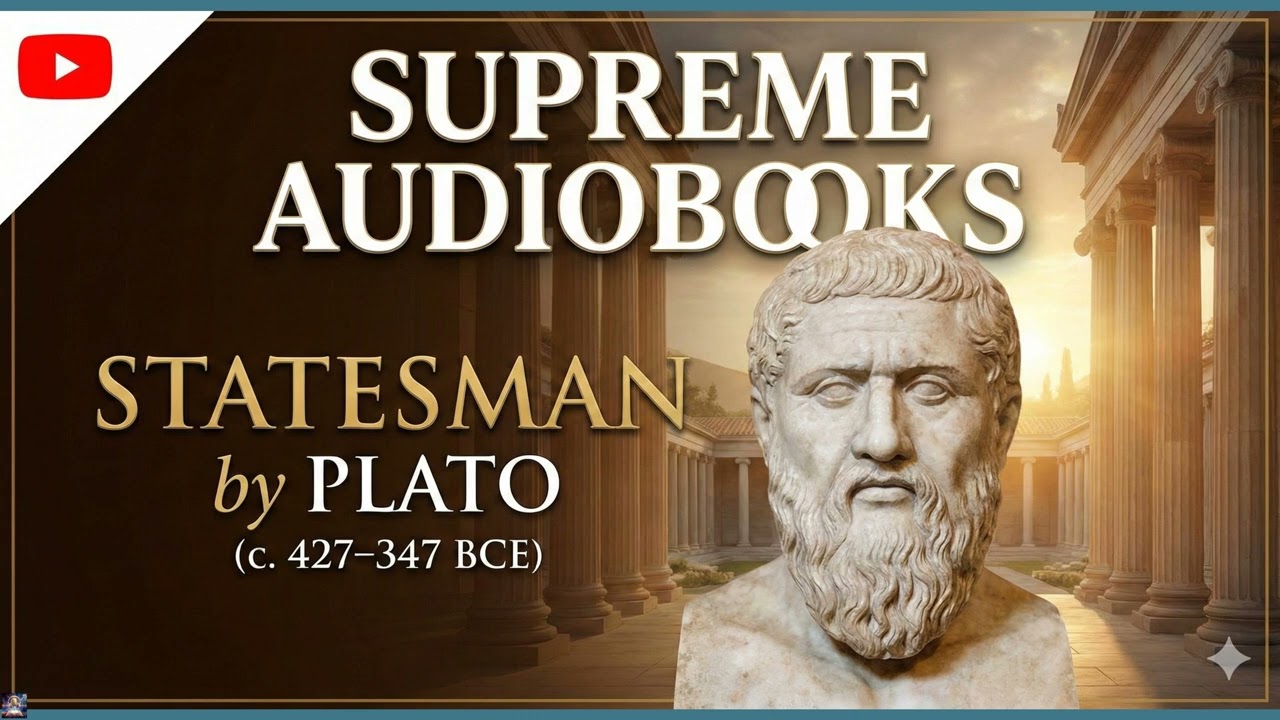
Statesman
In a world grappling with the complexities of leadership and the constant search for effective governance, Plato's Statesman arrives as a resonant whisper from antiquity. This profound Socratic dialogue poses a question as urgent now as it was over two millennia ago: what is a statesman? Beyond the fleeting polls, the divisive rhetoric, or the tactical maneuvering of modern politics, Plato — through the voice of an unnamed visitor from Elea — seeks to define the very essence of political competence, the unique knowledge required to shepherd a society towards well-being. It is a rigorous inquiry that cuts through superficial appearances to confront the core challenges of ruling, offering not easy answers, but a robust framework for thinking about the ideal leader. Listeners seeking a deeper understanding of political philosophy and the enduring principles of statecraft will find its arguments surprisingly immediate and relevant to our contemporary dilemmas. The dialogue unfolds as a methodical quest to precisely categorize and understand the figure of the statesman. The central speakers are the Eleatic Stranger, a philosophical visitor, and Young Socrates, a distinct character from the historical Socrates himself, who mostly listens. Socrates, the elder, introduces the Stranger and sets the stage, asking him to define the statesman after he has previously defined the sophist and the philosopher. The Stranger, employing the rigorous method of "division" or diairesis, begins by attempting to distinguish the statesman from other professions and types of rulers. He first tries to classify the statesman as a kind of shepherd for humanity, much like a herdsman cares for his flock. This initial analogy, however, soon proves inadequate, prompting a detailed and often humorous digression as they systematically divide and subdivide various forms of knowledge and human activity. They distinguish between productive and acquisitive arts, between commanding and ministering, and between the care of inanimate objects and living beings. The path to defining the statesman is littered with discarded definitions, false leads, and the realization that political rule is far more complex than simply managing a herd. The dialogue’s arc involves repeatedly refining their understanding, moving from broader categories to increasingly specific distinctions, demonstrating the challenges inherent in precise philosophical definition without ever revealing the final, distilled conclusion of their complex investigation until the work's end. Plato, born around 427 BCE in Athens, was a towering figure whose intellectual shadow stretches across Western thought. Descended from an aristocratic Athenian family, he lived through a tumultuous period in Greek history, witnessing the Peloponnesian War, the rise and fall of the Thirty Tyrants, and the eventual restoration of democracy that tragically led to the trial and execution of his beloved mentor, Socrates, in 399 BCE. This event profoundly shaped Plato's view of politics and justice, leading him to believe that true societal reform could only come through philosophical enlightenment and the rule of reason. After Socrates' death, Plato traveled extensively before returning to Athens to establish the Academy, often considered the first institution of higher learning in the Western world, where he taught and wrote for the remainder of his long life until his death around 347 BCE. His prodigious literary output, almost entirely in the form of philosophical dialogues, includes foundational texts such as The Republic, where he famously outlined his vision of an ideal state governed by philosopher-kings; the Apology, which records Socrates' defense speech; and the Symposium, a brilliant discussion on love. His dialogues are not merely philosophical treatises but literary works, featuring dramatic interactions, vivid characterizations, and eloquent prose that bridge the realms of philosophy, ethics, politics, and metaphysics. Plato’s ideas on forms, epistemology, and the nature of reality have influenced countless thinkers, from early Christian theologians to modern philosophers, securing his place as an indispensable originator of Western intellectual tradition. The Statesman enacts several crucial themes, chief among them the challenge of true governance. The Eleatic Stranger argues that genuine statesmanship is a unique "royal science" – a practical wisdom distinct from mere law-making or persuasive rhetoric. He uses the analogy of a skilled physician: just as a doctor, knowing what is best for a patient, might occasionally deviate from standard medical practice, so too might a true statesman, guided by profound knowledge, need to act beyond or even contrary to existing laws for the ultimate benefit of the state. This highlights the ideal leader's singular ability to discern and implement the most advantageous course of action, even when it requires flexibility. Another central theme is the tension between the rule of law and the rule of individual wisdom. While the dialogue acknowledges the necessity of general laws to maintain order and provide stability for a populace, it also suggests that an absolutely wise ruler, possessing perfect knowledge, would ideally operate above fixed statutes, adapting to every unique circumstance. The dialogue concludes that since such a perfect ruler is rare or perhaps impossible in human form, laws become a necessary, albeit imperfect, substitute. The philosophical method itself, diairesis—the systematic division of concepts into their constituent parts—is also a major theme. The prolonged, step-by-step process of defining the statesman exemplifies Plato's belief in rigorous intellectual analysis as the path to understanding, showcasing how one must patiently break down complex ideas to grasp their true nature. Plato wrote the Statesman during his later period, after The Republic and before his final work, Laws. This places it in a time of considerable reflection and perhaps a more pragmatic outlook on political realities. Having personally experienced the political upheavals in Athens and having even attempted to advise Dionysius II of Syracuse on governance with disappointing results, Plato likely tempered some of the earlier idealism found in The Republic. Athenian democracy, restored after the Peloponnesian War and the oppressive rule of the Thirty Tyrants, still suffered from factionalism and the perceived dangers of populist leadership, evidenced by Socrates' trial. This intellectual climate fueled Plato’s ongoing search for a stable and just form of government that could withstand human weaknesses. The work emerged from Plato’s enduring concern with establishing a rational basis for political order, reacting to both the practical failures of contemporary Athenian politics and the philosophical challenges of defining the ideal leader. Listening to Statesman as an audiobook offers an exceptional way to engage with Plato's intricate arguments. The dialogue format, with its back-and-forth questioning and the methodical unpacking of ideas, comes alive through skilled narration. An experienced voice actor can distinguish between the Eleatic Stranger's authoritative tone and Young Socrates' more tentative responses, making the complex philosophical exchanges easier to follow and grasp. The length, spanning several hours, is perfectly suited for focused listening sessions, allowing the listener to absorb the methodical pacing of the diairesis without feeling rushed. The verbal performance adds layers of meaning to the abstract concepts, enhancing the intellectual atmosphere and transforming what might be a challenging read into an engaging auditory experience that truly brings ancient Greek philosophical discourse into the present moment.
Enjoyed Statesman? A few ways to support us
Audible & Amazon links are affiliate; we may earn a small commission at no extra cost.
About this production
Human narration by a volunteer reader from LibriVox.org, the public-domain audiobook project. LibriVox volunteers record literary works whose copyright has expired in the United States, releasing the resulting recordings into the public domain.
Statesman by Plato. The underlying text is in the U.S. public domain. We do not republish any modern copyrighted edition, translation, or commentary.
The 4K cinematic visuals accompanying this audiobook are generated by an AI image model from prompts derived from the source text. No copyrighted photos, paintings, or stock footage are used. AI generation is disclosed on every video on our YouTube channel as required by YouTube's altered/synthetic content policy.
English subtitles are transcribed from the LibriVox recording with OpenAI Whisper. Translations into the 11 other supported languages are produced by Meta's NLLB-200 neural translation model. No human translator's copyrighted translation is used.
Questions about sourcing or rights? See our DMCA & Sourcing policy or contact us.
Enjoyed this audiobook?
If you'd like to own a copy of Statesman or hear a professionally produced edition, the links below help support free audiobook production at no extra cost to you.
As an Amazon Associate we earn from qualifying purchases. Audible / print links are affiliate.