Eryxias
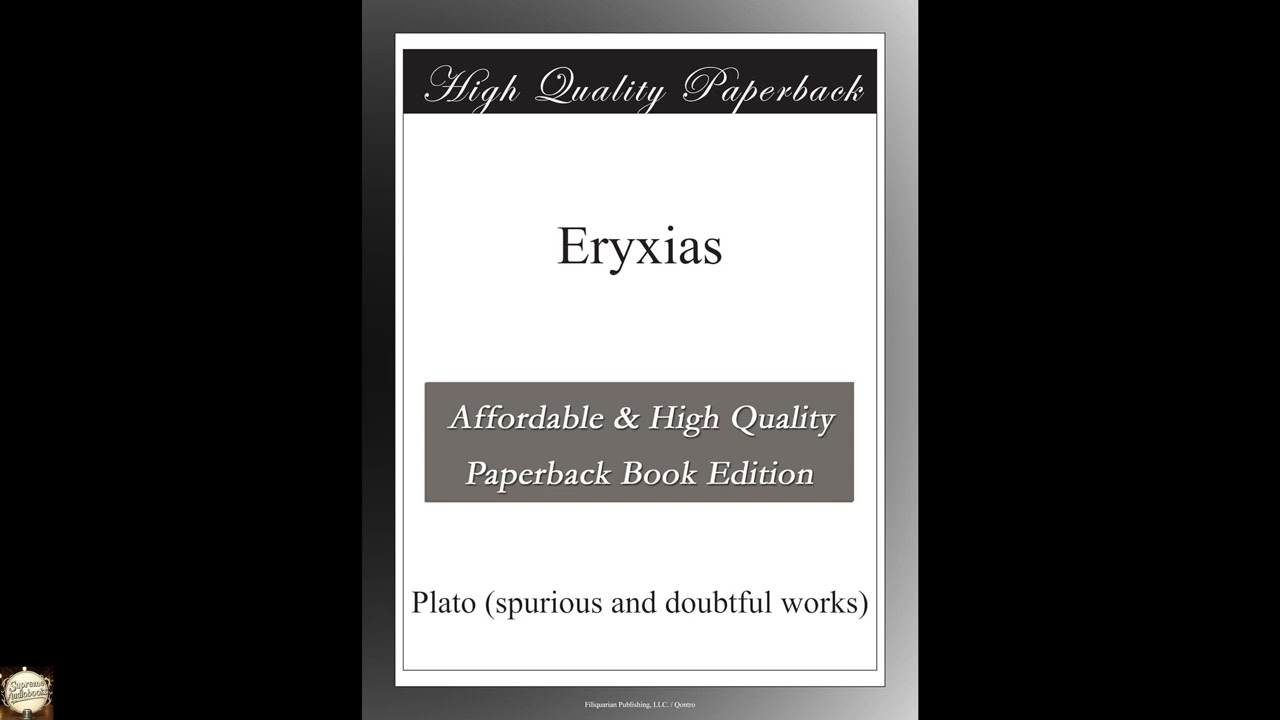
What truly constitutes wealth? Is it the shimmer of gold, the security of land, or the prestige of possessions? In an age often defined by the relentless pursuit of material gain, this question remains as urgent and relevant as it was in ancient Athens. The dialogue Eryxias, though its precise authorship has long been a subject of scholarly discussion, stands as a potent examination of this very query. It offers a bracing philosophical exercise, challenging our ingrained assumptions about money, happiness, and the true measure of a flourishing life. For anyone seeking to re-evaluate their own values in a world that so often equates prosperity with mere accumulation, this ancient text provides a rigorous and thought-provoking counter-narrative. The scene opens, as so many Platonic dialogues do, with Socrates encountering acquaintances, likely in a public gymnasium or stoa of ancient Athens – spaces where citizens gathered for exercise, discussion, and philosophical exchange. He engages with Eryxias, a man whose name itself suggests a connection to Eryx, a city known for its wealth, and whose views on material riches are seemingly straightforward and conventional. Also present are Critias and Prodicus, lending intellectual weight to the unfolding conversation. The initial exchange quickly turns to the nature of wealth, with Eryxias confidently asserting that wealth consists of tangible assets: silver, gold, and other possessions. Socrates, with his characteristic gentle but relentless probing, begins to dismantle Eryxias's seemingly solid definitions. He poses a series of questions designed to reveal the inherent contradictions and superficiality of equating wealth solely with material goods. The discussion moves from simple definitions to more complex scenarios, examining whether things universally considered valuable (like health or knowledge) are not also forms of wealth, and conversely, whether mere possession, without proper use or understanding, truly constitutes riches. The central conflict arises from Socrates’ challenge to the prevailing societal belief that material abundance guarantees a good or happy existence, guiding his interlocutors through a logical process that forces them to reconsider their initial premises. Plato, born Aristocles around 428/427 BCE in Athens, remains one of the foundational figures of Western philosophy. Coming from an aristocratic family, he witnessed the decline of Athenian democracy and was profoundly affected by the trial and execution of his mentor, Socrates. This seismic event spurred Plato to dedicate his life to philosophy, seeking to establish a system of thought that could rectify the moral and political failings he observed. His writings, primarily in the form of dialogues, became the enduring testament to his philosophical genius. He founded the Academy in Athens, often considered the first institution of higher learning in the Western world, where he taught for decades, shaping generations of thinkers, including Aristotle. Among his many enduring works are The Republic, a groundbreaking treatise on justice and the ideal state; Symposium, a celebration of love and beauty; and Apology, a vivid depiction of Socrates' defense. Plato's influence on metaphysics, ethics, political theory, and epistemology is immense, positioning him as a central figure in the Western philosophical canon. The dialogue Eryxias, however, resides among those works traditionally attributed to Plato that scholars have debated in terms of their authenticity. While its style and themes clearly align with the Socratic tradition, and it certainly contributes to the body of Platonic writing, it is often grouped with the apocryphal or doubtful dialogues, a testament to the powerful allure of Plato’s name and the Socratic method itself that others sought to emulate or attach themselves to his celebrated oeuvre. At its core, Eryxias enacts the relentless Socratic method, or elenchus. This method of cross-examination serves not only to refute false beliefs but also to lead the interlocutor, and by extension the listener, toward self-knowledge and a deeper understanding of truth. A compelling scene, for example, arises when Socrates prompts Eryxias to consider whether a skilled physician who lacks money but possesses the knowledge to heal is not "richer" in a fundamental sense than a wealthy person plagued by illness and ignorant of health. This exchange forces a re-evaluation of what constitutes true value. The dialogue also focuses on the nature of wealth and happiness. It pushes against the simplistic notion that material possessions automatically translate into a good life. Socrates demonstrates that if wealth is merely the accumulation of things, then a person could be "wealthy" in things that bring them harm, like an abundance of poisons. This forces a consideration of the use of things, and whether true wealth lies in knowing how to use resources wisely and virtuously. The text, therefore, suggests that true prosperity is inextricably linked to wisdom and right conduct, reflecting the broader Socratic belief that virtue is knowledge. The time in which this dialogue would have emerged, whether penned by Plato or a close contemporary, was a tumultuous one for Athens. Following the Peloponnesian War, which ended in 404 BCE, Athenian society grappled with political instability, moral uncertainty, and a questioning of traditional values. This period saw the rise of sophistry, with teachers offering instruction in rhetoric and persuasion, often for a fee, sometimes divorcing wisdom from ethical conduct. Philosophical inquiry, therefore, became a crucial response to these societal shifts, seeking to re-establish stable grounds for ethics and knowledge. A dialogue like Eryxias speaks directly to these concerns, offering a critique of superficial values and an argument for philosophical self-examination as the path to a genuinely good life, challenging the prevailing materialism and moral relativism that Plato and his followers perceived. Listening to Eryxias as an audiobook transforms a profound philosophical text into an immersive experience. The very structure of a Socratic dialogue, built on spoken question and answer, is perfectly suited for audio presentation. A skilled narrator can bring each character to life, distinguishing Socrates' gentle but insistent questioning from the often more dogmatic pronouncements of his interlocutors. The pacing of the dialogue – the thoughtful pauses, the gradual build-up of an argument, the sudden revelations – becomes palpable, allowing the listener to follow the intricate turns of thought more readily than by reading alone. The "several hours" run time offers ample opportunity to settle into the atmosphere of ancient Athenian debate, letting the cadence of the arguments wash over you. It's a chance to be present for a foundational conversation that continues to resonate today, hearing the ideas unfold as if you were truly sitting in the marketplace or gymnasium, witnessing the birth of Western ethical thought.
Enjoyed Eryxias? A few ways to support us
Audible & Amazon links are affiliate; we may earn a small commission at no extra cost.
About this production
Human narration by a volunteer reader from LibriVox.org, the public-domain audiobook project. LibriVox volunteers record literary works whose copyright has expired in the United States, releasing the resulting recordings into the public domain.
Eryxias by Plato. The underlying text is in the U.S. public domain. We do not republish any modern copyrighted edition, translation, or commentary.
The 4K cinematic visuals accompanying this audiobook are generated by an AI image model from prompts derived from the source text. No copyrighted photos, paintings, or stock footage are used. AI generation is disclosed on every video on our YouTube channel as required by YouTube's altered/synthetic content policy.
English subtitles are transcribed from the LibriVox recording with OpenAI Whisper. Translations into the 11 other supported languages are produced by Meta's NLLB-200 neural translation model. No human translator's copyrighted translation is used.
Questions about sourcing or rights? See our DMCA & Sourcing policy or contact us.
Enjoyed this audiobook?
If you'd like to own a copy of Eryxias or hear a professionally produced edition, the links below help support free audiobook production at no extra cost to you.
As an Amazon Associate we earn from qualifying purchases. Audible / print links are affiliate.