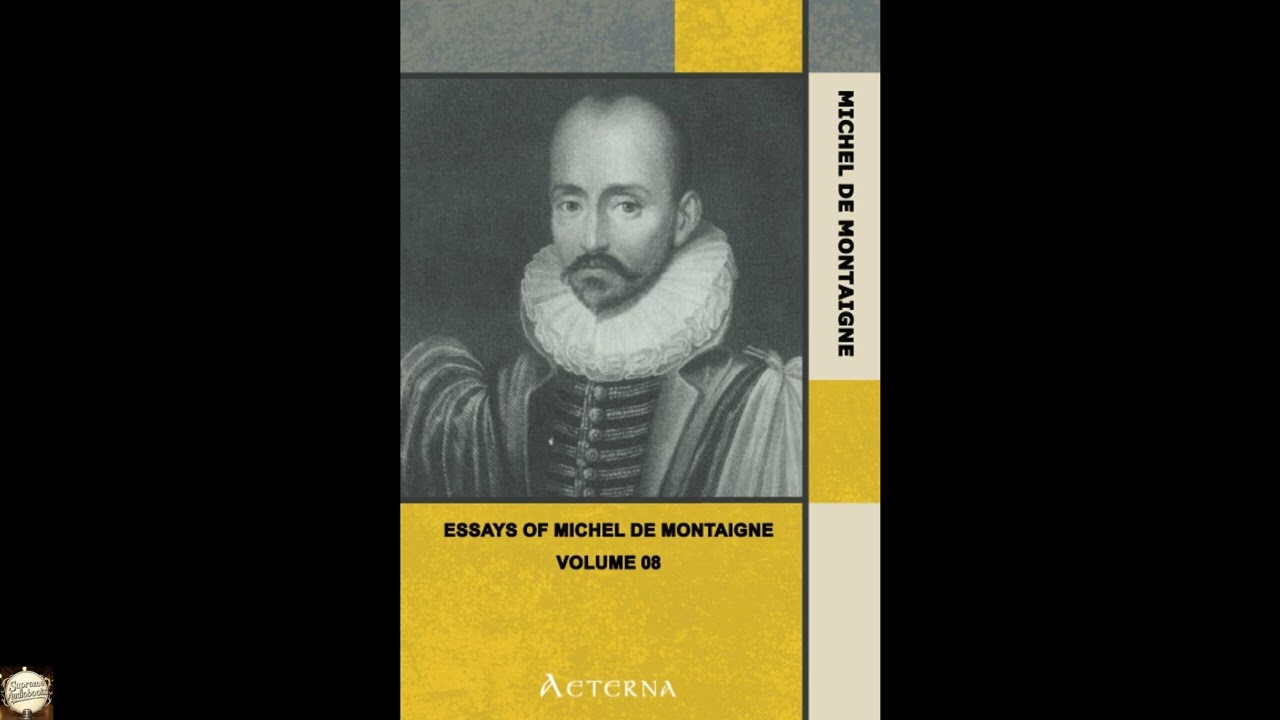
The Essays of Montaigne - Volume 19
Enter the singular, profound world of Michel de Montaigne, a voice from the sixteenth century whose gentle yet radical introspection continues to resonate with startling clarity in our own tumultuous era. The Essays of Montaigne - Volume 19 is not a conventional narrative; it is an intimate encounter with a mind wrestling openly with the grand questions of existence and the minute observations of daily life. What makes this collection, even in its nineteenth volume, essential listening today is its direct, unvarnished engagement with what it means to be human: to doubt, to believe, to age, to confront fear, to live with uncertainty, and to ultimately seek understanding not through dogma, but through relentless self-examination. Montaigne strips away pretense, inviting listeners into a private dialogue that is as challenging as it is comforting, proving that the most ancient anxieties are often our most modern concerns. The "story" within Montaigne's essays unfolds not through external events or dramatic character arcs, but within the fertile landscape of a singular intellect at work. Imagine the setting: a quiet study in a tower, nestled in the countryside of France, where the author retreated from the political and religious strife of his time. Here, the "main character" is Montaigne himself, an observer both of the world around him and, more importantly, of the world within. He begins an essay often with a simple thought or a classical anecdote, then allows his mind to wander, to connect seemingly disparate ideas, to contradict himself, to challenge common assumptions, and to ultimately circle back, often without a definitive conclusion. The central "conflict" is the human struggle to make sense of a chaotic world and an even more baffling self. Each essay becomes a miniature drama of thought, a methodical unpeeling of an idea or a behavior. Montaigne might ruminate on the nature of idleness, or the efficacy of prayer, or the absurdity of human customs. His "arc" is the fluid movement of his consciousness – a conversational, almost stream-of-consciousness path that weaves together personal anecdotes, historical examples, philosophical arguments, and quotes from ancient writers. He is not trying to persuade or instruct in the conventional sense, but to lay bare the process of thinking itself. The reader witnesses a mind grappling with its own contradictions, admitting its own ignorance, and finding profound insights precisely in the act of honest inquiry. This approach, profoundly personal and remarkably candid, creates a unique bond between author and audience, as if Montaigne were speaking directly to a trusted friend. Michel de Montaigne, born in 1533 at the family château in Périgord, France, came from a wealthy merchant family that had recently been ennobled. His father, a progressive man, ensured Montaigne received an unusual education, speaking Latin from infancy and being woken by musical instruments rather than bells. After studying law, Montaigne served as a magistrate in Bordeaux for many years, where he formed an intense, formative friendship with Étienne de La Boétie, whose early death profoundly affected him. At the age of 38, weary of public life and the escalating French Wars of Religion, he retired to his tower library to devote himself to reading and writing, engraving his decision and famous skepticism—"Que sais-je?" (What do I know?)—onto the beams of his study. He dedicated the remainder of his life to composing his Essays, a unique and groundbreaking literary form he invented, which allowed him to record his thoughts and observations without strict adherence to formal argumentation. Though he later served as Mayor of Bordeaux and was involved in delicate diplomatic negotiations between Catholic and Protestant factions, his primary legacy remains his writings. He continued to revise and expand his essays until his death in 1592, creating a work that stands alone in the literary canon, a predecessor to autobiography, psychology, and the modern novel, all while firmly rooted in Renaissance humanism. His method of self-observation and his commitment to intellectual honesty profoundly influenced thinkers across Europe, from Shakespeare to Emerson, shaping the very way we consider personal inquiry and philosophical thought. At the heart of Montaigne's project lies the enduring theme of self-knowledge. He believed that the most important study was that of oneself, advocating for a rigorous, unsentimental examination of one's own habits, prejudices, and physical being. For example, he dissects his own memory, or lack thereof, his bodily functions, and his fear of pain, not to confess sins, but to understand the universal human experience through his particular one. He uses his own mind as a laboratory, demonstrating how individual experience can illuminate broader truths about humanity. Coupled with this introspection is a profound skepticism. Montaigne constantly questions authority, tradition, and the certainty of human reason. He compares customs from different cultures to show how much of what we consider "natural" is merely convention. He does not offer definitive answers but encourages an openness to doubt, a humility in the face of the unknown. This skepticism, however, is not a path to nihilism, but a path to intellectual freedom, urging individuals to think for themselves rather than passively accept received wisdom. He implicitly argues that true wisdom often lies in acknowledging the limits of human understanding. The historical backdrop to Montaigne's writing was the volatile period of the French Wars of Religion, a brutal and protracted conflict between Catholics and Protestants that tore France apart for decades in the latter half of the sixteenth century. Montaigne, a moderate Catholic, witnessed firsthand the horrors of fanaticism, intolerance, and political upheaval. This environment undoubtedly fostered his deep distrust of dogmatism and his fervent appeal for moderation, reason, and peace. His essays often reflect an underlying search for a stable intellectual and moral ground in a world that seemed to be collapsing into chaos. His work also emerged during the flourishing of the Renaissance, a time characterized by a renewed interest in classical learning and human potential. Montaigne was deeply immersed in Greek and Roman texts, drawing heavily on figures like Seneca, Plutarch, and Virgil. However, he did not merely parrot ancient wisdom; he engaged with it critically, synthesizing it with his own observations. He represents a pivotal shift from scholastic, systematic philosophy towards a more personal, empirical approach to understanding the world and oneself. His essays, therefore, stand as both a product of Renaissance humanism and a significant step toward modern thought, bridging the gap between classical erudition and individual experience. Listening to Montaigne's essays as an audiobook provides an exceptionally fitting and enriching experience. The very nature of his prose, conversational and meandering, feels as though it was always meant to be heard. The narrator's voice becomes Montaigne's own, guiding the listener through his labyrinthine thoughts, his wry observations, and his moments of deep contemplation. The several hours of this volume allow for extended immersion, a chance to absorb his ideas at a measured pace, perhaps during a quiet walk or a thoughtful moment in one's day. The subtle inflections in pacing and tone can highlight Montaigne's wit, his occasional exasperation, or his profound melancholy, bringing alive a text that is meant to be digested slowly, pondered, and revisited. It is an invitation to spend time in the company of one of history's most thoughtful and relatable minds, a true dialogue that unfolds one sentence, one reflection, at a time.
Enjoyed The Essays of Montaigne - Volume 19? A few ways to support us
Audible & Amazon links are affiliate; we may earn a small commission at no extra cost.
About this production
Human narration by a volunteer reader from LibriVox.org, the public-domain audiobook project. LibriVox volunteers record literary works whose copyright has expired in the United States, releasing the resulting recordings into the public domain.
The Essays of Montaigne - Volume 19 by Michel de Montaigne. The underlying text is in the U.S. public domain. We do not republish any modern copyrighted edition, translation, or commentary.
The 4K cinematic visuals accompanying this audiobook are generated by an AI image model from prompts derived from the source text. No copyrighted photos, paintings, or stock footage are used. AI generation is disclosed on every video on our YouTube channel as required by YouTube's altered/synthetic content policy.
English subtitles are transcribed from the LibriVox recording with OpenAI Whisper. Translations into the 11 other supported languages are produced by Meta's NLLB-200 neural translation model. No human translator's copyrighted translation is used.
Questions about sourcing or rights? See our DMCA & Sourcing policy or contact us.
Enjoyed this audiobook?
If you'd like to own a copy of The Essays of Montaigne - Volume 19 or hear a professionally produced edition, the links below help support free audiobook production at no extra cost to you.
As an Amazon Associate we earn from qualifying purchases. Audible / print links are affiliate.