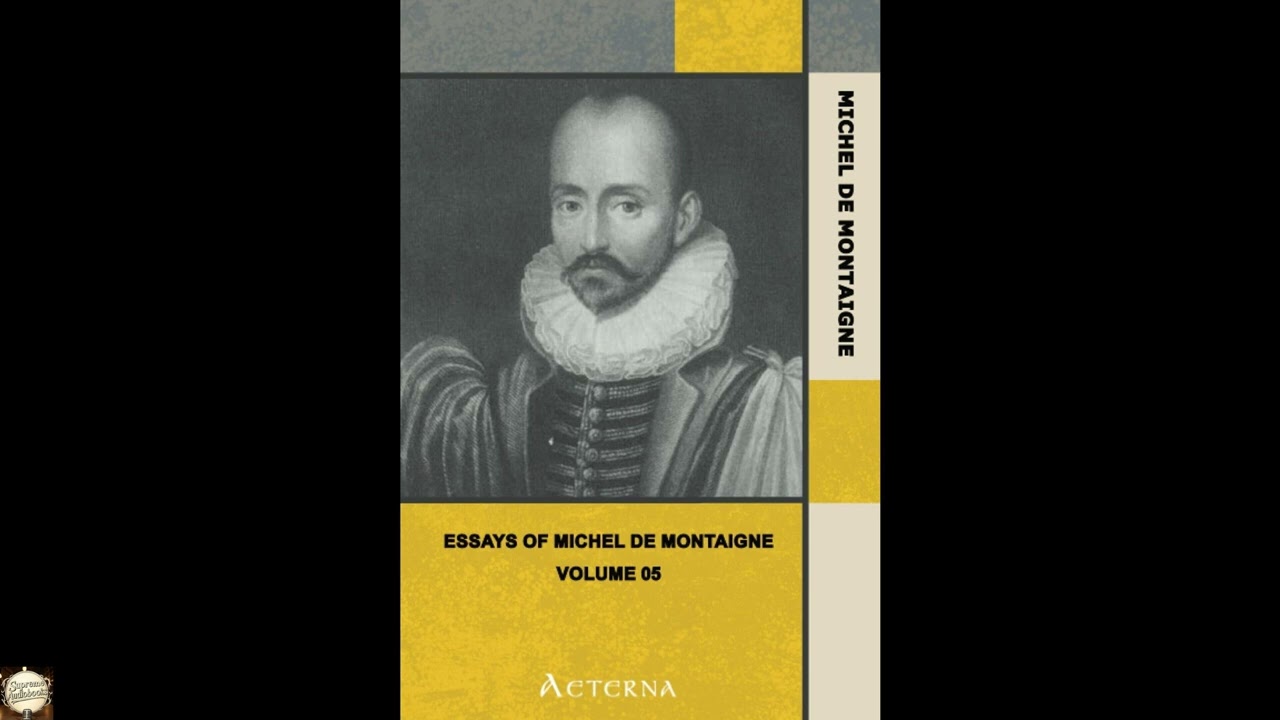
Essays of Michel de Montaigne — Volume 05
Michel de Montaigne, a figure whose very name conjures the spirit of introspective inquiry, stands as the undeniable progenitor of the essay form. His Essays of Michel de Montaigne — Volume 05 extends this groundbreaking project, inviting listeners into the intimate chamber of a brilliant mind wrestling with the universal questions of humanity. What makes this collection, penned centuries ago, so vital for the contemporary ear? It is Montaigne’s audacious commitment to understanding himself, and by extension, all of us, through candid self-examination and intellectual honesty. In a world saturated with opinions and fleeting truths, Montaigne offers not answers, but the more precious gift of method: how to think for oneself, how to doubt wisely, and how to live with grace amidst uncertainty. This is not a didactic sermon but a friendly, meandering conversation with a wise and ever-curious soul. Unlike a novel with a clear narrative arc, Montaigne's essays do not unfold a sequential plot with fictional characters and a singular climax. Instead, the setting is primarily the author's personal library, a quiet refuge in his tower at Château de Montaigne, and more profoundly, the vast landscape of his own consciousness. The main "character" is Montaigne himself—candid, fallible, philosophical, and utterly human. His companions are the ancient Greek and Roman philosophers whose wisdom he continually weighs against his own experiences, along with the various historical figures and contemporary events that spark his reflections. The central conflict animating these pages is Montaigne's lifelong struggle to comprehend the human condition, to make sense of the world's bewildering array of customs, beliefs, and contradictions, and ultimately, to learn how to live a good life. This intellectual quest is the arc of the entire collection. Each essay in this volume, like those before it, acts as a window into Montaigne’s mind as he grapples with a seemingly disparate topic—perhaps friendship, fear, idleness, or even the practice of wearing clothes—only to loop back, with surprising agility, to the overarching theme of self-knowledge. He is not building a grand philosophical system but rather sketching a nuanced self-portrait, painting himself exactly as he is, warts and all. The "story" is the continuous unfolding of his thoughts, his digressions, his doubts, and his changing perspectives, all serving to create a rich, cumulative picture of what it means to be human in its purest, most unvarnished form. The conclusion is not a revelation of plot, but a deepening of understanding, leaving the listener with an enriched sense of their own capacity for reflection and inquiry. Michel de Montaigne was born in 1533 at the family estate in Périgord, France, into a wealthy noble family. His education was famously unconventional, learning Latin from infancy before being exposed to French, a method intended to immerse him in classical thought. He pursued a legal career, serving as a magistrate and later as mayor of Bordeaux, positions that exposed him to the complexities of human nature and the mechanisms of justice. However, a profound turning point came in 1571 when, after the death of his beloved friend Étienne de La Boétie and his father, Montaigne retired from public life to his library. It was there, surrounded by his books, that he began the monumental task of writing his Essais, a word he coined meaning "attempts" or "trials." Montaigne's work is considered a cornerstone of Renaissance humanism, a movement that emphasized human agency, reason, and classical antiquity over medieval scholasticism. His singular contribution was not just the invention of a new literary form, but the profound shift in perspective it represented. He famously declared, "I am myself the matter of my book," placing personal experience and introspection at the heart of philosophical inquiry. Though he authored no other major works, the Essays themselves were continually revised and expanded throughout his life until his death in 1592, reflecting his evolving thoughts and observations. His influence resonated through the centuries, shaping the thought of figures as diverse as William Shakespeare, Francis Bacon, Jean-Jacques Rousseau, Friedrich Nietzsche, Ralph Waldo Emerson, and Virginia Woolf, securing his enduring place in the literary canon as a champion of individual thought and skeptical inquiry. Montaigne's essays enact several powerful themes, perhaps none more central than self-knowledge. He offers a relentless, almost microscopic examination of his own habits, fears, desires, and opinions. For instance, he writes candidly about his bodily functions, his memory, his fear of death, and his inconsistent judgments, demonstrating that understanding the self is not a static achievement but an ongoing, messy process. He doesn't present himself as an ideal, but as a laboratory specimen, through whom he hopes to understand universal humanity. Another dominant theme is skepticism, captured in his famous question, "Que sçay-je?" (What do I know?). Montaigne consistently questions received wisdom, dogmatic pronouncements, and the human propensity for certainty. He frequently offers multiple perspectives on a given topic without settling on a definitive truth, revealing the limits of human reason and the subjective nature of experience, a practice that encourages intellectual humility in the listener. He also engages deeply with the human condition and mortality. Montaigne frequently meditates on illness, aging, and the inevitability of death, not to induce despair but to encourage a more vital engagement with life. He recounts his own battles with kidney stones, using his physical suffering as a lens through which to consider pain, resilience, and the mind-body connection. Finally, a remarkable theme is his subtle form of cultural relativism. Drawing on accounts of newly discovered peoples in the Americas, he often challenges European ethnocentric biases. He juxtaposes the "barbarism" of these cultures with the supposed "civility" of his own, suggesting that many European customs and laws are equally arbitrary, rooted in habit rather than absolute truth. This questioning of ingrained societal norms urges listeners to view different cultures and practices with a more open and less judgmental mind. Montaigne's decision to retreat and write emerged from a turbulent historical context. The 16th century in France was a period of intense religious strife, known as the French Wars of Religion, pitting Catholics against Huguenot Protestants. This era saw widespread political instability, brutal violence, and fervent dogmatism, causing deep disillusionment among many intellectuals. The traditional certainties of the medieval world were crumbling under the weight of the Protestant Reformation, the Counter-Reformation, and the rediscovery of classical texts, which brought new philosophical perspectives to the fore. Simultaneously, overseas discoveries in the New World expanded horizons and challenged existing notions of civilization and humanity. Montaigne, witnessing the fanaticism and bloodshed firsthand, sought refuge from the chaos in his intellectual pursuits. His emphasis on individual judgment, personal experience, and philosophical skepticism can be seen as a direct response to a world where ideological certainty led to such destructive conflict, urging a more measured and humane approach to human differences. Listening to Essays of Michel de Montaigne — Volume 05 as an audiobook offers a uniquely immersive experience. With a run length of several hours, this installment invites sustained contemplation, allowing the listener to truly settle into Montaigne's rhythm of thought. His prose, even in translation, possesses a conversational flow, characterized by elegant digressions and unexpected turns, which lends itself perfectly to auditory presentation. A skilled narrator can bring out the nuances of Montaigne’s voice—his genial skepticism, his moments of profound reflection, his occasional wit, and his unwavering honesty. The pacing, often reflective and unhurried, encourages a similar thoughtfulness in the listener, transforming the act of listening into an intimate dialogue with one of history's great minds. It is an ideal companion for quiet moments, walks, or any time one seeks intellectual companionship that both challenges and comforts.
Enjoyed Essays of Michel de Montaigne — Volume 05? A few ways to support us
Audible & Amazon links are affiliate; we may earn a small commission at no extra cost.
About this production
Human narration by a volunteer reader from LibriVox.org, the public-domain audiobook project. LibriVox volunteers record literary works whose copyright has expired in the United States, releasing the resulting recordings into the public domain.
Essays of Michel de Montaigne — Volume 05 by Michel de Montaigne. The underlying text is in the U.S. public domain. We do not republish any modern copyrighted edition, translation, or commentary.
The 4K cinematic visuals accompanying this audiobook are generated by an AI image model from prompts derived from the source text. No copyrighted photos, paintings, or stock footage are used. AI generation is disclosed on every video on our YouTube channel as required by YouTube's altered/synthetic content policy.
English subtitles are transcribed from the LibriVox recording with OpenAI Whisper. Translations into the 11 other supported languages are produced by Meta's NLLB-200 neural translation model. No human translator's copyrighted translation is used.
Questions about sourcing or rights? See our DMCA & Sourcing policy or contact us.
Enjoyed this audiobook?
If you'd like to own a copy of Essays of Michel de Montaigne — Volume 05 or hear a professionally produced edition, the links below help support free audiobook production at no extra cost to you.
As an Amazon Associate we earn from qualifying purchases. Audible / print links are affiliate.