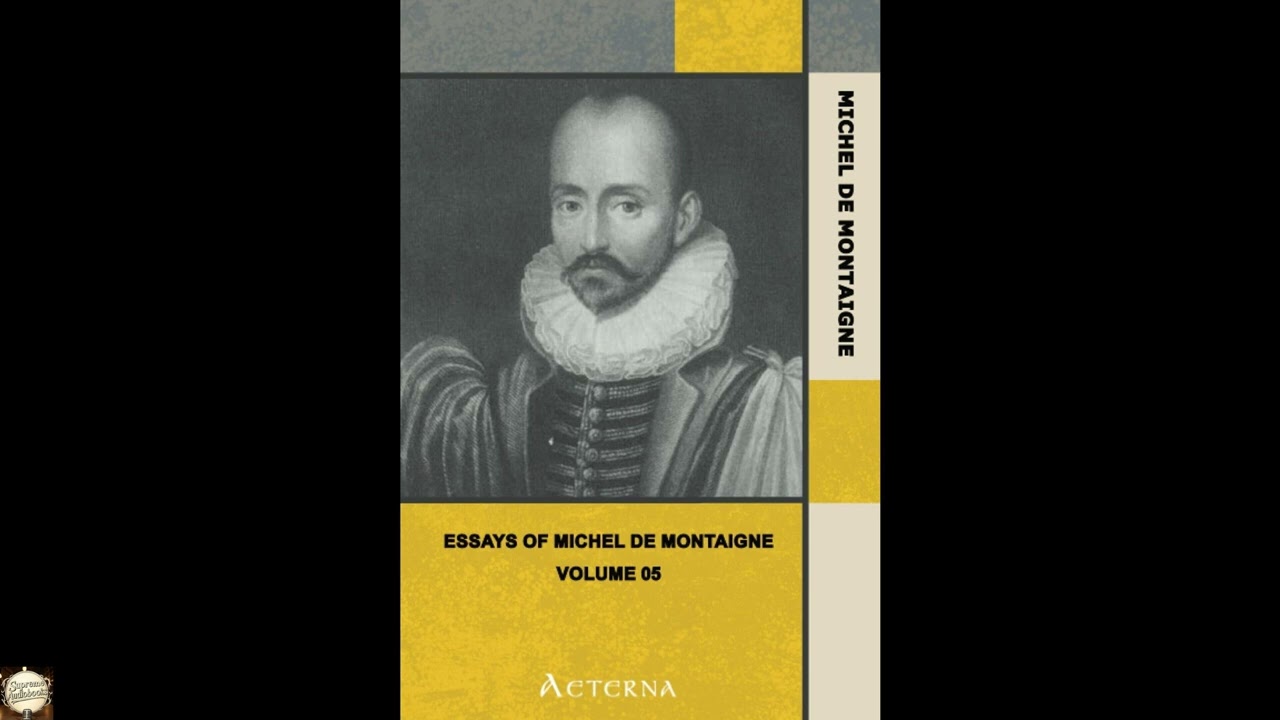
The Essays of Montaigne - Volume 18
To encounter Michel de Montaigne is to step into the very crucible of modern thought, to witness the birth of a literary form that changed how we understand ourselves and the world. In "The Essays of Montaigne - Volume 18," we find ourselves deeply immersed in the unique mind of a man who invented introspection as a public art, offering not grand pronouncements but honest, meandering self-reflection. These spoken words invite us to consider the most persistent questions of human existence: how to live, how to think, how to face mortality, and what it truly means to be a person. Montaigne’s observations, drawn from his own experiences and vast learning, remain as fresh and relevant today as they were centuries ago, providing a profound mirror for anyone seeking deeper understanding of the human condition. The setting for these essays is primarily the inner landscape of Michel de Montaigne’s mind, often unfolding within the quiet sanctuary of his library tower in Périgord, France. He is the central figure, but not as a fictional character; rather, he is the subject of his own rigorous, often humorous, scrutiny. His ‘main character’ is humanity itself, observed through the singular lens of his own ever-shifting thoughts and sensations. There is no conventional plot, but a continuous intellectual inquiry – a series of ‘attempts’ or ‘essais’ – to understand himself and, by extension, all people. Each essay takes a specific, often simple, subject as its starting point: friendship, idleness, or preparing for death. From these, Montaigne allows his thoughts to wander, drawing on classical anecdotes, history, and personal recollections. His central ‘conflict’ is the human struggle to reconcile inner and outer worlds, to navigate uncertainty, and to find a moral compass in a changing world. As 'Volume 18,' listeners join Montaigne in his mature reflections, where skepticism has deepened, and wisdom broadened by years of patient thought. Michel de Montaigne (1533-1592) was born at the Château de Montaigne in Aquitaine, France, into a wealthy merchant family who had recently acquired nobility. His upbringing was deliberately unconventional; his father arranged for Michel to learn Latin as his first language from a German tutor. This unique education fostered a lifelong love of classical antiquity and laid the groundwork for his distinctive intellectual curiosity. After studying law, Montaigne served as a counselor in the Parlement of Bordeaux, a judicial body, for many years. It was during this period that he formed a profound friendship with Étienne de La Boétie, whose early death profoundly influenced Montaigne's thoughts on human connection and loss. In 1571, at 38, Montaigne withdrew from public life, retiring to his estate and the solitude of his tower library. There, he dedicated himself to reading, contemplation, and above all, writing. This marked the true genesis of his Essais, a project he would continue to refine and expand until his death. He did briefly return to public service, notably as mayor of Bordeaux, a testament to his civic responsibility. Montaigne is considered the inventor of the essay as a literary genre, forging a form that was personal, informal, and speculative, a stark contrast to more didactic treatises. He stands as a pivotal figure in the French Renaissance, a humanistic thinker whose radical self-scrutiny and skeptical approach to knowledge anticipate much of modern philosophy and literature, firmly establishing his place as one of the most influential writers in the Western canon. Montaigne’s essays are largely concerned with self-knowledge and abiding skepticism. He interrogates received wisdom, famously asking, "What do I know?", challenging dogmatic certainty by comparing diverse cultural practices and personal experiences. Contemplation of mortality also forms a core theme; he urges readers to face death not with fear, but as a natural part of life. Friendship, especially his profound bond with La Boétie, is presented as an essential human connection, a rare antidote to solitude. These introspective themes, rendered through his conversational style, established a literary genre and made his work a foundational text for understanding human nature. Montaigne’s era, the late sixteenth century, was marked by the intense civil strife of the French Wars of Religion. This pervasive conflict and the collapse of external certainties spurred his retreat into personal inquiry. His quiet study offered sanctuary from the public discord, fostering a skeptical approach to dogmatic beliefs and a deep exploration of individual experience. Rooted in Renaissance humanism, Montaigne's unique literary form emerged as a powerful response to his tumultuous times, seeking internal stability when external order fractured. Listening to Montaigne's Essays as an audiobook provides an intimate, direct encounter with his mind. His conversational, meandering prose truly shines when spoken, allowing listeners to absorb his reflections as if in direct dialogue. The narrator's measured pace gives ample room to savor each observation and classical allusion. This format brings Montaigne's ancient wisdom into the present, inviting unhurried contemplation as his thoughts unfold in your ears.
Enjoyed The Essays of Montaigne - Volume 18? A few ways to support us
Audible & Amazon links are affiliate; we may earn a small commission at no extra cost.
About this production
Human narration by a volunteer reader from LibriVox.org, the public-domain audiobook project. LibriVox volunteers record literary works whose copyright has expired in the United States, releasing the resulting recordings into the public domain.
The Essays of Montaigne - Volume 18 by Michel Montaigne. The underlying text is in the U.S. public domain. We do not republish any modern copyrighted edition, translation, or commentary.
The 4K cinematic visuals accompanying this audiobook are generated by an AI image model from prompts derived from the source text. No copyrighted photos, paintings, or stock footage are used. AI generation is disclosed on every video on our YouTube channel as required by YouTube's altered/synthetic content policy.
English subtitles are transcribed from the LibriVox recording with OpenAI Whisper. Translations into the 11 other supported languages are produced by Meta's NLLB-200 neural translation model. No human translator's copyrighted translation is used.
Questions about sourcing or rights? See our DMCA & Sourcing policy or contact us.
Enjoyed this audiobook?
If you'd like to own a copy of The Essays of Montaigne - Volume 18 or hear a professionally produced edition, the links below help support free audiobook production at no extra cost to you.
As an Amazon Associate we earn from qualifying purchases. Audible / print links are affiliate.