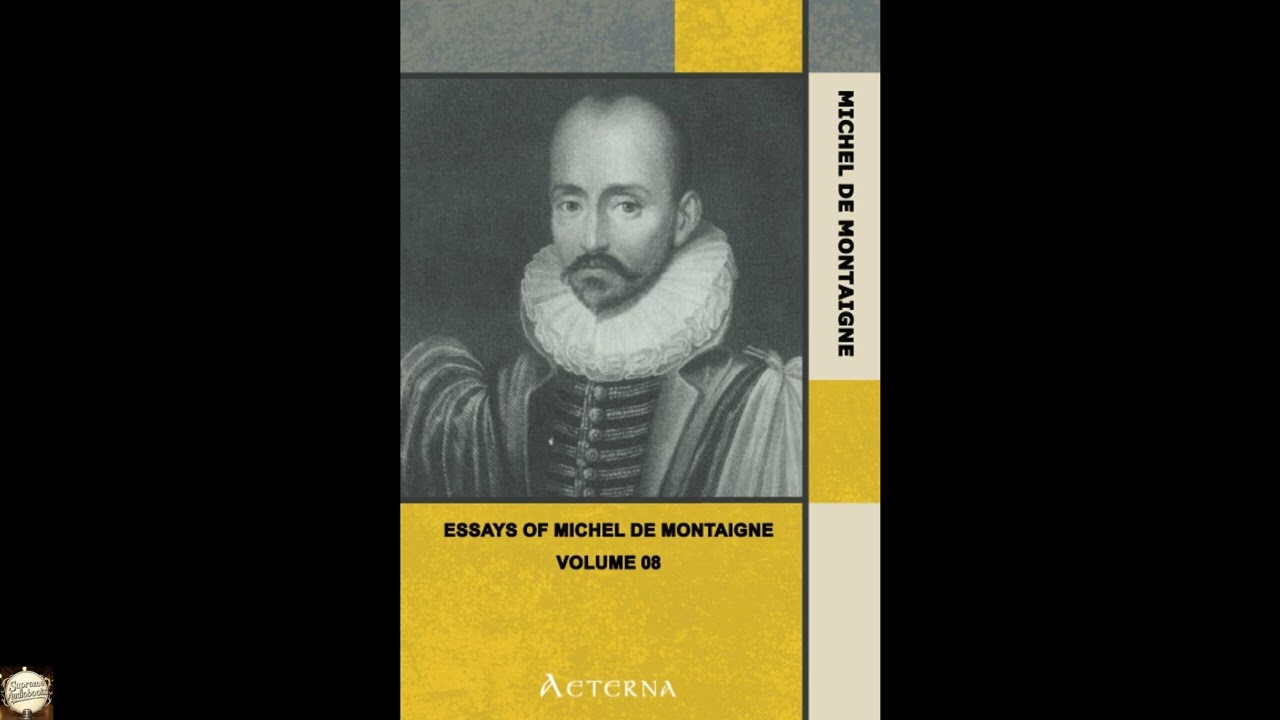
The Essays of Montaigne - Volume 06
Michel de Montaigne’s Essays, particularly this sixth volume, offers listeners an intimate window into one of history’s most profound and original minds. Far from a dusty relic of classical literature, Montaigne’s observations on life, human nature, and the pursuit of self-knowledge resonate with startling clarity even today. He was the first to truly turn philosophy inward, seeking universal truths not in grand systems or divine revelation, but in the minute details of his own experience, his doubts, and his changing opinions. This approach to understanding oneself and the world remains a cornerstone of modern thought, making his candid, questioning voice a perpetual companion for anyone grappling with the complexities of existence. While The Essays do not present a linear narrative with fictional characters or a dramatic arc in the conventional sense, they offer a profound, ongoing story – the story of a mind in self-discovery. The "setting" is Montaigne's secluded tower library in his family chateau in rural France, a sanctuary from the tumultuous world outside, where he retired from public life to dedicate himself to reading and reflection. The "main character" is Montaigne himself, portrayed with an unprecedented honesty that lays bare his habits, his prejudices, his physical ailments, and his intellectual struggles. Each essay functions as a focused meditation, a mental ramble around a specific subject, be it idleness, friendship, custom, sorrow, or education. The "central conflict" of these essays is the human struggle with uncertainty, the limitations of knowledge, and the challenge of living authentically in a world full of conflicting opinions and rapid change. Montaigne questions everything, constantly pitting his own experience against the wisdom of the ancients and the dogmas of his contemporaries. The "arc" of his work, continued and deepened in Volume 6, is the continuous unfolding of his thought, the gradual refinement of his skepticism, and his persistent effort to construct a coherent, if fluid, self-portrait. Listeners witness the evolution of his persona, his arguments, and his unique method of understanding through personal observation and gentle, often humorous, introspection, without ever reaching a definitive "conclusion" or final twist, as the search itself is the enduring point. Michel de Montaigne, born in 1533 at the Château de Montaigne near Bordeaux, France, came from a wealthy and influential family. His father, a mayor of Bordeaux, ensured he received a unique humanist education, having him speak Latin from infancy. This early immersion in classical languages and literature deeply shaped his intellectual development. After studying law, Montaigne served as a magistrate in the Parliament of Bordeaux for several years, where he formed an intense and formative friendship with Étienne de La Boétie. La Boétie’s untimely death profoundly impacted Montaigne, leaving a void that arguably contributed to his later philosophical turn towards introspection. In 1571, at the age of 38, Montaigne withdrew from public life, retiring to his estate to devote himself to reading, contemplation, and writing. It was during this period of learned leisure that he began composing what would become his life’s work: Essais – a term he coined, meaning "attempts" or "trials." The first two books were published in 1580, followed by a significantly expanded edition including a third book in 1588. He continued revising and adding to his work until his death in 1592. Montaigne stands as a pivotal figure in the Renaissance, bridging classical humanism with nascent modern thought, and he is rightly regarded as the progenitor of the essay as a literary form, influencing countless writers and thinkers from Francis Bacon and William Shakespeare to Ralph Waldo Emerson and Virginia Woolf. Among the central ideas Montaigne continually returns to, self-knowledge and introspection are paramount. He famously questioned, "Que sais-je?" (What do I know?), and throughout his writing, he attempts to answer that by dissecting his own habits, opinions, and flaws with unflinching honesty. For example, in various essays, he meticulously details his own memory—or lack thereof—his particular temperament when faced with physical discomfort, or his fluctuating moods, using these personal observations as a microcosm for understanding universal human traits. This rigorous self-scrutiny became his method for understanding humanity at large. Another prominent idea woven throughout The Essays is skepticism. Montaigne approaches all knowledge, received wisdom, and dogmatic assertions with a healthy dose of doubt, never accepting anything at face value. He frequently highlights the limitations of human reason, demonstrating how easily people are swayed by custom, prejudice, and fleeting passions. His observations of varied customs and laws across different cultures, from ancient Greece to newly discovered lands, serve to illustrate the relative and often arbitrary nature of what society deems "true" or "good," encouraging readers to cultivate an open, questioning mind rather than adhering blindly to tradition or authority. He suggests that genuine wisdom lies not in certainty, but in the intelligent acknowledgment of uncertainty. Montaigne wrote during a period of intense upheaval in 16th-century France. The nation was torn apart by the French Wars of Religion, a brutal and protracted conflict between Catholics and Huguenots that spanned several decades. This era was marked by pervasive political instability, widespread violence, and fervent religious fanaticism, leading to profound societal disruption and countless atrocities. Intellectually, it was the height of the Renaissance, characterized by a rediscovery of classical antiquity and the blossoming of humanism, which emphasized human potential and achievements. However, it was also a time when emerging scientific inquiry, notably Copernicus's heliocentric model, began to challenge long-held philosophical and theological certainties. In this context of chaos and intellectual ferment, Montaigne’s retreat to his library and his turn towards introspection make perfect sense. His skepticism was not a form of nihilism but rather a defense against the fervent dogmatism that fueled the religious wars. By questioning all certainties and demonstrating the fluidity of human nature and opinion, he subtly advocated for tolerance and moderation. His focus on individual judgment and the search for personal tranquility in a turbulent world represented a deeply personal, yet broadly impactful, response to the prevalent madness, offering a sanctuary of reason and self-reflection amidst the surrounding fanaticism and violence. Listening to The Essays of Montaigne as an audiobook offers a particularly rich and suitable experience. Montaigne’s prose is inherently conversational and intimate, making it an ideal candidate for spoken word. A skilled narrator can truly bring to life Montaigne’s distinctive voice – his musing tone, his gentle humor, his moments of doubt, and his sudden flashes of insight. The "several hours" length of this volume allows for deep immersion, whether one chooses to absorb it in long, contemplative sessions or in shorter, reflective segments, perhaps while on a walk or during a quiet evening. A narrator’s pacing can effectively mirror Montaigne’s deliberate, sometimes meandering, thought process, allowing the listener to follow the turns of his mind. One can almost feel present in his library, hearing his thoughts unfold, as he engages in a profound dialogue with himself, with classical authors, and ultimately, with the listener. The intimate nature of these essays, meant to be pondered rather than rushed, lends itself perfectly to the solitary and personal act of listening.
Enjoyed The Essays of Montaigne - Volume 06? A few ways to support us
Audible & Amazon links are affiliate; we may earn a small commission at no extra cost.
About this production
Human narration by a volunteer reader from LibriVox.org, the public-domain audiobook project. LibriVox volunteers record literary works whose copyright has expired in the United States, releasing the resulting recordings into the public domain.
The Essays of Montaigne - Volume 06 by Michel de Montaigne. The underlying text is in the U.S. public domain. We do not republish any modern copyrighted edition, translation, or commentary.
The 4K cinematic visuals accompanying this audiobook are generated by an AI image model from prompts derived from the source text. No copyrighted photos, paintings, or stock footage are used. AI generation is disclosed on every video on our YouTube channel as required by YouTube's altered/synthetic content policy.
English subtitles are transcribed from the LibriVox recording with OpenAI Whisper. Translations into the 11 other supported languages are produced by Meta's NLLB-200 neural translation model. No human translator's copyrighted translation is used.
Questions about sourcing or rights? See our DMCA & Sourcing policy or contact us.
Enjoyed this audiobook?
If you'd like to own a copy of The Essays of Montaigne - Volume 06 or hear a professionally produced edition, the links below help support free audiobook production at no extra cost to you.
As an Amazon Associate we earn from qualifying purchases. Audible / print links are affiliate.