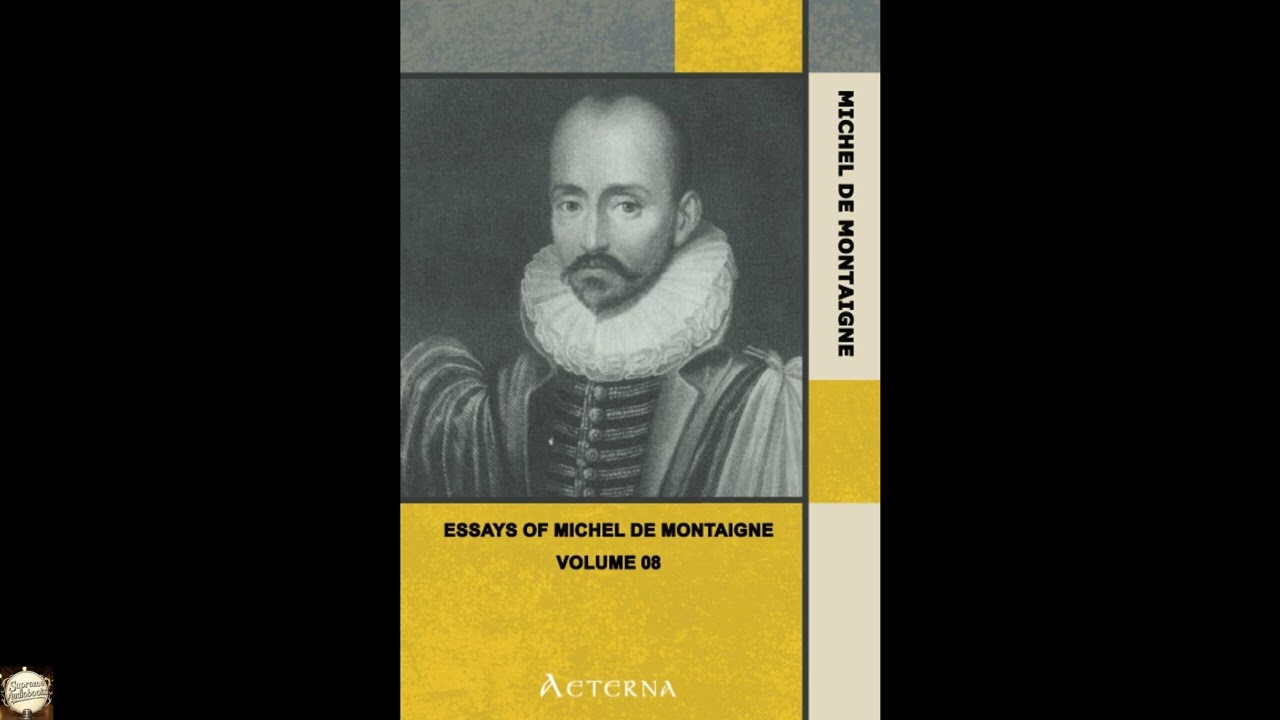
Essays of Michel de Montaigne — Volume 08
Step into the private world of a mind determined to understand itself and, in doing so, to understand humanity. Essays of Michel de Montaigne — Volume 08 presents another segment of one of literature’s most profound and groundbreaking works, a collection that essentially invented a genre and continues to resonate with startling relevance centuries after its conception. Montaigne offers not grand pronouncements, but honest self-questioning, a patient observation of human nature in all its contradictions, and an enduring plea for tolerance in a turbulent age. He invites you not to follow a rigid argument, but to join him in the very act of thinking, providing a balm for the spirit in our own era of uncertainty and division, reminding us that wisdom often begins with the simple admission, "What do I know?" This volume, like its predecessors, welcomes the listener into Montaigne's study, a sanctuary located in a tower of his ancestral château in Gascony, France. Here, the main "character" is Montaigne himself, presented through his unvarnished thoughts, his readings of ancient authors like Plutarch and Seneca, and his reflections on the world swirling outside his windows. The setting is less a physical place and more a state of mind: a consciousness grappling with the human condition. The central conflict isn't between warring factions or dramatic love interests, but rather the individual's struggle to find stable ground in a constantly shifting intellectual and moral landscape. Montaigne faces down mortality, the chaos of religious wars, and the bewildering array of human customs with the only weapon he truly trusts: his own honest intellect. The arc of the “story” within Montaigne's essays is the unfolding and evolving process of his thought. He doesn't set out to prove a point but to try an idea, to turn it over in his mind, to view it from different angles, often contradicting himself or revising earlier positions. The drama lies in witnessing this intellectual dance, observing how his personal experiences—a bout of illness, a conversation with a traveler, a passage from a book—spark wider reflections on friendship, education, the fear of death, or the nature of opinion. The listener becomes an intimate confidant, privy to the internal motions of a philosopher who finds universal truths not in abstract systems, but in the specific details of his own existence and the daily paradoxes of life. Michel Eyquem de Montaigne, born in 1533 at the Château de Montaigne near Bordeaux, lived a life deeply immersed in the political and intellectual currents of the French Renaissance. Born into a wealthy noble family, he received an unconventional education, speaking Latin as his first language before learning French. This early immersion in classical thought would profoundly shape his philosophical outlook. He served for years as a magistrate in the Parliament of Bordeaux, a position that exposed him to the complexities of law and human judgment, before retreating from public life at the age of 38 to dedicate himself to reading and writing. This decision, following the devastating loss of his close friend Étienne de La Boétie, marked a pivotal moment, ushering in the period during which he composed his monumental collection. Montaigne's most significant literary contribution was the invention of the essay itself. Derived from the French word essai, meaning "to try" or "to attempt," his writings were precisely that: intellectual attempts, tentative explorations rather than definitive treatises. He wasn't constructing a philosophical system; he was painting a portrait of himself as he evolved, presenting a human mind in action. His singular, conversational style, deeply personal yet profoundly universal, secured his place as a foundational figure in Western literature. His influence extends widely, touching figures from William Shakespeare and Francis Bacon in his own time to Ralph Waldo Emerson and Virginia Woolf centuries later, each finding in Montaigne a kindred spirit or a fertile source of inspiration for their own meditations on self and society. Central to Montaigne's project is the theme of self-knowledge, famously encapsulated in his personal motto, "Que sçais-je?" (What do I know?). He turns his gaze inward, documenting his habits, his physical sensations, his shifting opinions, and his responses to the world with unflinching honesty. For example, he might discuss his struggles with memory or the particular sensations of an illness, using these specific observations as springboards for wider reflections on human fallibility and the limits of reason. This intense introspection is not self-indulgent; it's an empirical method for understanding human nature by starting with the most accessible specimen: himself. Another pervasive theme is the relativity of customs and opinions. Montaigne observed the profound differences in human behavior and belief across cultures and historical periods, often remarking on the folly of assuming one's own way of life is inherently superior. He recounts meetings with indigenous people from the New World, for instance, and uses their different societal structures to critique European prejudices and assumptions. This theme promotes a radical form of tolerance and skepticism toward universal truths, suggesting that much of what we hold dear as "natural" or "right" is, in fact, merely conventional and culturally determined. The historical context for Montaigne's writing was one of immense turmoil. France in the latter half of the sixteenth century was consumed by the Wars of Religion, a brutal and protracted conflict between Catholics and Protestant Huguenots that tore the nation apart. This period saw widespread violence, political instability, and a crisis of authority, both secular and religious. Montaigne, a Catholic who maintained good relations with both sides, experienced this chaos firsthand and often reflected on the human capacity for cruelty and factionalism. His retreat to his library was partly an escape from this external madness, a search for an internal tranquility and philosophical steadiness amidst the storms. His work emerged not in spite of this chaos, but perhaps because of it. In an age where dogmatic certainty fueled relentless conflict, Montaigne's skepticism and his emphasis on individual judgment offered a vital alternative. He sought to demonstrate that a well-examined life, grounded in self-awareness and a recognition of human limitations, could be a path to peace and understanding, even if only for oneself. He represented a humanistic counterpoint to the prevailing religious and political fanaticism, championing a quiet, reasoned approach to life over dogmatic assertions and violent crusades. Listening to Montaigne's Essays as an audiobook transforms the experience into something akin to a direct conversation with the author. His prose, naturally discursive and intimate, lends itself perfectly to the spoken word. The listener is invited to absorb his observations and musings at a reflective pace, perhaps while engaged in their own quiet activities or during a meditative commute. A skilled narrator can bring out the nuanced shifts in Montaigne's tone—his moments of wit, his flashes of melancholy, his profound skepticism, and his underlying warmth. The several hours of listening time allow for sustained engagement with a mind that, despite the passage of centuries, remains a profoundly engaging and comforting presence, a voice that speaks across time directly to the listener's own thoughts and concerns.
Enjoyed Essays of Michel de Montaigne — Volume 08? A few ways to support us
Audible & Amazon links are affiliate; we may earn a small commission at no extra cost.
About this production
Human narration by a volunteer reader from LibriVox.org, the public-domain audiobook project. LibriVox volunteers record literary works whose copyright has expired in the United States, releasing the resulting recordings into the public domain.
Essays of Michel de Montaigne — Volume 08 by Michel de Montaigne. The underlying text is in the U.S. public domain. We do not republish any modern copyrighted edition, translation, or commentary.
The 4K cinematic visuals accompanying this audiobook are generated by an AI image model from prompts derived from the source text. No copyrighted photos, paintings, or stock footage are used. AI generation is disclosed on every video on our YouTube channel as required by YouTube's altered/synthetic content policy.
English subtitles are transcribed from the LibriVox recording with OpenAI Whisper. Translations into the 11 other supported languages are produced by Meta's NLLB-200 neural translation model. No human translator's copyrighted translation is used.
Questions about sourcing or rights? See our DMCA & Sourcing policy or contact us.
Enjoyed this audiobook?
If you'd like to own a copy of Essays of Michel de Montaigne — Volume 08 or hear a professionally produced edition, the links below help support free audiobook production at no extra cost to you.
As an Amazon Associate we earn from qualifying purchases. Audible / print links are affiliate.