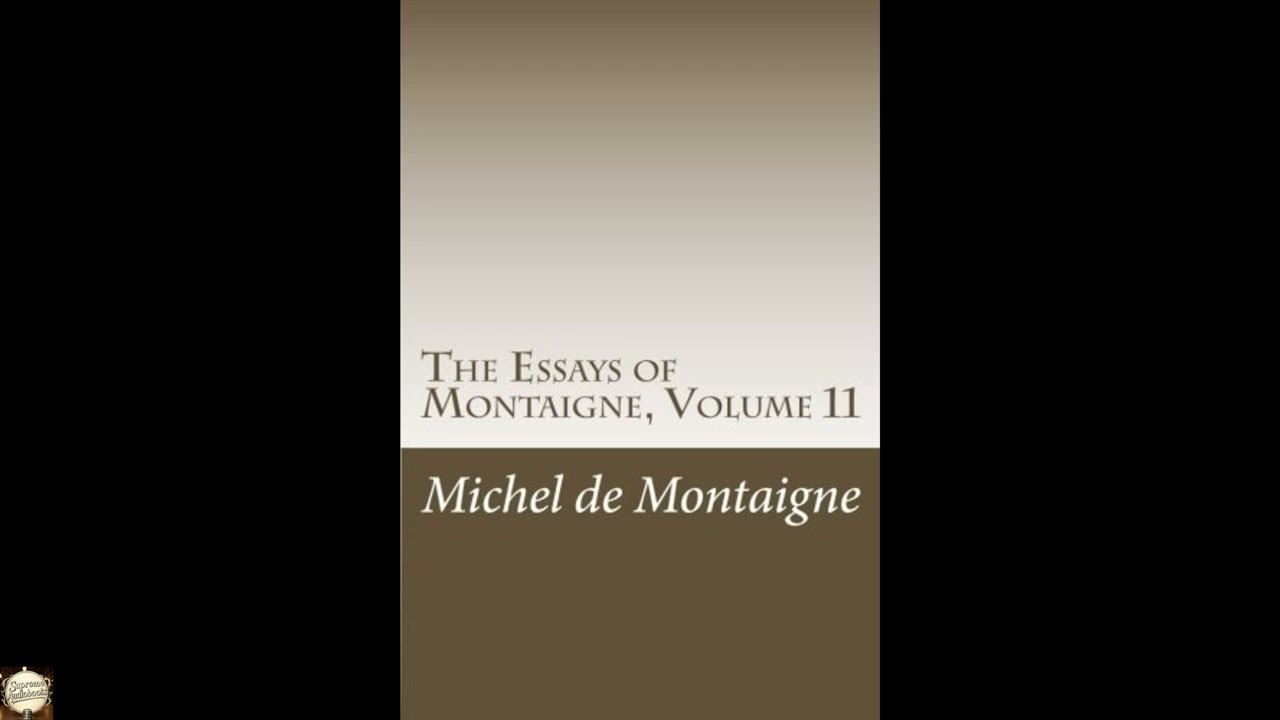
The Essays of Montaigne, Volume 11
Step into the mind of one of history's most original thinkers with The Essays of Montaigne, Volume 11. Michel de Montaigne, a figure who lived through a period of immense upheaval, retreated to his library to construct a profound and startlingly modern self-portrait through prose. This particular volume continues his unparalleled intellectual enterprise, inviting listeners not just to hear his observations on the world, but to witness the very act of thinking unfold. Why should we care about the musings of a 16th-century Frenchman today? Because Montaigne’s core pursuit—the relentless questioning of self, custom, and knowledge—remains utterly relevant in an age saturated with information and competing certainties. His voice offers a calming, clarifying counterpoint, a call to introspection that cuts across centuries, reminding us of the enduring value in honest self-assessment and the cultivation of an open mind. Montaigne’s grand intellectual project, which begins with the simple premise of observing himself, creates an unprecedented literary form that defies easy categorization. There is no conventional "plot" in these essays; rather, the listener is transported into Montaigne's private study, a quiet refuge in southwest France, where he surrounded himself with books and, crucially, with his own thoughts. The main character is Montaigne himself, presenting his personality, his quirks, his illnesses, his reading habits, and his opinions on everything from idleness to the education of children. His central conflict isn't a dramatic external struggle, but an internal one: how does one live a good life, understand oneself, and navigate a chaotic world when absolute truth seems elusive and human reason so fallible? The arc of this ongoing story is the evolution of Montaigne's thought process. Each essay, often meandering and associative, builds upon his growing skepticism and his deep humanism. He doesn't propose grand systems or definitive answers. Instead, he demonstrates how to live with uncertainty, how to continually test one's assumptions, and how to find wisdom not in dogma, but in personal experience and the careful observation of human nature. This eleventh volume continues to build his argument not through linear narrative, but through the cumulative weight of candid self-examination, where the journey of contemplation itself becomes the most compelling aspect. Michel de Montaigne, born in 1533 at the Château de Montaigne in the Aquitaine region of France, led a life that spanned some of the most tumultuous decades in European history. Descended from a wealthy merchant family that had recently achieved nobility, Montaigne received a privileged education, including an unusual childhood immersion in Latin. He served as a parliamentary counselor in Bordeaux for a number of years, engaging in public life and legal affairs. However, at the age of 38, following the death of his father and a close friend, he retired to his ancestral estate. It was there, in the solitude of his tower library, that he dedicated the remainder of his life to reading, meditating, and composing his monumental Essays. He passed away in 1592, leaving behind a work that reshaped literature. Montaigne is widely credited as the inventor of the essay as a literary form—a short, non-fiction composition that presents a personal viewpoint on a subject. His unique contribution was not just the form, but the frankness of his self-portrayal, making his inner life the subject matter itself. He belonged to the Renaissance humanist movement, valuing classical learning and human potential, but he infused it with a deep-seated skepticism that challenged the dogmatic thinking prevalent in his era. His candid, often conversational style distinguishes him from many philosophical writers who came before, placing him firmly at the genesis of modern individualistic thought. His work influenced countless writers and thinkers, from William Shakespeare to Ralph Waldo Emerson, solidifying his place as a seminal figure in the Western literary canon. At the heart of Montaigne's Essays lie several profound themes. One primary concern is self-knowledge, famously encapsulated in his motto, "Que sais-je?" (What do I know?). He relentlessly examines his own habits, prejudices, and physical limitations, not out of narcissism, but to understand the universal human condition through the particularity of his own experience. For instance, he might spend pages dissecting his tendency to be absent-minded or his aversion to certain foods, not merely to relay anecdote, but to illustrate the elusive nature of the self and the surprising power of custom over reason. Another significant theme is skepticism, not as an end in itself, but as a method for intellectual honesty. He often pits the certainty of ancient philosophers against the contradictions of everyday life, demonstrating how easily human judgment can be swayed by passion or tradition. He also frequently returns to the theme of the acceptance of death, viewing it not as something to fear but as a natural part of life that should be continually contemplated to live more fully. He might recount a historical anecdote about a stoic death, or simply reflect on his own aging body, showing how contemplating our mortality can sharpen our appreciation for the present. Finally, Montaigne consistently addresses the malleability of human custom and opinion. He observes how different societies hold vastly divergent beliefs on everything from justice to decorum, thereby stripping away any notion of absolute, universal standards and encouraging a more charitable and understanding view of other cultures. Through these recurring reflections, the Essays become a guide to thoughtful living, showing how to navigate a complex world with intellectual humility and personal integrity. Montaigne wrote his Essays during a period of profound social and political turmoil in France, specifically the French Wars of Religion (1562-1598). This protracted conflict between Catholics and Huguenots (French Protestants) tore the country apart, marked by widespread violence, political instability, and a pervasive sense of moral decay. It was a time when dogmatic certainty on both sides fueled bloody atrocities, making Montaigne’s retreat to his library and his emphasis on personal judgment and skepticism all the more striking and courageous. His work can be seen as a direct response to this chaos, a search for a stable intellectual ground when external society offered none. The Renaissance was also in full swing, bringing a renewed interest in classical antiquity and humanistic learning. Montaigne, with his extensive classical education, drew heavily from Greek and Roman authors like Plutarch, Seneca, and Lucretius, using their wisdom as a foundation for his own meditations. However, unlike many humanists who sought to replicate ancient ideals, Montaigne subjected these classical texts, and indeed all knowledge, to his own rigorous, questioning intellect. The emergence of the printing press also meant that Montaigne's unique voice could reach a wider audience, influencing intellectual discourse across Europe and laying the groundwork for modern individualistic philosophy. Listening to The Essays of Montaigne, Volume 11 as an audiobook offers a singular opportunity to engage with this profound text. Montaigne’s prose, while intellectually stimulating, is also intimate and conversational, making it ideally suited for the spoken word. A skilled narrator can bring out the nuances of his tone—the gentle irony, the thoughtful pause, the flashes of wit—that might be missed in silent reading. With several hours of content, this volume provides ample time for the listener to settle into Montaigne’s rhythm, allowing his thoughts to unfold at their natural, contemplative pace. The experience becomes less about acquiring information and more about participating in a dialogue with a great mind, absorbing his reflections on humanity and existence as if he were speaking directly to you, making his wisdom feel immediate and deeply personal.
Enjoyed The Essays of Montaigne, Volume 11? A few ways to support us
Audible & Amazon links are affiliate; we may earn a small commission at no extra cost.
About this production
Human narration by a volunteer reader from LibriVox.org, the public-domain audiobook project. LibriVox volunteers record literary works whose copyright has expired in the United States, releasing the resulting recordings into the public domain.
The Essays of Montaigne, Volume 11 by Michel de Montaigne. The underlying text is in the U.S. public domain. We do not republish any modern copyrighted edition, translation, or commentary.
The 4K cinematic visuals accompanying this audiobook are generated by an AI image model from prompts derived from the source text. No copyrighted photos, paintings, or stock footage are used. AI generation is disclosed on every video on our YouTube channel as required by YouTube's altered/synthetic content policy.
English subtitles are transcribed from the LibriVox recording with OpenAI Whisper. Translations into the 11 other supported languages are produced by Meta's NLLB-200 neural translation model. No human translator's copyrighted translation is used.
Questions about sourcing or rights? See our DMCA & Sourcing policy or contact us.
Enjoyed this audiobook?
If you'd like to own a copy of The Essays of Montaigne, Volume 11 or hear a professionally produced edition, the links below help support free audiobook production at no extra cost to you.
As an Amazon Associate we earn from qualifying purchases. Audible / print links are affiliate.