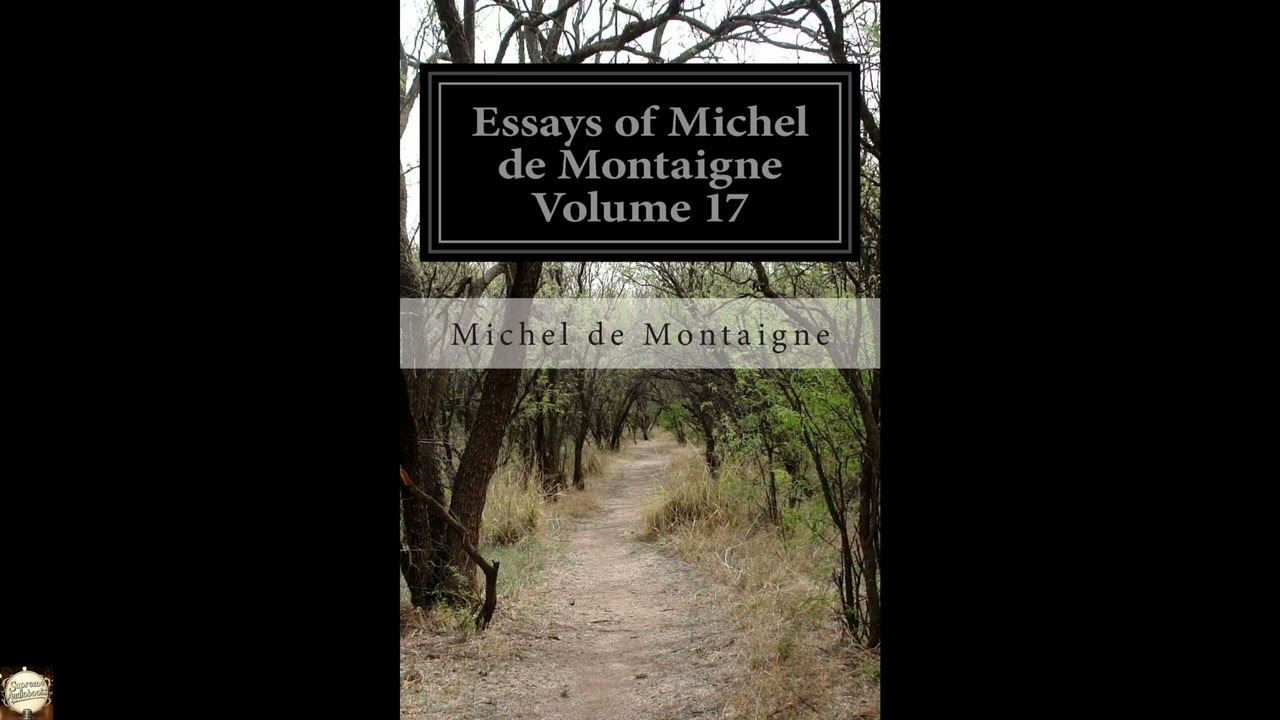
Essays of Michel de Montaigne Volume 17
Essays of Michel de Montaigne Volume 17 offers a remarkable entry into one of literature's most profound and enduring conversations: the ceaseless quest to understand what it means to be human. Here is not a story told with characters and plot, but a mind speaking directly, intimately, inviting the listener to join in the act of thinking. For over four centuries, Montaigne's unique form of personal reflection has resonated with readers, proving that the deepest truths are often found not in grand pronouncements, but in the candid examination of everyday experience, one's own biases, and the shifting sands of individual perception. This collection of thoughts from the celebrated French philosopher presents an opportunity to engage with an intellect that revolutionized how we record and understand ourselves, proving that the act of turning inward can illuminate the entire world. Listeners stepping into these pages will discover a unique literary landscape. The setting is primarily the inner world of Michel de Montaigne, who, having retired from public life, turned his gaze inward and outward. There are no dramatic plot points or conventional narrative arcs. Instead, each essay acts as a chamber of thought, a meandering intellectual stroll where the author takes up a subject — anything from idleness, friendship, or education to practicalities of sleeping, smells, or cannibals — and turns it over in his mind. The "main character" is Montaigne's own inquiring consciousness, revealed through his shifting perspectives, his candid admissions of ignorance, and his extensive references to classical authors and contemporary events. The central "conflict" isn't external, but rather the internal struggle to arrive at certainty in an uncertain world. Montaigne grapples with the limitations of human reason, the instability of opinions, and the sheer variety of human experience, constantly questioning assumptions. Each piece builds not towards a definitive conclusion, but towards a more nuanced understanding, a fuller appreciation of ambiguity. The collection's "arc" is cumulative: an ongoing intellectual unfolding, as Montaigne revisits ideas, sometimes contradicting himself, always refining his observations. It is a slow, thoughtful revelation of a mind in motion, offering not answers, but the more valuable invitation to participate in the process of questioning. This specific compilation, "Essays of Michel de Montaigne Volume 17," draws from the monumental work of Michel de Montaigne, a figure whose intellectual contributions shaped the very landscape of modern thought. Born in 1533 in southwestern France, Montaigne, from a wealthy merchant family, received a humanist education. After a career as a magistrate, he retired to his estate at 38, dedicating his life to study and writing. In this withdrawal, amidst the turmoil of the French Wars of Religion, he began composing his "essays" — literally "attempts" — a new literary form he essentially invented. Montaigne sought not a grand philosophical treatise, but a sincere account of his own mind, observing himself with scientific rigor. His goal was to paint "the passage" of thought, not its arrival. He documented his opinions, moods, sensations, and reactions. The first edition of his Essays appeared in 1580, with expanded versions published throughout his life, culminating in a posthumous edition in 1595. These writings cemented his place as a prominent voice of the French Renaissance and a foundational figure in Western literature and philosophy, influencing thinkers like Pascal, Rousseau, Emerson, and Nietzsche. His work stands as a testament to the humanist ideal of understanding humanity through direct observation and classical wisdom. It offered a profound counterpoint to dogmatism during an era rife with religious strife, championing instead a radical skepticism and appreciation for human diversity. This volume, "Essays of Michel de Montaigne Volume 17," continues that tradition, presenting a selection highlighting the enduring relevance and depth of his unique intellectual legacy. At the heart of Montaigne's contribution lies a fervent dedication to self-knowledge, often expressed through his famous motto, "Que sçay-je?" or "What do I know?" This radical skepticism underpins much of his writing. He tirelessly questioned the certainty of human judgment, showing how our perspectives are shaped by custom, culture, and temperament. For instance, he might examine a common belief, then present counter-examples from ancient history or exotic lands to demonstrate its arbitrary nature, gently nudging the reader toward humility and open-mindedness. His unflinching self-examination – detailing his habits, fears, and ailments – becomes a universal mirror, inviting us to scrutinize our own inner lives with similar honesty. Another vital theme running through the essays is the art of living well, particularly in the face of mortality. Montaigne wrote extensively on the inevitability of death, not with morbid despair, but with a serene pragmatism that sought to integrate it into the fabric of life. He often recalled his own near-death experiences or contemplated stoic philosophers, arguing that by accepting our finitude, we might live more fully, appreciating the present and freeing ourselves from anxieties. His writings also stand as a powerful argument for tolerance and the relativity of customs. By comparing different societies and historical practices, he subtly undermines the notion of universal moral absolutes, advocating instead for a compassionate understanding of human diversity. Montaigne's Essays emerged from a period of intense upheaval in sixteenth-century France. The Protestant Reformation had shattered the religious unity of the continent, leading to decades of brutal religious wars that tore French society apart. Montaigne himself lived through this civil strife, witnessing firsthand the profound divisions and violent fanaticism. Against this backdrop of ideological conflict, he retreated from public life, seeking stability and truth not in dogma, but within his own mind and classical wisdom. The Renaissance humanist movement, rediscovering classical Greek and Roman texts, provided a crucial intellectual framework for Montaigne. He engaged with them personally, using their ideas as a springboard for his own reflections. His work represents a departure from purely theological or scholastic modes of thought, instead emphasizing human experience, individual reason, and moral philosophy. By turning attention to the "self" as its explicit subject, Montaigne pioneered a new mode of philosophical and literary expression, perfectly suited to an age grappling with the collapse of old certainties and the birth of modern individuality. Listening to "Essays of Michel de Montaigne Volume 17" as an audiobook offers a unique, immersive way to connect with this foundational text. Montaigne's conversational tone, meandering structure, and intimate prose lend themselves perfectly to the spoken word. A skilled narrator brings his voice to life, allowing thoughtful pauses and rhetorical questions to resonate fully. The several hours of content encourage sustained, contemplative engagement, ideal for quiet moments or reflection. Without the visual demand of reading, the listener absorbs the rhythm of Montaigne's thought, allowing his observations on humanity, skepticism, and the art of living to unfold directly into the mind, creating a private dialogue with one of history's most compelling intellects.
Enjoyed Essays of Michel de Montaigne Volume 17? A few ways to support us
Audible & Amazon links are affiliate; we may earn a small commission at no extra cost.
About this production
Human narration by a volunteer reader from LibriVox.org, the public-domain audiobook project. LibriVox volunteers record literary works whose copyright has expired in the United States, releasing the resulting recordings into the public domain.
Essays of Michel de Montaigne Volume 17 by Michel de Montaigne. The underlying text is in the U.S. public domain. We do not republish any modern copyrighted edition, translation, or commentary.
The 4K cinematic visuals accompanying this audiobook are generated by an AI image model from prompts derived from the source text. No copyrighted photos, paintings, or stock footage are used. AI generation is disclosed on every video on our YouTube channel as required by YouTube's altered/synthetic content policy.
English subtitles are transcribed from the LibriVox recording with OpenAI Whisper. Translations into the 11 other supported languages are produced by Meta's NLLB-200 neural translation model. No human translator's copyrighted translation is used.
Questions about sourcing or rights? See our DMCA & Sourcing policy or contact us.
Enjoyed this audiobook?
If you'd like to own a copy of Essays of Michel de Montaigne Volume 17 or hear a professionally produced edition, the links below help support free audiobook production at no extra cost to you.
As an Amazon Associate we earn from qualifying purchases. Audible / print links are affiliate.