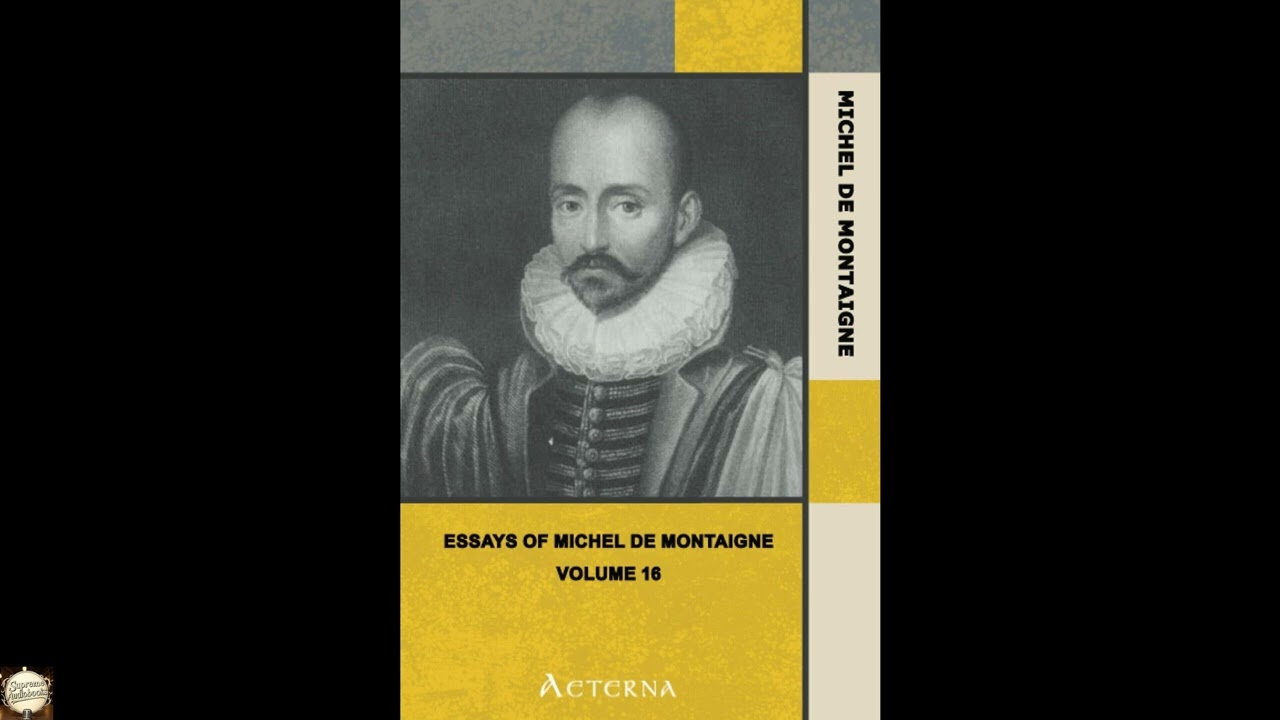
Essays of Michel de Montaigne — Volume 16
Michel de Montaigne’s Essays stand as a monument to individual thought, a pioneering work that invites us into the very architecture of a mind grappling with existence, doubt, and the human condition. This particular collection, Volume 16, offers listeners a fresh entry point into one of Western literature’s most influential and comforting works. More than four centuries after its conception, Montaigne’s unique blend of autobiography, philosophy, and casual observation continues to resonate with startling immediacy. He speaks to anyone who has ever questioned their assumptions, felt the weight of convention, or simply pondered what it means to be human in a chaotic world. His essays are not prescriptive doctrines but rather open-ended conversations, an invitation to self-reflection that feels as vital and necessary today as it did during the tumultuous French Renaissance. To speak of a "plot" in Montaigne's Essays is to miss the point entirely, for the narrative unfolds not in external events but within the boundless territory of a single consciousness. The setting is primarily Montaigne's isolated study in his tower at his family estate in Périgord, France, a sanctuary where he retreated from the world's clamor to engage in rigorous self-examination. The central "character" is, of course, Montaigne himself—a man whose candid portrayal of his own habits, quirks, illnesses, and intellectual struggles forms the core of his literary project. He doesn't invent personas; he offers himself, nakedly and honestly, as the subject of his inquiry. The "central conflict" is Montaigne’s lifelong wrestling with uncertainty. Against a backdrop of religious wars and dogmatic assertions, he set out to understand what humans could truly know, often concluding with his famous query, "Que sais-je?" (What do I know?). This intellectual struggle manifests in his method: a meandering, digressive style where one thought naturally leads to another, often circling back, contradicting itself, or opening new avenues of inquiry. There is no traditional story arc leading to a grand resolution; instead, the arc is that of a mind continually questioning, observing, and re-evaluating, a constant intellectual motion that mirrors the fluidity of human experience. He writes about friendship, education, custom, death, travel, and politics, always filtering these vast subjects through the intimate lens of his own experience and sensibility, making his personal reflections universal. The author, Michel de Montaigne, born in 1533 at the Château de Montaigne in the Aquitaine region of France, was a nobleman, a former magistrate, and for a time, the mayor of Bordeaux. Educated in Latin from infancy and steeped in classical learning, he initially followed a public career in the Parlement of Bordeaux, where he developed a close friendship with Étienne de La Boétie, whose early death profoundly affected him. In 1571, at the age of 38, Montaigne retired to his country estate, dedicating himself to study and writing. It was in the library tower that he began compiling his sprawling collection of Essays, an unprecedented literary form that he essentially invented. Montaigne spent the rest of his life writing, revising, and expanding this singular work, until his death in 1592. Unlike his contemporaries who sought to present systematic philosophies or grand narratives, Montaigne focused inward, believing that by examining himself meticulously, he could better understand the entirety of humankind. His method—observing his own thought processes, reactions, and physical sensations with disarming frankness—marked a radical departure from established literary norms, laying foundational groundwork for autobiography, psychology, and the modern prose style. His willingness to express doubt and ambiguity in an era of fervent conviction secured his enduring place as a crucial figure in Western intellectual history. At the heart of Montaigne's writing are several interconnected themes, often woven together through personal anecdote and classical citation. One prominent theme is skepticism, embodied by his famous motto "Que sais-je?" He consistently challenges human presumption and the certainty of knowledge, urging readers to doubt accepted truths and question the reliability of their senses and reason. For instance, in an essay addressing custom, he demonstrates how what one culture deems sacred, another finds absurd, using such observations to undermine any claim to universal, absolute truth and advocating for a healthy intellectual humility. Another core theme is self-examination and the human condition. Montaigne’s project is nothing less than an attempt to describe himself completely, believing that "each man carries the entire form of man's estate." He frequently discusses his own physical ailments, his memory, his habits, and his intellectual preferences, often revealing his foibles and contradictions without apology. His musings on death, particularly after the death of his beloved friend La Boétie and his own brushes with mortality, reveal a profound engagement with human vulnerability and the ephemeral nature of life, urging a reconciliation with our own finitude rather than a desperate flight from it. Montaigne wrote during a period of immense upheaval in France. The late sixteenth century was torn by the devastating French Wars of Religion, a brutal conflict between Catholics and Protestants that saw widespread violence and instability. Witnessing the fanaticism and bloodshed firsthand profoundly shaped Montaigne’s philosophical outlook, reinforcing his skepticism towards dogma and his appeal for tolerance and moderation. His retreat to his study was, in part, a response to this political and social chaos, a search for an inner steadiness when the outside world offered none. Culturally, this was the height of the Renaissance, a time of renewed interest in classical antiquity, humanism, and individual achievement. Montaigne, deeply versed in Greek and Roman texts, drew extensively from figures like Seneca, Plutarch, and Lucretius, using their wisdom not as dogma but as a springboard for his own thoughts. Simultaneously, reports from the New World were challenging European perceptions of "civilization" and "barbarism," which Montaigne referenced to critique his own society’s ethnocentrism, as seen in his discussion of the Tupinambá cannibals. His invention of the essay form itself was a literary innovation, offering a more personal, discursive alternative to the formal treatises and theological arguments prevalent at the time, perfectly suited to the restless, questioning spirit of his age. Listening to these essays as an audiobook provides an exceptional way to engage with Montaigne’s conversational and introspective style. The experience of hearing Montaigne’s thoughts unfold through a skilled narrator’s voice brings a particular intimacy to his work. The "several hours" of Volume 16 allow for a sustained immersion, whether during a long walk, a commute, or quiet contemplation. A good narration highlights the natural rhythm of Montaigne’s prose, allowing his famous digressions to feel less like detours and more like integral parts of a continuous intellectual stream. The subtle shifts in tone—from philosophical musing to personal confession, from wry observation to profound insight—are brought to life, helping the listener appreciate the nuances of his argument and the warmth of his personality. It’s akin to having a thoughtful friend speak directly to you, sharing their deepest meditations, allowing the atmosphere of his study, where the pen scratched and the mind turned, to become present in your own space.
Enjoyed Essays of Michel de Montaigne — Volume 16? A few ways to support us
Audible & Amazon links are affiliate; we may earn a small commission at no extra cost.
About this production
Human narration by a volunteer reader from LibriVox.org, the public-domain audiobook project. LibriVox volunteers record literary works whose copyright has expired in the United States, releasing the resulting recordings into the public domain.
Essays of Michel de Montaigne — Volume 16 by Michel de Montaigne. The underlying text is in the U.S. public domain. We do not republish any modern copyrighted edition, translation, or commentary.
The 4K cinematic visuals accompanying this audiobook are generated by an AI image model from prompts derived from the source text. No copyrighted photos, paintings, or stock footage are used. AI generation is disclosed on every video on our YouTube channel as required by YouTube's altered/synthetic content policy.
English subtitles are transcribed from the LibriVox recording with OpenAI Whisper. Translations into the 11 other supported languages are produced by Meta's NLLB-200 neural translation model. No human translator's copyrighted translation is used.
Questions about sourcing or rights? See our DMCA & Sourcing policy or contact us.
Enjoyed this audiobook?
If you'd like to own a copy of Essays of Michel de Montaigne — Volume 16 or hear a professionally produced edition, the links below help support free audiobook production at no extra cost to you.
As an Amazon Associate we earn from qualifying purchases. Audible / print links are affiliate.