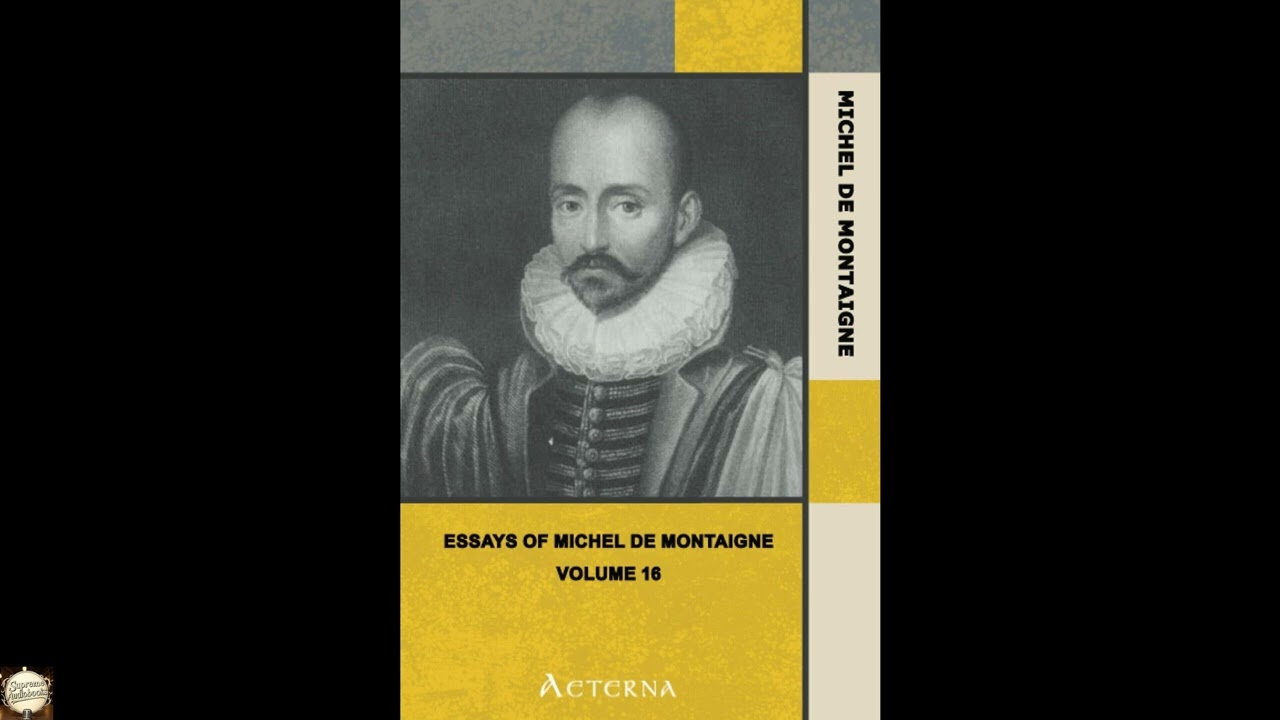
Essays of Michel de Montaigne (Volume 13)
Step into the singular mind of Michel de Montaigne, a figure whose intellectual generosity birthed an entirely new literary form: the essay. This particular volume, a segment of his monumental Essays, invites you to become an intimate witness to his tireless self-inquiry and his profound engagement with the human condition. Why should a listener in the modern age turn to the musings of a 16th-century French nobleman? Because Montaigne’s questions are our questions. He wrestled with uncertainty, mortality, the nature of belief, and the bewildering variety of human experience, offering not definitive answers, but the invaluable courage to seek and to doubt. His voice cuts through centuries of change, reminding us that the truest wisdom often begins with the honest examination of one’s own prejudices, habits, and fleeting thoughts. This is not a book to be passively consumed but a conversation to join, an invitation to understand oneself better through the prism of another’s radical honesty. Rather than following a traditional narrative with characters and a plot, the Essays offer a different kind of drama: the unfolding thought process of a brilliant and restless mind. Imagine the setting not as a physical landscape, but as Montaigne’s renowned tower study at his chateau in Bordeaux, France, where he retreated from public life in 1571. His "characters" are legion: himself, first and foremost, laid bare in all his inconsistencies; but also the classical authors whose wisdom he devoured, the historical figures whose lives he scrutinized, and the various people he encountered—soldiers, peasants, philosophers—all serving as grist for his intellectual mill. The central conflict of the Essays is Montaigne’s lifelong struggle to understand himself and the bewildering world around him, especially amidst an era of intense religious and political upheaval. His method is one of continuous "trying" or "assaying" (the literal meaning of "essay"): he takes a subject—be it friendship, fear, idleness, cannibals, or carriages—and approaches it from every conceivable angle, circling around it, quoting others, contradicting himself, and always returning to the question of what he, Michel de Montaigne, truly believes or perceives. The arc of this unique intellectual story is not a rising action towards a climax, but a meandering, organic growth. Each essay is a standalone reflection, yet together they form a sprawling, interconnected web of observation and introspection. The reader is given access to a mind in motion, observing its own operations, celebrating its own quirks, and wrestling with profound universal concerns, without ever reaching a fixed or final declaration. There is no traditional "ending" to spoil because Montaigne’s intellectual project is an ongoing, evolving dialogue with life itself. Michel de Montaigne was born in 1533 at the Château de Montaigne, near Bordeaux, to a wealthy merchant family who had recently acquired noble status. His early education was unusual and thorough; his father, a progressive humanist, arranged for him to be raised speaking Latin, a language he mastered before French. After studying law, Montaigne followed in his father's footsteps, serving as a magistrate in the Bordeaux Parlement for over a decade. It was during this period that he formed a profound and celebrated friendship with the writer Étienne de La Boétie, whose untimely death in 1563 profoundly affected Montaigne and is often cited as a catalyst for his later introspective work. In 1571, weary of public life and the escalating religious conflicts that plagued France, Montaigne retired to his estate. He converted his tower library into a study, had the ceilings inscribed with maxims, and began the work that would define his legacy: the Essays. His initial intention was to compile anecdotes and reflections, but the project quickly evolved into an unprecedented act of self-examination. He published the first two books of Essays in 1580, with a third book and significant additions to the earlier ones appearing in 1588. Despite his retirement, Montaigne was drawn back into public service, serving as mayor of Bordeaux for two terms and acting as a negotiator between Catholic King Henry III and Protestant Henry of Navarre (the future Henry IV). He continued revising and expanding his Essays until his death in 1592, leaving behind a work that established the essay as a literary genre and secured his place as one of the most influential thinkers of the Renaissance. Among the fundamental themes that permeate Montaigne's work, self-knowledge stands preeminent. He famously declared, "I study myself more than any other subject." This isn't vanity, but a genuine belief that understanding the self is the primary path to understanding humanity. For example, in an essay discussing the unreliability of human judgment, he might cite a personal instance of changing his mind or misjudging a situation, showing how his own experience serves as a microcosm for universal human fallibility. Another vital theme is skepticism, encapsulated in his famous question, "Que sais-je?" (What do I know?). Montaigne consistently questions dogma, received wisdom, and the certainty of human reason. He often presents multiple sides of an argument without necessarily endorsing one, demonstrating a profound discomfort with absolute claims. When considering, for instance, the efficacy of laws or the wisdom of various customs, he shows how widely practices differ across cultures and times, thereby undermining the idea of a single, universal truth. Montaigne also engages deeply with the theme of the human condition, particularly our mortality and vulnerability. He confronts fear, pain, and death with remarkable candor, arguing for a kind of equanimity in the face of life’s inevitable challenges. He might discuss the specific anxieties he feels about illness or old age, not to wallow in despair, but to understand these feelings better and perhaps diminish their power. Finally, his writing celebrates the value of ordinary life and experience. Unlike many philosophers who sought transcendent truths, Montaigne found profound insights in eating, sleeping, friendship, reading, and travel. He elevated the seemingly mundane details of existence to the level of serious philosophical inquiry, showing how our everyday lives are fertile ground for observation and reflection. He considers the act of riding a horse, or the simple pleasure of conversation, as moments pregnant with meaning, deserving of his full attention. Montaigne’s era, the latter half of the 16th century, was a time of immense turmoil in France, dominated by the protracted and brutal French Wars of Religion between Catholics and Protestants. This widespread violence and instability deeply impacted Montaigne, reinforcing his desire for personal peace and his skepticism towards dogmatic beliefs that fueled such conflict. Culturally, it was the height of the Renaissance, characterized by a renewed interest in classical antiquity—Greek and Roman philosophy, history, and literature. Montaigne was steeped in these classical texts, frequently quoting Seneca, Plutarch, and Cicero, using their wisdom as a foil and a mirror for his own reflections. His work emerged precisely when it did because the breakdown of traditional authorities—both religious and political—created a vacuum where individual introspection became a powerful means of finding order. Montaigne retreated from the chaos to construct his own inner world, a portable sanctuary of thought. His Essays can be seen as a personal response to a fractured world, an attempt to find stable ground not in external institutions, but in the shifting terrain of the self. This made his project revolutionary, paving the way for later philosophical traditions that emphasize individual experience and subjective understanding. Listening to Montaigne’s Essays as an audiobook offers a uniquely intimate experience, akin to sitting beside the author in his tower study, privy to his every thought. The narration brings a contemplative pacing to the prose, allowing the listener to absorb his complex ideas and the meandering nature of his reflections without the pressure of reading. A thoughtful narrator’s voice can convey the nuances of Montaigne’s tone—his gentle skepticism, his moments of humor, his profound seriousness—making his internal "dialogue" feel like a personal conversation directed at you. The several hours of listening time allow for deep immersion, enabling Montaigne’s quiet, companionable atmosphere to fully envelop you. It’s an opportunity to let his searching questions resonate, encouraging your own thoughts to unfurl alongside his, creating a shared space of reflection that endures long after the final words are spoken.
Enjoyed Essays of Michel de Montaigne (Volume 13)? A few ways to support us
Audible & Amazon links are affiliate; we may earn a small commission at no extra cost.
About this production
Human narration by a volunteer reader from LibriVox.org, the public-domain audiobook project. LibriVox volunteers record literary works whose copyright has expired in the United States, releasing the resulting recordings into the public domain.
Essays of Michel de Montaigne (Volume 13) by Michel de Montaigne. The underlying text is in the U.S. public domain. We do not republish any modern copyrighted edition, translation, or commentary.
The 4K cinematic visuals accompanying this audiobook are generated by an AI image model from prompts derived from the source text. No copyrighted photos, paintings, or stock footage are used. AI generation is disclosed on every video on our YouTube channel as required by YouTube's altered/synthetic content policy.
English subtitles are transcribed from the LibriVox recording with OpenAI Whisper. Translations into the 11 other supported languages are produced by Meta's NLLB-200 neural translation model. No human translator's copyrighted translation is used.
Questions about sourcing or rights? See our DMCA & Sourcing policy or contact us.
Enjoyed this audiobook?
If you'd like to own a copy of Essays of Michel de Montaigne (Volume 13) or hear a professionally produced edition, the links below help support free audiobook production at no extra cost to you.
As an Amazon Associate we earn from qualifying purchases. Audible / print links are affiliate.