Stories of Ohio - William Dean Howells
"Stories of Ohio" by William Dean Howells invites listeners to step into a particular slice of American life at a pivotal moment in the nation's history. It offers a unique window into the landscapes, customs, and evolving social fabric of a state that epitomized both the frontier spirit and the burgeoning industrial age. For anyone seeking to understand the foundational experiences that shaped modern America, or simply to immerse themselves in the honest, unsentimental observations of a literary giant, this collection holds immediate relevance. Howells, often called the "Dean of American Letters," brought a keen eye and sympathetic heart to the ordinary lives he observed in his home state, elevating their daily struggles and triumphs. These intimate vignettes reveal the profound human drama within the seemingly unremarkable, making them enduring examples of regional fiction. Within "Stories of Ohio," listeners encounter everyday individuals navigating the complex currents of life in the post-Civil War Midwest. The settings range from sleepy river towns, where steamboats still define commerce and gossip, to nascent industrial centers grappling with new populations and technologies. Howells introduces us to young men wrestling with ambitions, often torn between inherited traditions and the siren call of progress. We meet women whose lives are circumscribed by social expectations, yet who often display surprising resilience in their domestic spheres or community roles. Farmers contend with the whims of weather and markets, while budding entrepreneurs face ethical dilemmas in rapid economic expansion. The central conflicts rarely involve dramatic confrontations. Instead, they unfold in subtle interactions between neighbors, unspoken tensions within families, or internal moral struggles of individuals. A character might contend with local opinion, or a family might face a difficult choice between dignity and financial stability. The overarching arc across these narratives is less about resolution and more about sustained observation of how people adapt—or fail to adapt—to a rapidly changing world. Howells provides snapshots of a society in flux, where rural past collides with modernizing America. Each story illuminates the human condition through the lens of Ohioan experience, presenting dilemmas rather than tidy resolutions. William Dean Howells, born in Martin's Ferry, Ohio, in 1837, stood as a towering figure in American literature at the close of the nineteenth century. His early life was steeped in the Ohioan experiences he would later chronicle; his father was a newspaper editor, and Howells himself began working in printing and journalism at a young age. This hands-on experience in reporting sharpened his eye for detail and his commitment to presenting life as it truly was. He honed his craft in Ohio, publishing early pieces, before a pivotal appointment as U.S. Consul to Venice during the Civil War broadened his perspective. Upon his return, he quickly rose in American publishing, eventually editing the influential Atlantic Monthly, a position that gave him unparalleled sway over literary tastes of his era. Howells championed the emerging literary movement of realism, advocating for stories depicting everyday characters and situations with fidelity and psychological depth, rather than romanticized narratives. He famously befriended and supported a generation of writers, including Mark Twain and Henry James, encouraging their distinctive voices and solidifying realism's place in the literary canon. His prolific output included over thirty novels, short stories, essays, and plays. Among his celebrated novels are The Rise of Silas Lapham, which dissects the social ascent of a self-made businessman, and A Modern Instance, a searching examination of a failing marriage. Howells continued to write and publish well into the twentieth century, dying in 1920, leaving a profound legacy as both author and critic who shaped American literature for decades. His Ohio roots remained a source of inspiration, grounding his universal observations in his home state. A central theme throughout "Stories of Ohio" is the nuanced portrayal of American realism. Howells rejected dramatic excesses of earlier fiction, opting instead to present life's complexities with unvarnished honesty. For instance, in a scene where a character negotiates a land deal, Howells focuses not on high-stakes drama, but on awkward pauses, subtle shifts in tone, and careful calculations that define ordinary business dealings. He meticulously observes the way people speak, specific details of their clothing, or the precise look of a domestic interior, grounding his narratives in a tangible reality that resonates with the listener's own experience. This commitment to verisimilitude makes these stories feel strikingly authentic, capturing the texture of daily existence in late nineteenth-century Ohio. Another powerful theme Howells frequently examines is the fluidity of social class and ethical dilemmas in American ambition. He understood that in a relatively young nation, particularly like post-frontier Ohio, social hierarchies were less rigid than in Europe, yet still very real. A character from humble origins could, through hard work, rise to prominence, but often at a moral cost. Consider a store owner weighing greater prosperity against the simple integrity of his operations; Howells illustrates the internal conflict as the character grapples with the lure of expansion versus quiet dignity. These stories subtly question the price of success and the ethical compromises individuals often make in pursuit of the American Dream, revealing how economic advancement can clash with personal values and community expectations. "Stories of Ohio" emerged from a period of profound transformation in the United States, spanning the decades after the Civil War through the turn of the twentieth century. This era witnessed rapid industrialization, with factories and railroads reshaping the landscape and economy, drawing populations from rural areas into burgeoning cities. Ohio itself stood as a microcosm of this national development, transitioning from an agricultural state to an industrial powerhouse, a "gateway" between the established East and expanding West. Howells captured this change, showing how traditional ways of life were challenged by new technologies, social structures, and opportunities. The narratives reflect the anxieties and aspirations of a nation in motion, grappling with issues like immigration, new social classes, and ethical responsibilities of growing wealth. Literarily, this was also the era when American writers began to break away from European models and romanticized portrayals of earlier American fiction. Howells was at the forefront of realism. He and his contemporaries sought to create a literature that mirrored actual experiences of Americans, using vernacular speech, believable characters, and ordinary settings. The call for "truthful" depiction directly challenged the escapism of romanticism. "Stories of Ohio," by focusing on the local and everyday with such precision, served as a prime example of this new literary sensibility, demonstrating that profound human drama could be found not in distant castles or heroic battlefields, but in the quiet villages and bustling main streets of America's heartland. To experience "Stories of Ohio" as an audiobook is to gain a deeper appreciation for Howells's subtle artistry and the texture of the world he describes. The narrative voice becomes paramount, guiding the listener through detailed observations and understated dramas that are hallmarks of his realism. With several hours of listening time, the format allows for sustained immersion in the period, encouraging a reflective pace that mirrors Howells's thoughtful prose. A skilled narrator can bring out nuances of regional accents, if depicted, or the quiet dignity of a character's internal monologue. Listen for the precise pacing of dialogue, which often reveals as much through what is left unsaid as what is spoken aloud, and the careful articulation of descriptive passages that paint vivid mental images of Ohio's fields, rivers, and towns. The spoken word helps build an atmosphere of late nineteenth-century American life, making the listener feel like a quiet observer, absorbing the rhythms and moral undercurrents of these compelling tales.
Enjoyed Stories of Ohio - William Dean Howells? A few ways to support us
Audible & Amazon links are affiliate; we may earn a small commission at no extra cost.
About this production
Human narration by a volunteer reader from LibriVox.org, the public-domain audiobook project. LibriVox volunteers record literary works whose copyright has expired in the United States, releasing the resulting recordings into the public domain.
Stories of Ohio - William Dean Howells by William Dean Howells. The underlying text is in the U.S. public domain. We do not republish any modern copyrighted edition, translation, or commentary.
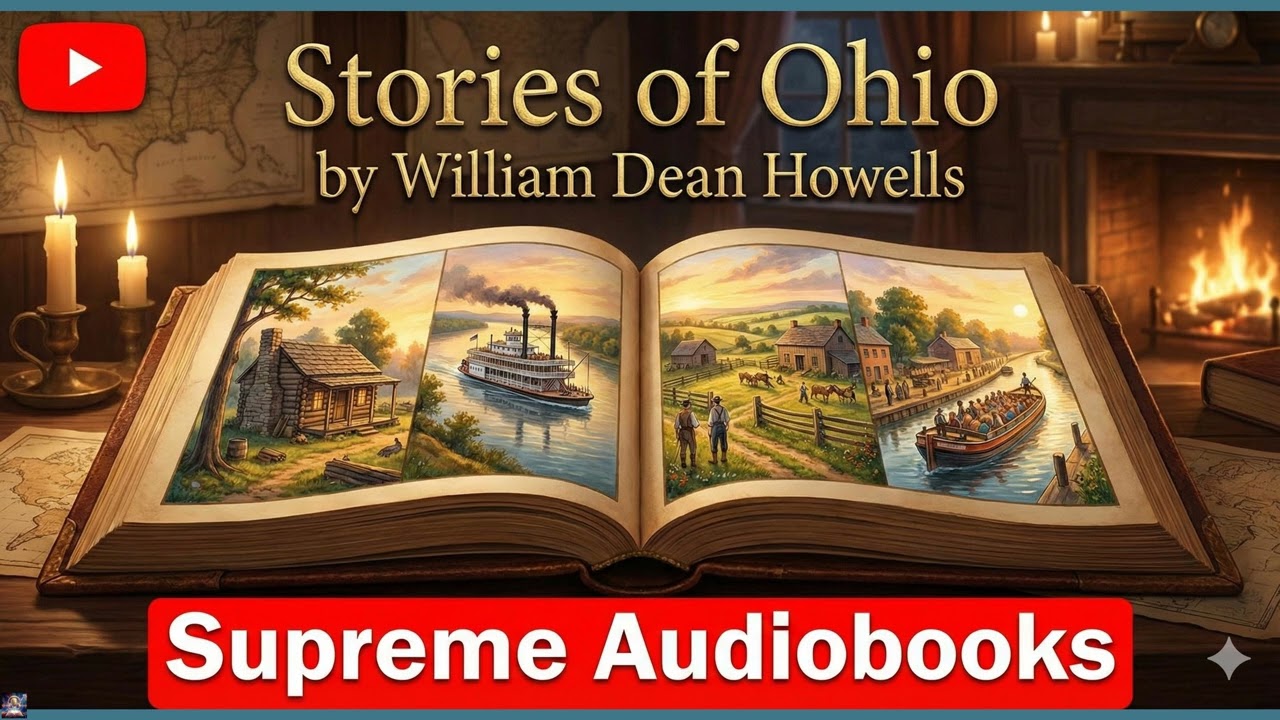
The 4K cinematic visuals accompanying this audiobook are generated by an AI image model from prompts derived from the source text. No copyrighted photos, paintings, or stock footage are used. AI generation is disclosed on every video on our YouTube channel as required by YouTube's altered/synthetic content policy.
English subtitles are transcribed from the LibriVox recording with OpenAI Whisper. Translations into the 11 other supported languages are produced by Meta's NLLB-200 neural translation model. No human translator's copyrighted translation is used.
Questions about sourcing or rights? See our DMCA & Sourcing policy or contact us.
Enjoyed this audiobook?
If you'd like to own a copy of Stories of Ohio - William Dean Howells or hear a professionally produced edition, the links below help support free audiobook production at no extra cost to you.
As an Amazon Associate we earn from qualifying purchases. Audible / print links are affiliate.