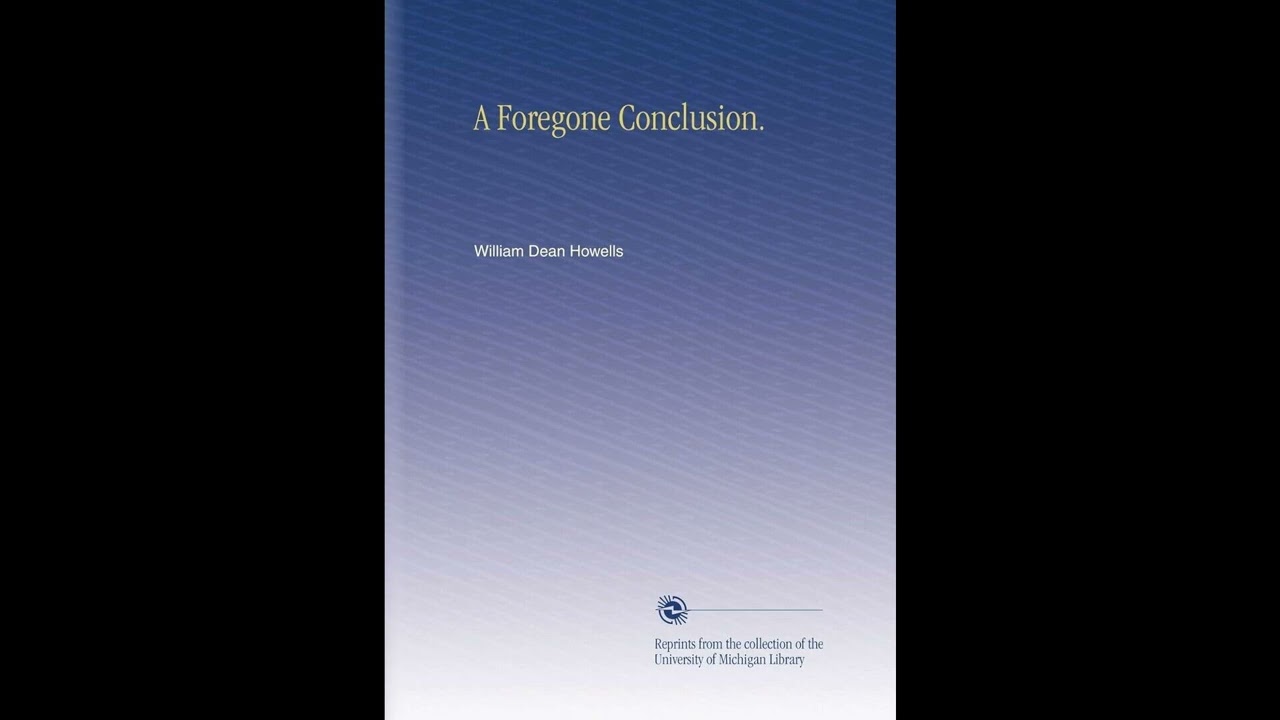
A Foregone Conclusion
William Dean Howells’s 1875 novel, A Foregone Conclusion, transports listeners to the atmospheric canals and hidden courtyards of nineteenth-century Venice, offering a poignant examination of cultural misunderstanding, unrequited affection, and the clash between artistic dreams and societal expectations. It’s a story that rings true today, as relevant as ever in its portrayal of how we idealize others, project our own desires onto them, and grapple with the often-painful realities that emerge when those illusions inevitably crumble. Howells, a master of American realism, distills universal questions of identity, purpose, and the profound loneliness of a heart’s true longing into this delicate and deeply human drama, asking us to consider the price of aspiration and the nature of genuine connection across divides. The story unfolds primarily in Venice, where the spirited young American woman, Florida Vervain, and her ailing mother have settled, seeking respite and artistic inspiration. Florida, herself an aspiring writer with a vivid imagination, engages Don Ippolito, a local priest, to serve as her Italian tutor. Ippolito is a complex and enigmatic figure—a man of the cloth outwardly, but secretly consumed by a passion for scientific invention and mechanical artistry, often creating whimsical devices in his hidden workshop. Florida, with her romantic American sensibilities, quickly becomes fascinated by her tutor, misinterpreting his reserved nature and artistic leanings as signs of a profound, suppressed genius that she believes she can liberate. Her intense interest and encouragement inadvertently ignite in Ippolito the notion that he might shed his clerical vows and pursue a life of invention, perhaps even with Florida as his muse. Observing this unfolding drama is Lieutenant Ferris, the American consul to Venice, a more pragmatic and clear-eyed man who harbors a quiet, steady affection for Florida. Ferris, grounded in reality, sees the true nature of Ippolito’s internal conflict and the depth of Florida’s romantic projections. He watches with a mixture of concern and resignation as Florida’ unwittingly fosters Ippolito’s unrealistic hopes, creating a delicate triangle of emotion and misunderstanding. The novel meticulously charts the slow, inevitable progression of these relationships, building towards a moment of crucial decision for Ippolito and a painful awakening for Florida, all set against the backdrop of Venice’s fading grandeur and the contrasting cultures of old-world duty and new-world idealism. William Dean Howells (1837-1920) stood as one of the most prominent literary figures of his era, often hailed as the "Dean of American Letters." Born in Martins Ferry, Ohio, Howells was largely self-educated, honing his literary skills through extensive reading and working in various journalistic roles from a young age, including typesetter and reporter. His career took a pivotal turn when, in 1861, he was appointed U.S. consul to Venice, a post he held for four years. This period proved foundational, profoundly shaping his perspective on European culture and providing the authentic details and atmosphere that would later grace novels like A Foregone Conclusion. Upon returning to the United States, Howells joined the staff of the prestigious Atlantic Monthly, eventually becoming its editor-in-chief, a position he used to champion the emerging literary movement of realism. Howells became the leading advocate for American literary realism, a style that sought to depict life as it truly was, avoiding the sentimentality and idealism often found in earlier Romantic literature. He believed literature should present "the smiling aspects of life" but also confront its complexities and social realities with honesty. Beyond A Foregone Conclusion, his extensive body of work includes enduring novels such as The Rise of Silas Lapham (1885), a nuanced portrayal of a self-made industrialist grappling with moral dilemmas, and A Modern Instance (1882), an unflinching look at the disintegration of a marriage. Howells’s influence extended to mentoring younger writers like Stephen Crane and Frank Norris, solidifying his crucial role in steering American literature away from pure escapism and towards a more rigorous engagement with social issues and psychological truth. One of the central themes running through A Foregone Conclusion is the profound clash of cultures—specifically, American innocence and romanticism encountering European tradition and reality. Florida Vervain’s American energy and boundless idealism drive her to project an almost mythical status onto Don Ippolito, seeing him as a figure of Byronic sorrow and suppressed genius, rather than the struggling, earthbound individual he truly is. Her inability to grasp the nuanced social and religious constraints of Ippolito’s Venetian life exemplifies this cultural divide, creating a fertile ground for misunderstanding. Meanwhile, Lieutenant Ferris, the pragmatic American consul, provides a contrasting viewpoint, his observations often highlighting the stark differences between American and Italian sensibilities regarding love, duty, and individual aspiration. Another potent theme the novel addresses is the complex nature of unrequited love and misplaced affection. Florida’s fascination with Ippolito is largely built upon her own idealized notions, a love born more of literary fantasy than actual understanding of the man himself. She falls for the idea of Ippolito, the tragic artist-priest, rather than for his true character. This projection, while well-intentioned, leads to significant emotional turmoil, not only for herself but also for Ippolito, who struggles to reconcile her image of him with his own inner life and his sacred vows. The novel carefully unpacks the consequences of such misdirected passion, alongside Ippolito's own internal conflict between his duty as a priest and his burgeoning desire for a different, more secular life, fueled by Florida's encouragement. The mid-1870s, when A Foregone Conclusion was published, marked a fascinating period in American cultural and literary history. The country was still in the throes of Reconstruction after the Civil War, grappling with rapid industrialization and profound social changes that would define the Gilded Age. Culturally, there was a growing interest in Europe, with increasing numbers of Americans—often seeking refinement or artistic inspiration—traveling abroad, leading to numerous "international novels" that explored the friction between American and European values. Howells, with his firsthand experience as consul in Venice, was uniquely positioned to capture this transatlantic encounter with unparalleled authenticity. The novel thus emerged at a moment when American literature was asserting its own identity, moving away from earlier European Romantic influences towards a distinctly American realism, eager to observe and scrutinize the complexities of both domestic and international life. It reflects a time when America was defining itself, often through the lens of its interactions with the Old World. Listening to A Foregone Conclusion as an audiobook offers a uniquely intimate experience of Howells's prose and character development. The deliberate pacing allows the listener to fully absorb the subtle details of Venetian life, feeling the atmosphere of the city through the narrator’s voice, which can highlight the wistful beauty of its descriptions. A skilled narrator can bring out the quiet dignity of Don Ippolito's internal struggles and the endearing, if sometimes misguided, earnestness of Florida Vervain, making their emotional nuances palpable. The spoken word can particularly enhance the irony present in Howells’s dialogue and the moments of profound miscommunication that drive the plot, letting the listener appreciate the unspoken tensions and the delicate shifts in emotional temperature. The several hours of runtime become an immersive sojourn, allowing Howells’s careful observation of human nature and cultural collision to unfold with clarity and emotional resonance.
Enjoyed A Foregone Conclusion? A few ways to support us
Audible & Amazon links are affiliate; we may earn a small commission at no extra cost.
About this production
Human narration by a volunteer reader from LibriVox.org, the public-domain audiobook project. LibriVox volunteers record literary works whose copyright has expired in the United States, releasing the resulting recordings into the public domain.
A Foregone Conclusion by William Dean Howells. The underlying text is in the U.S. public domain. We do not republish any modern copyrighted edition, translation, or commentary.
The 4K cinematic visuals accompanying this audiobook are generated by an AI image model from prompts derived from the source text. No copyrighted photos, paintings, or stock footage are used. AI generation is disclosed on every video on our YouTube channel as required by YouTube's altered/synthetic content policy.
English subtitles are transcribed from the LibriVox recording with OpenAI Whisper. Translations into the 11 other supported languages are produced by Meta's NLLB-200 neural translation model. No human translator's copyrighted translation is used.
Questions about sourcing or rights? See our DMCA & Sourcing policy or contact us.
Enjoyed this audiobook?
If you'd like to own a copy of A Foregone Conclusion or hear a professionally produced edition, the links below help support free audiobook production at no extra cost to you.
As an Amazon Associate we earn from qualifying purchases. Audible / print links are affiliate.