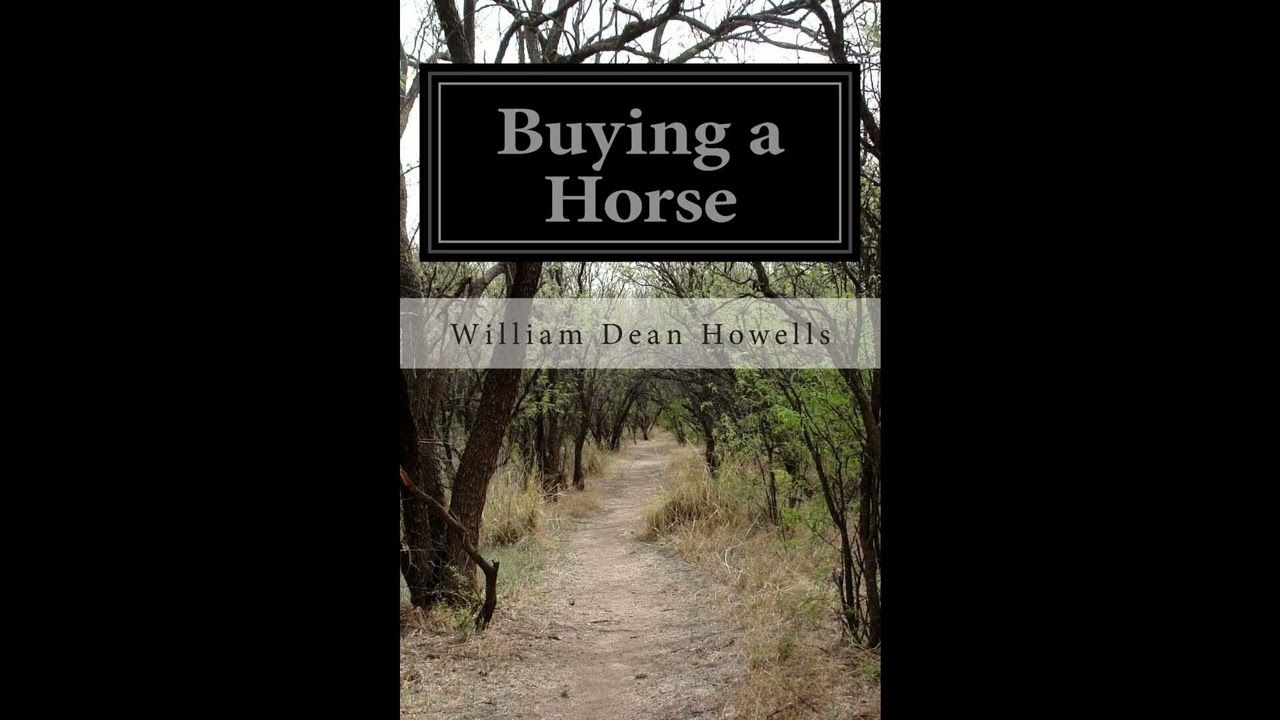
Buying a Horse
For anyone who has ever faced the daunting task of making a significant purchase, especially when lacking personal expertise in the matter, William Dean Howells’s "Buying a Horse" offers a warm, knowing smile of recognition. This deceptively simple narrative, penned by one of America's most astute observers of human nature, distills the universal anxiety, the humorous frustrations, and the quiet triumphs inherent in navigating a market where the buyer is fundamentally at a disadvantage. More than a quaint look back at equestrian pursuits, this is a story about the often-comical struggle between idealism and practicality, city wit and country wisdom, and the perpetual search for honesty in a transaction. It resonates today as a witty meditation on consumerism, trust, and the awkward dance of human interaction. The story drops us into the world of an unnamed narrator, a man of evident intelligence and literary inclinations, but one who finds himself utterly out of his depth in the practical realm of horse acquisition. He requires a horse for general use, perhaps for carriage rides or a bit of recreational riding, and thus begins a series of expeditions into the rural fringes, far from his familiar urban comforts. We meet a colorful procession of horse sellers—farmers, dealers, and various intermediaries—each presenting their animals with a blend of homespun charm and practiced salesmanship. The setting is recognizably late 19th-century America, a landscape where the horse remains an essential mode of transport and labor, and where dealings are often conducted on a handshake and a shrewd appraisal. Our narrator, armed with little more than good intentions and a healthy dose of skepticism, attempts to decipher the cryptic language of horse appraisal. He scrutinizes teeth, listens to descriptions of temperament, and attempts to gauge the elusive quality of "soundness," all while feeling keenly aware of his own ignorance. The central conflict arises from this disparity: the sophisticated buyer wants to make a rational, informed decision, but he operates in an arena governed by instinct, experience, and the subtle art of persuasion. Each potential purchase brings its own set of peculiar problems, from animals with questionable pedigrees to those with unadvertised quirks, leading the narrator through a delightful gauntlet of near-misses and growing exasperation, though always tempered by his keen sense of irony. William Dean Howells (1837-1920) stood as a towering figure in American letters during the latter half of the nineteenth century and into the early twentieth. Born in Martin’s Ferry, Ohio, he rose from humble beginnings, largely self-educated through extensive reading and work in his father’s various newspaper offices. This journalistic background instilled in him a sharp eye for detail and a dedication to presenting life as it truly was. His career took a pivotal turn with his appointment as consul to Venice by Abraham Lincoln in 1861, an experience that broadened his cultural horizons and informed some of his early, more romanticized writings. Upon his return, Howells settled in Boston and, in 1871, ascended to the prestigious editorship of The Atlantic Monthly, a position he held for a decade, shaping the literary tastes of a nation. As "The Dean of American Letters," Howells became the foremost proponent of literary realism in the United States, advocating for a truthful, unsentimental portrayal of everyday life, ordinary characters, and contemporary social issues. He famously declared that fiction should deal with "the smiling aspects of life that are the more common and the more American." Howells championed the careers of many younger writers, including Henry James and Mark Twain, with whom he maintained a lifelong friendship and correspondence. His major novels, such as A Modern Instance (1882), The Rise of Silas Lapham (1885), and A Hazard of New Fortunes (1890), meticulously dissected American class structures, business ethics, and the psychological impact of social change, securing his place as a pivotal bridge between earlier Romanticism and the Naturalist movement that followed. "Buying a Horse" masterfully enacts several of Howells’s key thematic preoccupations. One prominent theme is the clash between urban and rural sensibilities, particularly regarding practical knowledge. The narrator, clearly accustomed to intellectual pursuits, finds his formal education useless when confronted with the raw, earthy cunning of country horse traders. He observes, for instance, how a seemingly simple transaction becomes a complex negotiation of implicit assumptions and local lore, exposing the limitations of his own urban perspective. Another theme is the illusion of expertise and the necessity of trust, especially when one is an amateur. The narrator repeatedly relies on the advice of others, often with mixed results, highlighting the precarious position of a buyer who cannot truly judge the product for himself. This leads to moments of both humor and genuine frustration as he grapples with conflicting advice and veiled deceptions. Howells also deftly uses the story to showcase the gentle absurdity of everyday life. The seemingly mundane task of buying an animal transforms into a mini-epic of human foibles, demonstrating how even the most ordinary transactions can reveal profound truths about character and motivation through understated humor and irony. This work emerged during a fascinating period in American history, the post-Civil War era. The nation was undergoing rapid industrialization and urbanization, leading to significant social and economic shifts. While cities grew, the agrarian sector remained vital, and the horse, despite the advent of the railroad and the distant promise of the automobile, was still an indispensable part of daily life and commerce. Howells's brand of realism—focused on the common man, the details of social interaction, and the everyday struggles of American life—was a direct response to the perceived need for a literature that accurately reflected the realities of this changing landscape. He moved away from the more overtly sentimental or melodramatic narratives that had characterized earlier American fiction, striving instead for fidelity to life as it was actually lived, portraying characters and situations without romantic embellishment or overt moralizing. "Buying a Horse" offers a delightful glimpse into this specific cultural moment, capturing the anxieties and humor of a society grappling with its own modernization. Listening to "Buying a Horse" as an audiobook truly elevates its understated charm and subtle humor. The relatively short length, a few hours, makes it an ideal companion for a single long drive, an afternoon of chores, or quiet relaxation, allowing one to absorb Howells’s precise observations without feeling rushed. A skilled narrator can bring out the gentle exasperation of the protagonist, the distinct voices of the various country folk, and the specific cadence of late 19th-century American speech. The pacing of the prose, often deliberate and observational, lends itself perfectly to audio, inviting listeners to savor the witty asides and the vivid, though spare, descriptions. The dialogue, true to life and full of character, becomes immediate and engaging when spoken aloud, immersing the listener in the quiet, sometimes quirky, atmosphere of the horse-trading world.
Enjoyed Buying a Horse? A few ways to support us
Audible & Amazon links are affiliate; we may earn a small commission at no extra cost.
About this production
Human narration by a volunteer reader from LibriVox.org, the public-domain audiobook project. LibriVox volunteers record literary works whose copyright has expired in the United States, releasing the resulting recordings into the public domain.
Buying a Horse by William Dean Howells. The underlying text is in the U.S. public domain. We do not republish any modern copyrighted edition, translation, or commentary.
The 4K cinematic visuals accompanying this audiobook are generated by an AI image model from prompts derived from the source text. No copyrighted photos, paintings, or stock footage are used. AI generation is disclosed on every video on our YouTube channel as required by YouTube's altered/synthetic content policy.
English subtitles are transcribed from the LibriVox recording with OpenAI Whisper. Translations into the 11 other supported languages are produced by Meta's NLLB-200 neural translation model. No human translator's copyrighted translation is used.
Questions about sourcing or rights? See our DMCA & Sourcing policy or contact us.
Enjoyed this audiobook?
If you'd like to own a copy of Buying a Horse or hear a professionally produced edition, the links below help support free audiobook production at no extra cost to you.
As an Amazon Associate we earn from qualifying purchases. Audible / print links are affiliate.