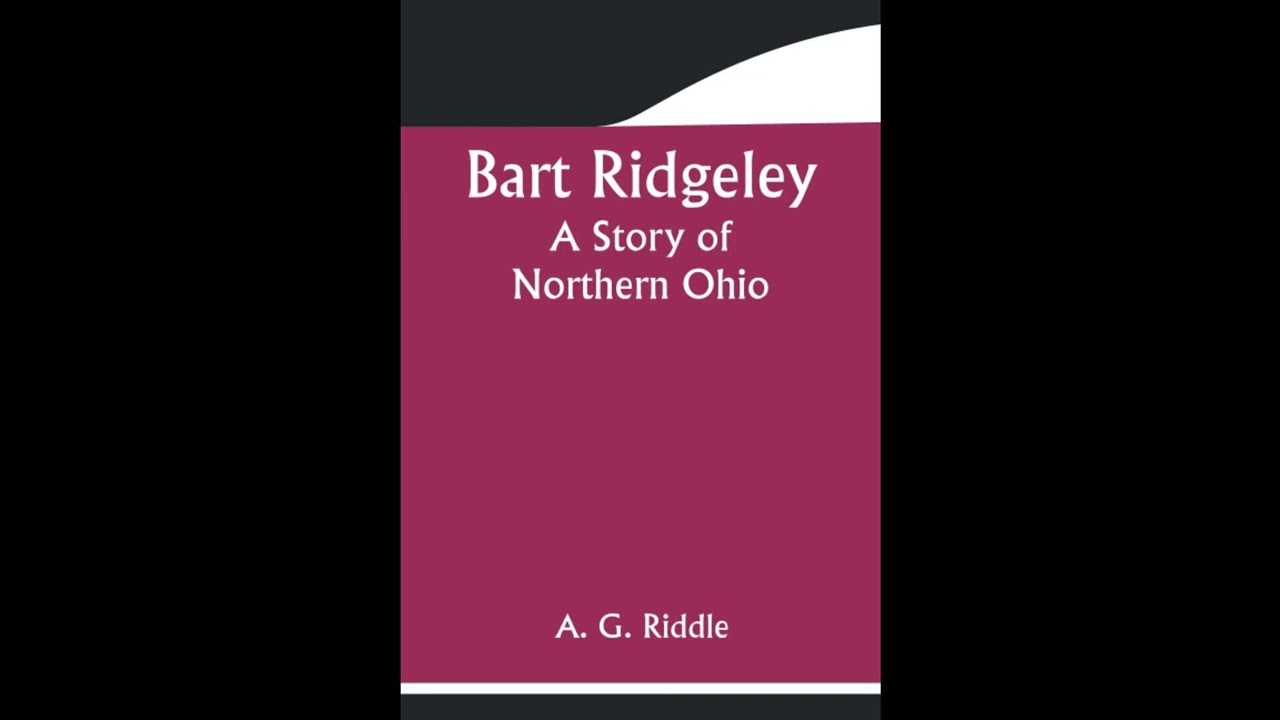
Bart Ridgeley: A Story of Northern Ohio
The unassuming title of A. G. Riddle's "Bart Ridgeley: A Story of Northern Ohio" belies a profoundly human drama, one that speaks volumes about the steadfast spirit and enduring struggles of a nation finding its footing after profound upheaval. Published in the wake of the Civil War, this novel offers listeners a window into a specific place and time—the burgeoning communities of northern Ohio as they grappled with the implications of peace, progress, and personal ambition. It is a tale that, while rooted in the fertile soil of the American Midwest, addresses universal questions of identity, community, and the persistent pursuit of a meaningful life, making it a compelling listen for anyone seeking to understand the foundational experiences that shaped modern America. Set against the rugged, fertile backdrop of northern Ohio, "Bart Ridgeley" introduces us to its eponymous protagonist, a young man of integrity and grit striving to forge his own path in a world undergoing rapid change. Bart, a veteran of the Union Army, returns to a region that is both familiar and irrevocably altered. He finds himself caught between the traditional agrarian values he was raised with and the siren call of industrial expansion and new social structures. His ambitions are modest yet profound: to reclaim his family's standing, secure his future, and win the hand of the woman he loves, Mary Glenn, whose quiet strength mirrors his own determined spirit. The central conflict quickly emerges as Bart encounters powerful forces that threaten his aspirations. A prominent local figure, wealthy and influential, poses a significant obstacle, not only to Bart's economic independence but also to his pursuit of Mary. This antagonist embodies the shift in power dynamics occurring in post-war America, where material wealth often overshadowed moral fortitude. Bart must navigate legal battles, social prejudices, and the quiet machinations of his opponents, all while wrestling with his own internal doubts and the lingering scars of war. The narrative builds steadily, following Bart as he tirelessly works his land, seeks counsel from loyal friends, and attempts to outmaneuver those who would see him fail, demonstrating the often-slow but inexorable fight for justice in a developing society. The story meticulously details the daily lives, customs, and challenges faced by residents of a growing Ohio community, leading to a crucial confrontation that will determine Bart's fate and the future of those he holds dear, without revealing the ultimate resolution of his struggles. Albert Gallatin Riddle, the author, was a remarkable figure whose life was deeply intertwined with the social and political currents of his era. Born in Monson, Massachusetts, in 1816, Riddle moved to northern Ohio in his youth, establishing himself as a lawyer and later a prominent politician. He served in the U.S. House of Representatives from 1861 to 1863, during the tumultuous early years of the Civil War, and was a staunch abolitionist and advocate for Union causes. His legal background and experience on the national stage undoubtedly informed his literary sensibilities, particularly his interest in justice, societal structures, and the moral dilemmas faced by individuals within a community. Beyond his political career, Riddle maintained a prolific literary output, publishing several novels and historical works that often centered on themes relevant to Ohio and the wider American experience. "Bart Ridgeley," published in 1873, stands as one of his more enduring fictional contributions. Other notable works include "The House of Ross" and "The Portrait: A Romance of the Cuyahoga." Riddle’s writing style often placed him among the early American realists, though with clear romantic undertones, seeking to depict life and its challenges with a measure of verisimilitude while still upholding clear moral principles. He passed away in 1902, leaving behind a legacy that bridges law, politics, and literature, all rooted in his profound connection to the evolving American landscape. One of the prominent themes running through "Bart Ridgeley" is the concept of resilience in the face of adversity. Bart's character serves as a compelling embodiment of this ideal; despite setbacks, legal battles, and social pressures, he consistently returns to his work and his principles. For example, when a critical legal document goes missing, seemingly sabotaging his claim, Bart does not surrender to despair but instead redoubles his efforts, seeking alternative evidence and refusing to be intimidated by his more powerful adversaries. This unwavering resolve highlights the pioneering spirit often celebrated in post-war American literature, where self-reliance and moral fortitude were seen as crucial for individual and societal progress. Another significant theme is the tension between tradition and the emerging forces of modernity. Northern Ohio, at this time, was a region transitioning from a largely agrarian society to one experiencing the early throes of industrialization and expanding commerce. The novel subtly portrays this shift through characters who either cling to older ways of life or eagerly embrace the new. Bart, though a farmer, must contend with a changing legal and economic landscape, symbolizing the broader societal adjustments. The narrative also thoughtfully examines the idea of community and individual responsibility. Characters’ actions are often weighed against their impact on the wider local society, reflecting the tightly knit social fabric of the period and the expectations placed upon individuals to contribute positively to their communal well-being. The period following the American Civil War, when "Bart Ridgeley" was conceived and published, was a time of immense transformation for the United States. The nation was grappling with Reconstruction, the integration of formerly enslaved people into society, and the burgeoning industrial revolution that was rapidly reshaping economies and demographics, particularly in burgeoning regions like Ohio. Literature of this era began to shift away from purely romantic ideals towards a more grounded realism, reflecting the desire to portray the complex realities of American life. Authors sought to document the struggles of ordinary people, the impact of war, and the challenges of westward expansion and urban growth. Riddle's novel emerged within this context, offering a regional story that contributed to the larger national conversation about progress, justice, and the American identity in a post-war landscape. It allowed readers to engage with the moral and social dilemmas of their own time through the lens of a relatable local narrative. Listening to "Bart Ridgeley: A Story of Northern Ohio" as an audiobook offers a unique opportunity to immerse oneself in this vivid historical landscape. The narrative, spanning several hours, unfolds with a deliberate, measured pace that mirrors the rhythms of rural life in the nineteenth century, yet maintains a constant undercurrent of tension and personal drama. A skilled narrator can bring to life the distinct voices of the Northern Ohio characters—from the earnest determination of Bart Ridgeley to the nuanced complexity of his antagonists and the steadfast support of his allies. Pay attention to how the narration conveys the atmosphere of the burgeoning towns, the quiet strength of the natural world, and the emotional weight behind key dialogues, allowing the listener to truly experience the daily struggles and triumphs that shape this compelling story.
Enjoyed Bart Ridgeley: A Story of Northern Ohio? A few ways to support us
Audible & Amazon links are affiliate; we may earn a small commission at no extra cost.
About this production
Human narration by a volunteer reader from LibriVox.org, the public-domain audiobook project. LibriVox volunteers record literary works whose copyright has expired in the United States, releasing the resulting recordings into the public domain.
Bart Ridgeley: A Story of Northern Ohio by A. G. Riddle. The underlying text is in the U.S. public domain. We do not republish any modern copyrighted edition, translation, or commentary.
The 4K cinematic visuals accompanying this audiobook are generated by an AI image model from prompts derived from the source text. No copyrighted photos, paintings, or stock footage are used. AI generation is disclosed on every video on our YouTube channel as required by YouTube's altered/synthetic content policy.
English subtitles are transcribed from the LibriVox recording with OpenAI Whisper. Translations into the 11 other supported languages are produced by Meta's NLLB-200 neural translation model. No human translator's copyrighted translation is used.
Questions about sourcing or rights? See our DMCA & Sourcing policy or contact us.
Enjoyed this audiobook?
If you'd like to own a copy of Bart Ridgeley: A Story of Northern Ohio or hear a professionally produced edition, the links below help support free audiobook production at no extra cost to you.
As an Amazon Associate we earn from qualifying purchases. Audible / print links are affiliate.