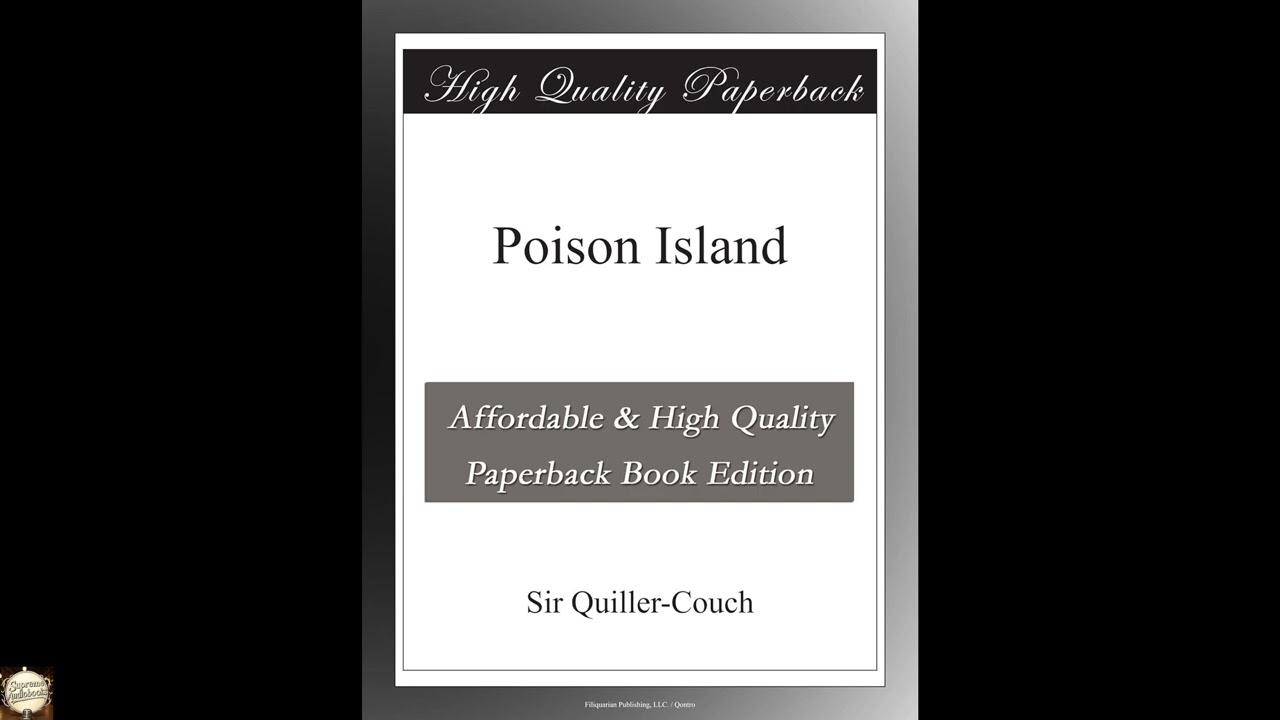
Poison Island
Step onto the deck of a literary vessel that sails the treacherous waters of human ambition and the alluring mystery of the unknown. Sir Arthur Quiller-Couch's "Poison Island," a foundational work in the annals of classic literature, invites listeners to a world where the promise of immense wealth clashes with the primal fears lurking in the heart of a remote, dangerous landscape. Far from being merely another treasure hunt, this story, with its unique blend of high adventure and subtle psychological tension, continues to resonate, reminding us that the greatest threats often lie not in the external world, but within the human soul itself. Its questions about greed, scientific hubris, and the corrupting influence of isolation remain as pertinent today as they were when the ink first dried on its pages. Our story introduces Alexander Maclean, a narrator with a taste for both adventure and scholarly pursuits, whose life takes an abrupt turn when he is drawn into an extraordinary expedition. The instigator is John Good, a brilliant, if eccentric, scholar obsessed with unraveling the legend of Captain John Avery’s fabled treasure. Good has not only deciphered cryptic clues leading to the hoard, but also identified its perilous location: a remote island shrouded in ominous whispers of a deadly, pervasive poison. This is not a voyage for the faint-hearted, and the small crew assembled for this daunting quest is a motley collection of individuals, each driven by their own motivations, but all united by the irresistible lure of untold riches. The initial thrill of discovery and the camaraderie of a shared enterprise soon give way to the chilling realities of their destination. As the schooner approaches the shores of the enigmatic island, an unsettling atmosphere settles upon the adventurers. The island itself becomes a character—beautiful yet menacing, its lush flora concealing insidious dangers, and its silence pregnant with unseen threats. Maclean’s observations become the audience’s eyes and ears, documenting the growing unease among the crew as they confront the physical perils of the terrain and the psychological pressures of their isolation. The pursuit of the treasure transforms from a grand adventure into a desperate struggle, testing the limits of human endurance and challenging the very bonds that initially held the group together. The real 'poison' of the island slowly begins to reveal itself, less as a simple toxic plant and more as a creeping malady affecting minds and loyalties. Sir Arthur Quiller-Couch, affectionately known to his readers as "Q," was a prominent literary figure whose life spanned the late Victorian and early Edwardian eras. Born in 1863 in Bodmin, Cornwall, his origins in the rugged, romantic landscape of the West Country deeply influenced his writing, often imbuing his narratives with a distinctive sense of place and a rich, atmospheric quality. After an education at Clifton College and Trinity College, Oxford, he dedicated himself to a life of letters, excelling as a novelist, poet, literary critic, and academic. He was appointed the King Edward VII Professor of English Literature at Cambridge University in 1912, a position he held until his death in 1944. "Q" was an immensely prolific writer, renowned for his elegant prose and his unwavering commitment to clarity and precision in language. Beyond his adventure novels like "Poison Island" and "Dead Man's Rock," he gained widespread acclaim for his literary criticism and his role in compiling and editing The Oxford Book of English Verse, an anthology that became a foundational text for generations of poetry lovers. He stood as a bridge between the romantic sensibilities of the 19th century and the emerging literary concerns of the 20th, contributing significantly to the development of English literary scholarship while maintaining a popular appeal through his storytelling. His work often explored themes of heroism, moral dilemma, and the enduring spirit of human endeavor, securing his lasting place in the canon of classic British authors. "Poison Island" enacts several profound themes that grant it enduring significance. The most apparent is the corrupting influence of greed. The lure of Captain Avery's treasure acts as a catalyst, slowly eroding the moral compasses of the expedition members. What begins as a noble, adventurous pursuit gradually devolves into suspicion and conflict, as characters reveal their baser instincts under the pressure of potential wealth. We see this in the subtle shift in their interactions, where a shared goal gives way to individual self-interest, demonstrating how easily the promise of riches can fracture even the strongest bonds. Another compelling theme is the clash between theoretical knowledge and practical experience. John Good, the scholarly mastermind, possesses intellectual brilliance but lacks the streetwise cunning and resilience necessary for survival in a genuinely hostile environment. This tension is repeatedly shown through his interactions with the more pragmatic members of the crew, highlighting the limitations of academic wisdom when confronted with the raw, unpredictable forces of nature and human nature. Furthermore, the story thoughtfully considers the psychological impact of isolation and extreme environments. The remote, "poisoned" island serves as a crucible, intensifying the characters' anxieties and fears. Cut off from civilization, their perceptions become distorted, leading to paranoia and a breakdown in trust. The very air of the island seems to amplify their internal struggles, turning minor disagreements into major confrontations. Finally, the novel touches upon the nature of courage and heroism, questioning whether it lies in grand gestures or in the quiet perseverance of ordinary individuals facing extraordinary circumstances. The characters are forced to confront their own limitations and define their personal codes of conduct in a setting that offers no easy answers, making "Poison Island" a compelling study of character under duress. Published in 1907, "Poison Island" emerged from a period of significant cultural and intellectual ferment in Britain. The early 20th century was a time when the British Empire, though still vast, was beginning to face its own internal questions and external challenges. Adventure narratives, particularly those set in exotic or uncharted territories, remained immensely popular, a literary reflection of the public's fascination with exploration and imperial reach. Authors like Robert Louis Stevenson and H. Rider Haggard had cemented the genre's appeal, but "Q" brought a distinctive scholarly sensibility to his own tales, blending swashbuckling excitement with more nuanced character studies and thoughtful moral dilemmas. The era was also marked by advancements in science, leading to a fascination with both discovery and the potential dangers inherent in the unknown—a tension that "Poison Island" embodies through its central premise of a scientifically observed, yet mysterious, poison. This convergence of adventure, psychological depth, and a subtle questioning of human ambition made the work particularly relevant to its contemporary audience. Listening to "Poison Island" as an audiobook offers a unique opportunity to immerse oneself in its atmospheric prose and unfolding drama. With a run length of several hours, there is ample time for the narrator's voice to build the slow-burn tension that defines the story. Pay attention to how the narration conveys the island's eerie silence, the subtle shifts in the characters' dialogue revealing their growing paranoia, and the mounting sense of dread that pervades the expedition. A skilled reader will bring to life the distinctive voices of the scholar Good, the observant Maclean, and the various, often desperate, members of the crew, allowing their individual traits and mounting anxieties to truly resonate. The pacing of the narration will be key, starting with the hopeful excitement of discovery and gradually transitioning to the more deliberate, suspenseful rhythm of men trapped by their own ambition and the island's insidious grip, drawing you deeper into its chilling embrace.
Enjoyed Poison Island? A few ways to support us
Audible & Amazon links are affiliate; we may earn a small commission at no extra cost.
About this production
Human narration by a volunteer reader from LibriVox.org, the public-domain audiobook project. LibriVox volunteers record literary works whose copyright has expired in the United States, releasing the resulting recordings into the public domain.
Poison Island by Arthur Quiller-Couch. The underlying text is in the U.S. public domain. We do not republish any modern copyrighted edition, translation, or commentary.
The 4K cinematic visuals accompanying this audiobook are generated by an AI image model from prompts derived from the source text. No copyrighted photos, paintings, or stock footage are used. AI generation is disclosed on every video on our YouTube channel as required by YouTube's altered/synthetic content policy.
English subtitles are transcribed from the LibriVox recording with OpenAI Whisper. Translations into the 11 other supported languages are produced by Meta's NLLB-200 neural translation model. No human translator's copyrighted translation is used.
Questions about sourcing or rights? See our DMCA & Sourcing policy or contact us.
Enjoyed this audiobook?
If you'd like to own a copy of Poison Island or hear a professionally produced edition, the links below help support free audiobook production at no extra cost to you.
As an Amazon Associate we earn from qualifying purchases. Audible / print links are affiliate.