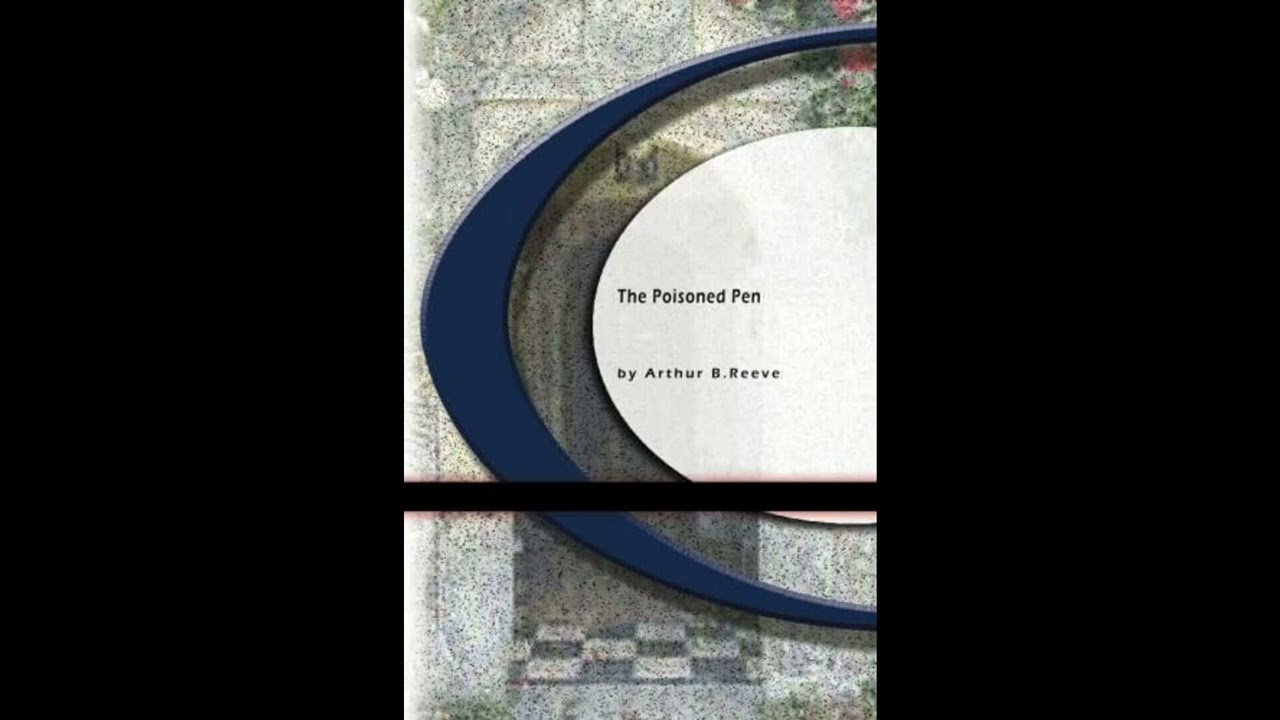
The Poisoned Pen
Step into the laboratory of the mind with Arthur B. Reeve’s The Poisoned Pen, a collection that introduces listeners to Craig Kennedy, the "American Sherlock Holmes." This isn't merely a series of detective stories; it's an invitation to witness the birth of forensic science in fiction, a thrilling glimpse into a world where cutting-edge chemistry, psychology, and technology are the ultimate weapons against crime. In an era still largely reliant on old-fashioned police work, Kennedy stands as a beacon of modern investigative methods, offering a unique blend of intellectual challenge and pulse-ppounding suspense. For listeners today, it’s a chance to experience the genesis of a genre, to understand how the tools and techniques we now take for granted in crime procedurals first captivated an eager public, making these tales as fresh and thought-provoking as when they first appeared. Set against the bustling, rapidly modernizing backdrop of early 20th-century New York, The Poisoned Pen brings us into the world of Professor Craig Kennedy, a brilliant, somewhat enigmatic academic with a position at a prestigious university. He is a chemist by trade, but his true calling lies in applying scientific principles to the baffling mysteries that stump the city's police force. Each story in this collection presents a distinct, often seemingly impossible puzzle: a mysterious death where no conventional weapon can be found, a case of apparent spontaneous combustion, or the ingenious use of a seemingly innocuous object to commit a heinous act. The police, led by the more traditional Inspector O'Connor, frequently find themselves at a dead end, only for Kennedy to step in, not with brawn or intuition, but with a meticulous attention to detail and a battery of laboratory equipment. Kennedy’s investigations unfold not in dark alleys or through gritty stakeouts, but often in the sterile calm of his own laboratory. He is a master of toxicology, ballistics, fingerprint analysis, and the emerging field of criminal psychology. The central conflict in these narratives often pits the old guard's reliance on eyewitness accounts and brute force against Kennedy's calm, methodical approach of examining physical evidence. He analyzes residues, deciphers coded messages, and even reconstructs crime scenes using scientific probabilities. The arc of the stories consistently demonstrates the power of observation and deduction when paired with scientific rigor, transforming the chaotic reality of crime into a solvable equation. Listeners watch, fascinated, as Kennedy peels back layers of deception, revealing the hidden truths behind elaborate schemes that test the very limits of human ingenuity and malevolence. Arthur B. Reeve, born in Patchogue, New York in 1880, became one of America's most celebrated popular fiction writers during the early decades of the 20th century. After graduating from Princeton University, Reeve initially pursued a career in journalism, a background that no doubt sharpened his keen observational skills and ability to craft compelling narratives. It was in 1910, with the introduction of Craig Kennedy in the pages of Cosmopolitan magazine, that Reeve truly found his calling and captured the public imagination. He quickly became a prolific author, dedicating much of his career to the adventures of his scientific detective. Reeve’s other notable works include The Silent Bullet, The Gold of the Gods, and The Romance of E-101. Reeve’s contribution to literature lies primarily in his pioneering role within the burgeoning "scientific detective" genre. While Arthur Conan Doyle's Sherlock Holmes had already established the archetype of the brilliant, deductive sleuth in England, Reeve introduced an American counterpart who explicitly leveraged the latest advancements in science and technology. He bridged the gap between pure deduction and forensic investigation, placing the laboratory at the very heart of crime-solving. Reeve’s popularity during his lifetime was immense, securing his place as a significant figure in the development of American popular fiction and influencing countless subsequent writers of crime and mystery. He passed away in 1936, leaving behind a legacy of innovation that shaped the very way fictional detectives operate. The Poisoned Pen enacts several compelling themes that resonate even today. One central theme is the triumph of rational inquiry and scientific method over ignorance and superstition. Kennedy repeatedly confronts scenarios that seem impossible or supernatural, only to systematically dismantle them through chemical analysis, microscopic examination, and psychological profiling. For instance, a seemingly spontaneous combustion is revealed to be a meticulously planned chemical reaction, demonstrating how science can both create and solve complex deceptions. Another significant theme involves the deceptive nature of appearances. Characters often hide sinister motives behind respectable facades, and seemingly innocuous objects are repurposed as deadly tools. Kennedy’s brilliance lies in seeing beyond the obvious, revealing the hidden dangers in plain sight, forcing both the characters and the listener to question every assumption. Furthermore, the stories frequently underscore the precariousness of justice and the urgent need for verifiable truth. Without Kennedy's rigorous methods, many of these crimes would remain unsolved, perpetrators unpunished. The recurring motif of the "poisoned pen" itself —whether literal or metaphorical— speaks to the insidious ways harm can be inflicted through cunning and forethought, often leaving behind only the faintest, most scientific clues. These tales serve as a commentary on the burgeoning complexities of modern life and the escalating sophistication of criminal endeavors, necessitating an equally sophisticated response. They illuminate the eternal struggle between human malice and the unwavering pursuit of truth. The early 20th century, the period in which The Poisoned Pen was written and published, was a time of tremendous change and optimism, particularly regarding scientific advancement. The world was witnessing rapid innovations in chemistry, physics, and medicine. Electricity was transforming cities, automobiles were revolutionizing transportation, and new technologies were emerging at an astonishing pace. This era fostered a public fascination with science and its potential to solve previously intractable problems, making the "scientific detective" a particularly timely and appealing figure. In the literary world, the popularity of detective fiction was soaring, largely propelled by the success of Sherlock Holmes. Reeve capitalized on this cultural enthusiasm, offering an American variation on the detective hero who, rather than relying solely on deduction, actively engaged with the cutting-edge forensic science of the day. His work reflected and amplified the public's growing trust in empirical evidence and expert knowledge as essential tools for understanding the world and upholding order. Listening to The Poisoned Pen as an audiobook offers a unique way to experience these foundational tales of forensic detection. A skilled narrator brings a vital layer of atmosphere and suspense, allowing the listener to fully immerse themselves in the intricate plotting and scientific explanations. The precise pacing of the narration can enhance the tension as Kennedy meticulously gathers clues, building suspense before the inevitable, satisfying revelation. Listen for the subtle shifts in voice that differentiate characters, from the earnest but often baffled Inspector O'Connor to the cool, intellectual Craig Kennedy. The run length of several hours makes this collection ideal for focused listening, perhaps during a long commute or while engaging in quiet tasks, allowing ample time to ponder the clues alongside the professor. The audio format truly highlights the methodical unfolding of each case, letting the listener appreciate the ingenuity of the crimes and the brilliance of their scientific solutions as Reeve intended.
Enjoyed The Poisoned Pen? A few ways to support us
Audible & Amazon links are affiliate; we may earn a small commission at no extra cost.
About this production
Human narration by a volunteer reader from LibriVox.org, the public-domain audiobook project. LibriVox volunteers record literary works whose copyright has expired in the United States, releasing the resulting recordings into the public domain.
The Poisoned Pen by Arthur B. Reeve. The underlying text is in the U.S. public domain. We do not republish any modern copyrighted edition, translation, or commentary.
The 4K cinematic visuals accompanying this audiobook are generated by an AI image model from prompts derived from the source text. No copyrighted photos, paintings, or stock footage are used. AI generation is disclosed on every video on our YouTube channel as required by YouTube's altered/synthetic content policy.
English subtitles are transcribed from the LibriVox recording with OpenAI Whisper. Translations into the 11 other supported languages are produced by Meta's NLLB-200 neural translation model. No human translator's copyrighted translation is used.
Questions about sourcing or rights? See our DMCA & Sourcing policy or contact us.
Enjoyed this audiobook?
If you'd like to own a copy of The Poisoned Pen or hear a professionally produced edition, the links below help support free audiobook production at no extra cost to you.
As an Amazon Associate we earn from qualifying purchases. Audible / print links are affiliate.