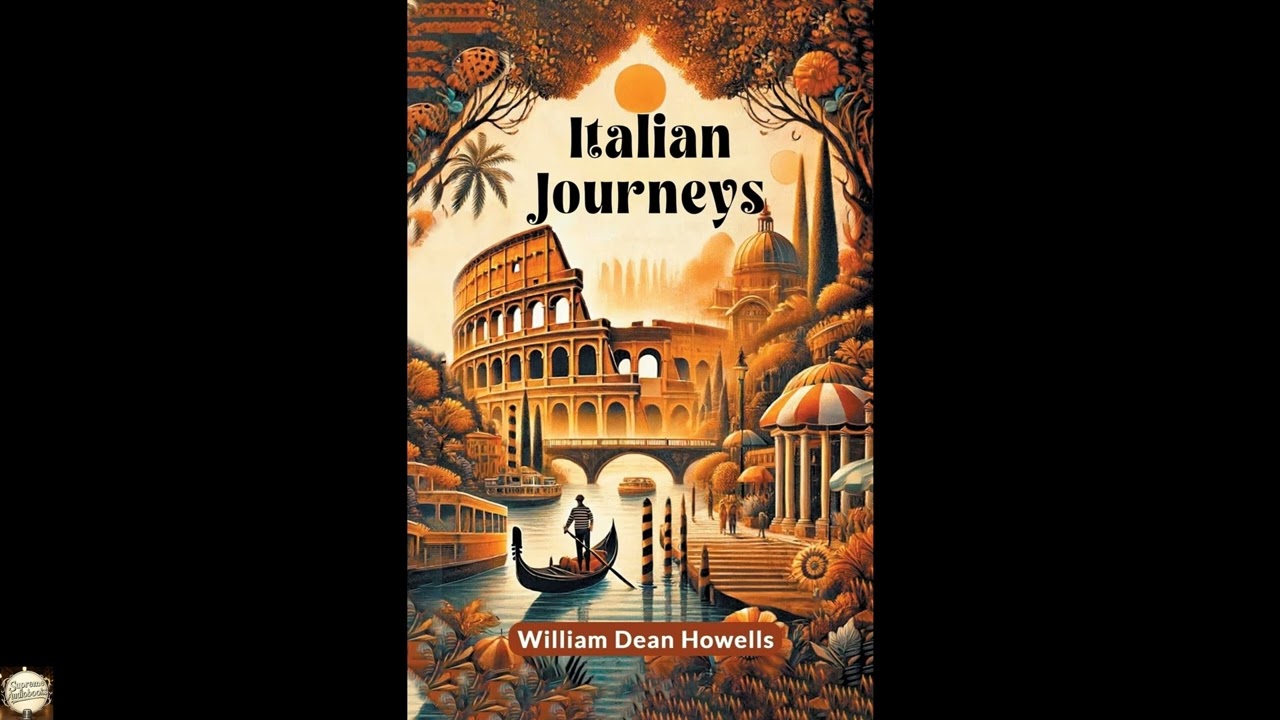
Italian Journeys
Step into a world seen through the discerning eyes of a literary titan, as William Dean Howells invites you to witness nineteenth-century Italy not as a grand, romanticized stage, but as a living, breathing landscape of human experience. Italian Journeys stands as a seminal work in American travel writing, offering far more than mere sightseeing. It is a perceptive record of cultural encounter, a nuanced reflection on history, and a subtle commentary on the evolving American identity. Listening to Howells's meticulous observations today provides a rare opportunity to connect with a period of profound change in both Italy and America, all filtered through the engaging prose of a writer who would come to define an entire literary movement. His insights into daily life, human nature, and the persistent allure of the past remain remarkably relevant, speaking to anyone who has ever found themselves a stranger in a strange land. The narrative arc of Italian Journeys unfurls primarily through Howells's experiences as the American consul in Venice between 1861 and 1865. The book, however, extends beyond his consular duties, encompassing a series of excursions and stays across the Italian peninsula. We find him, a young American intellectual, immersed in the ancient grandeur and modern realities of Venice, observing the ebb and flow of daily life from his apartments, navigating the city's labyrinthine canals, and engaging with its diverse inhabitants. From the quiet domesticity of his Venetian household to the bustling public squares, Howells captures the city's unique rhythms, portraying gondoliers, shopkeepers, artists, and fellow expatriates with equal measures of curiosity and wit. Beyond Venice, Howells ventures to other iconic Italian cities. He spends time in Florence, reflecting on its Renaissance heritage and the Florentine character, and travels southward to Rome and Naples, confronting the stark beauty and sometimes unsettling squalor of the south. The central tension running through these accounts is the narrator's gentle but persistent effort to reconcile his preconceived, often romantic ideals of Italy—shaped by literature and art—with the more complex, sometimes mundane, realities he encounters. This "conflict" is less about dramatic external events and more about the internal process of understanding a foreign culture, its enduring traditions, and its people, stripped of romantic illusion but never losing affection. His observations build towards a more honest and profound appreciation for the country. William Dean Howells (1837–1920) was one of the most influential American writers and literary critics of his time. Born in Martins Ferry, Ohio, he rose from humble beginnings, largely self-educated through voracious reading and practical experience in printing and journalism. His early career as a newspaper editor and reporter laid the groundwork for his sharp observational skills and precise prose. A pivotal moment in his life came with his appointment as U.S. consul to Venice in 1861, a reward for writing a campaign biography of Abraham Lincoln. This four-year European posting proved foundational, directly inspiring Italian Journeys and shaping his perspective on the world. Upon his return to America, Howells became a powerful force in the literary world. He served as editor of the prestigious Atlantic Monthly from 1871 to 1881, a position he used to champion emerging American writers and new literary styles. He cultivated friendships with literary figures such as Henry James and Mark Twain, and through his critical essays and reviews, he became the leading proponent of literary realism in America. His own novels, including A Modern Instance (1882) and The Rise of Silas Lapham (1885), are considered cornerstones of the realist movement, depicting ordinary American life, social mobility, and moral dilemmas with an unprecedented degree of psychological truth and social detail. Howells occupied a unique position, earning him the informal title "the Dean of American Letters," bridging the genteel traditions of the mid-nineteenth century with the emerging modernism of the twentieth. A prominent thread woven through Italian Journeys is the inherent clash of cultures and the concept of American "innocence" confronting European antiquity and experience. Howells, with his distinctly American sensibility, frequently contrasts the practicality and directness of his homeland with the layered history, bureaucratic intricacies, and differing social customs of Italy. He often finds humor and insight in these differences, for instance, marveling at the Italians' ability to live amidst overwhelming historical ruins while simultaneously being vexed by local inefficiencies or the complexities of a simple transaction. His descriptions illustrate a continuous negotiation between his American expectations and the distinct realities of Italian life, demonstrating how foreign experiences can reshape one's understanding of home. Furthermore, the account showcases Howells's unwavering commitment to literary realism, even within the framework of a personal travel narrative. He steadfastly refuses to merely romanticize Italy, instead presenting an honest, unsentimental portrayal that includes moments of discomfort, confusion, and even exasperation alongside the awe and delight. He details the specificities of market scenes, the practicalities of Venetian domestic life, the nuances of local dialects, and the varied temperaments of the people he encounters. Through these concrete observations, Howells articulates a clear-eyed affection for Italy, one that acknowledges both its enduring beauty and its everyday imperfections. He isn't seeking idealized beauty, but rather an authentic connection to the people and places he encounters, often finding it in the simple exchanges with ordinary citizens rather than in grand historical sites. The publication of Italian Journeys in 1867 placed it squarely in a period of intense transformation both in Italy and America. Italy had only recently achieved unification in 1861, though Venice, where Howells spent much of his time, remained under Austrian control until 1866. This political ferment provides an unspoken backdrop to Howells's observations; while he largely focuses on the cultural and everyday, the lingering effects of historical shifts and the anticipation of national identity are palpable. Across the Atlantic, America was emerging from the trauma of the Civil War, entering an era of rapid industrialization and social redefinition. Americans were increasingly seeking to define their own cultural identity, and Howells's meticulous observations of Europe contributed significantly to the evolving American understanding of its place in the world, distinct yet connected to its European heritage. Listening to Italian Journeys as an audiobook offers a singular opportunity to immerse oneself in Howells’s distinctive voice and precise observations. The narrator's performance becomes essential in conveying Howells's subtle humor, his gentle irony, and the contemplative pace of his prose. The run length makes it an ideal companion for extended listening sessions or for savoring in shorter segments, allowing ample time to absorb the rich detail of each locale and encounter. A skilled voice actor can bring to life the numerous "characters" Howells describes, from the specific inflections of a gondolier to the earnestness of a local guide. The atmospheric descriptions—the lapping of water against Venetian palaces, the sounds of bustling city squares, the quiet moments of reflection amidst ancient ruins—gain an additional layer of resonance through the auditory experience, allowing the listener to truly feel present alongside Howells as he navigates the wonders and peculiarities of nineteenth-century Italy.
Enjoyed Italian Journeys? A few ways to support us
Audible & Amazon links are affiliate; we may earn a small commission at no extra cost.
About this production
Human narration by a volunteer reader from LibriVox.org, the public-domain audiobook project. LibriVox volunteers record literary works whose copyright has expired in the United States, releasing the resulting recordings into the public domain.
Italian Journeys by William Dean Howells. The underlying text is in the U.S. public domain. We do not republish any modern copyrighted edition, translation, or commentary.
The 4K cinematic visuals accompanying this audiobook are generated by an AI image model from prompts derived from the source text. No copyrighted photos, paintings, or stock footage are used. AI generation is disclosed on every video on our YouTube channel as required by YouTube's altered/synthetic content policy.
English subtitles are transcribed from the LibriVox recording with OpenAI Whisper. Translations into the 11 other supported languages are produced by Meta's NLLB-200 neural translation model. No human translator's copyrighted translation is used.
Questions about sourcing or rights? See our DMCA & Sourcing policy or contact us.
Enjoyed this audiobook?
If you'd like to own a copy of Italian Journeys or hear a professionally produced edition, the links below help support free audiobook production at no extra cost to you.
As an Amazon Associate we earn from qualifying purchases. Audible / print links are affiliate.