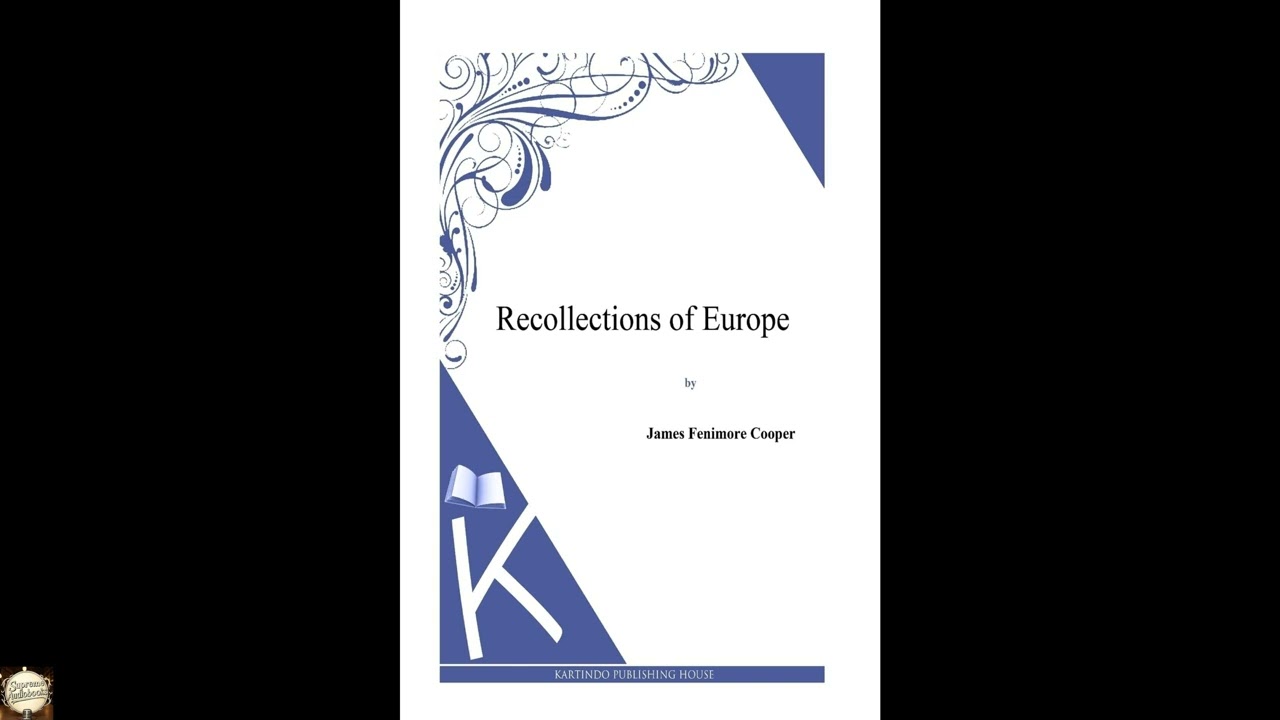
Recollections of Europe
Step into a bygone era, not with a fictional tale, but through the discerning eyes of America's first internationally acclaimed novelist, J. Fenimore Cooper. "Recollections of Europe" offers more than a simple travelogue; it is a profound cultural critique and a foundational document in the ongoing conversation between the Old World and the New. For listeners today, it provides an invaluable window into the early 19th century, revealing not only the societies Cooper observed but also the nascent American identity he championed. This collection of his European observations speaks to universal themes of national character, political ideals, and the eternal challenge of understanding cultures distinct from one's own, offering perspectives that continue to resonate in a world still grappling with global comparisons and self-definition. Imagine Europe in the years following the Napoleonic Wars, a continent still structured by ancient monarchies, burgeoning liberal movements, and the visible scars of conflict. This is the stage upon which J. Fenimore Cooper presents himself as the quintessential American observer. As he travels through various nations, including the picturesque landscapes of Switzerland and the historically rich cities of Italy, he acts as both reporter and commentator, scrutinizing everything from architectural styles and daily customs to political systems and social hierarchies. His primary aim is to understand these foreign lands, but his secondary, and perhaps more powerful, purpose is to continually measure them against the republican ideals he held so dear for his own burgeoning United States. The central tension of Cooper's "Recollections" lies in this persistent comparison: the ancient traditions and aristocratic structures of Europe facing off against the democratic principles and egalitarian aspirations of America. Cooper interacts with locals, converses with fellow travelers, and meticulously records his observations, often finding European societies lacking in true liberty or burdened by antiquated class distinctions. Yet, he is not blind to the continent's beauty, its historical depth, or its cultural achievements. The arc of the narrative, then, is less a conventional plot and more a progression of intellectual engagement, as Cooper moves from one setting to the next, accumulating insights, refining his critiques, and solidifying his conviction in the unique promise of the American experiment, even as he wrestles with the complexities and occasional allure of European life. James Fenimore Cooper, born in Burlington, New Jersey, in 1789, spent his formative years in Cooperstown, New York, a frontier settlement founded by his father. His early life was marked by education at Yale University, a period in the merchant marine, and service in the U.S. Navy. It was on a dare from his wife that he turned to writing, publishing his first novel, "Precaution," in 1820. The subsequent success of "The Spy" (1821), an American Revolutionary War tale, quickly established him as a significant voice in American letters. Cooper is most widely celebrated for his "Leatherstocking Tales," a series of five novels featuring the iconic frontiersman Natty Bumppo: "The Pioneers," "The Last of the Mohicans," "The Prairie," "The Pathfinder," and "The Deerslayer." These works helped define the American frontier myth, painting vivid pictures of wilderness, encounters with Native Americans, and the formation of a distinctly American character. From 1826 to 1833, Cooper resided in Europe, serving unofficially as a cultural ambassador and a passionate defender of American republicanism. It was during this period that he authored a series of travel books, including "Recollections of Europe," which offered his comprehensive observations and criticisms of the continent. Upon his return to America, he became increasingly critical of his own country's direction, particularly its social and political institutions, which led to numerous public controversies and libel suits until his death in 1851. Cooper remains a foundational figure in American literature, a pioneer of the historical novel and a key voice in the development of a national literary identity. At the heart of "Recollections of Europe" are several compelling themes, perhaps none more prominent than the clash between American Identity and European Tradition. Cooper consistently uses his European experiences as a mirror for American values. For instance, his detailed descriptions of the rigidly stratified class structures and aristocratic pretensions he observed in Italian and Swiss society often lead to direct, sometimes indignant, comparisons with America's theoretical egalitarianism. He might recount a sumptuous court banquet or a formal social gathering, only to follow with a commentary on the inherent lack of true meritocracy, thereby asserting American superiority in principle. Another potent theme is that of Republicanism and Liberty. Cooper was an ardent believer in democratic governance, and his writings are infused with a vigilant concern for political freedom. He critiques the various forms of censorship, the overt power of the aristocracy, and the omnipresent standing armies he encountered across Europe, contrasting them with the ideals of free expression and the citizen-soldier he associated with America. A concrete example of this appears in his observations of Swiss cantonal governments, where he carefully distinguishes between genuine republican self-governance and mere historical precedent, always weighing their practices against an idealized vision of American liberty. Finally, the book itself embodies the theme of The Role of the Observer and the Construction of National Character. Cooper presents himself not just as a traveler but as an interpreter, keenly aware of his own American biases, yet striving to present an "honest" assessment. The very act of his detailed observation of landscapes, customs, and political structures serves to define both Europe and, by contrast, America, solidifying an imagined national character for both. The early to mid-19th century was a period of intense self-definition for the young United States, emerging from the War of 1812 with a growing sense of national identity, even as internal tensions simmered. Across the Atlantic, Europe was a patchwork of restored monarchies, lingering revolutionary ideals, and the first stirrings of industrial change. The cultural and political landscape was dynamic, and American intellectuals like Cooper felt a strong impulse to engage with the Old World, both to learn from it and to assert their own nation's distinctness. Literarily, American authors were striving to forge a literature independent of European models. Cooper, alongside Washington Irving and later authors, was at the forefront of this movement. Travel writing, in particular, was a popular and important genre, allowing writers to comment on foreign societies while subtly, or not so subtly, critiquing their own. "Recollections of Europe" emerged from Cooper's extended European sojourn, where he not only gathered material for his travelogues but also actively participated in political debates, defending American democracy against its European detractors. The book is therefore a product of this specific historical moment, embodying the intellectual ferment of a young nation asserting its place on the world stage. Listening to "Recollections of Europe" as an audiobook allows Cooper's insightful, often impassioned, prose to truly come alive. With a run length of several hours, it offers ample opportunity for focused engagement, making it an excellent companion for long commutes, thoughtful walks, or quiet evenings at home. A skilled narrator can render Cooper's sometimes formal language approachable and his pointed observations immediate. Listen for the careful pacing, which reflects the contemplative nature of a true travelogue, allowing you to absorb the nuances of his cultural critiques and vivid descriptions without feeling rushed. The narrator's voice becomes Cooper's own, lending personality to his detailed accounts and making the historical scenes and philosophical musings feel present. This oral presentation enhances the sense of traveling alongside Cooper, experiencing the grand vistas and intimate social encounters as if you were truly there, observing a pivotal continent through the eyes of an equally pivotal American figure.
Enjoyed Recollections of Europe? A few ways to support us
Audible & Amazon links are affiliate; we may earn a small commission at no extra cost.
About this production
Human narration by a volunteer reader from LibriVox.org, the public-domain audiobook project. LibriVox volunteers record literary works whose copyright has expired in the United States, releasing the resulting recordings into the public domain.
Recollections of Europe by J. Fenimore Cooper. The underlying text is in the U.S. public domain. We do not republish any modern copyrighted edition, translation, or commentary.
The 4K cinematic visuals accompanying this audiobook are generated by an AI image model from prompts derived from the source text. No copyrighted photos, paintings, or stock footage are used. AI generation is disclosed on every video on our YouTube channel as required by YouTube's altered/synthetic content policy.
English subtitles are transcribed from the LibriVox recording with OpenAI Whisper. Translations into the 11 other supported languages are produced by Meta's NLLB-200 neural translation model. No human translator's copyrighted translation is used.
Questions about sourcing or rights? See our DMCA & Sourcing policy or contact us.
Enjoyed this audiobook?
If you'd like to own a copy of Recollections of Europe or hear a professionally produced edition, the links below help support free audiobook production at no extra cost to you.
As an Amazon Associate we earn from qualifying purchases. Audible / print links are affiliate.