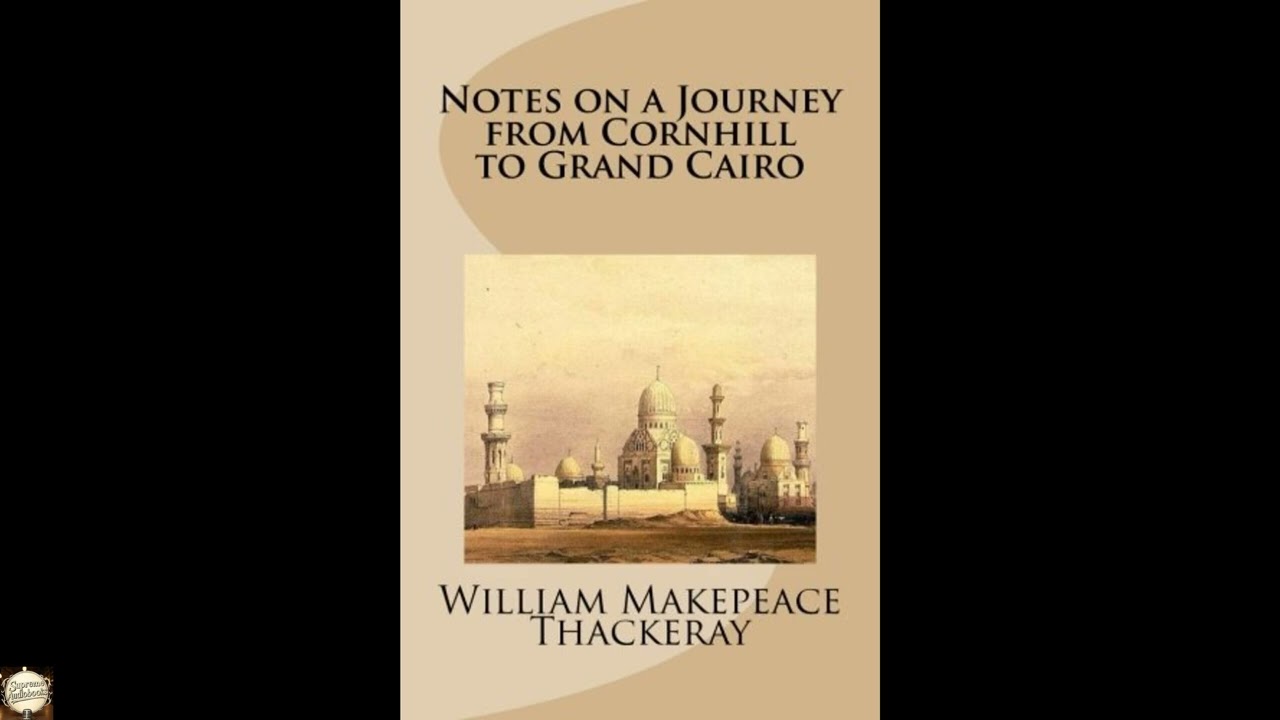
Notes on a Journey from Cornhill to Grand Cairo
Imagine a Victorian gentleman, weary of London’s fog and social rituals, setting off not on a grand, world-changing expedition, but a rather ordinary Mediterranean cruise. That’s the premise behind William Makepeace Thackeray’s delightful and surprisingly modern travelogue, Notes from Cornhill to Grand Cairo. This isn't just a record of sights seen; it’s a brilliant, often satirical, look at the very act of seeing, filtering foreign lands through the distinct lens of nineteenth-century British sensibility. Why listen today? Because Thackeray’s wry observations on culture clash, the absurdities of tourism, and the universal human desire to both experience and judge the world beyond one's doorstep are as piercingly relevant now as they were nearly two centuries ago. It’s a book that invites you not merely to visit the past, but to laugh with it. The story begins, as the title suggests, in the heart of London commerce, Cornhill, where our narrator—Thackeray himself, thinly veiled—decides to join a steamer excursion. His route takes him first across France and through Italy, offering glimpses of Marseilles and Genoa, before venturing across the azure expanse of the Mediterranean. He pauses in Athens, marveling at its ancient ruins, then sails onward to Constantinople, the bustling capital of the Ottoman Empire, where he witnesses its mosques, bazaars, and diverse populace with a mixture of wonder and characteristic English skepticism. From the splendors of Turkey, the steamship presses further south, leading the traveler to Egypt. Here, he navigates the bustling streets of Alexandria and Cairo, confronts the timeless mystery of the Pyramids and the Sphinx, and reflects on the stark differences between Eastern and Western life. The final leg of his outward passage brings him to the Holy Land, where he grapples with the weight of religious history and the commercial realities that even then surrounded sacred sites. Throughout this meandering progress, the central arc isn't a dramatic external conflict, but the steady stream of the narrator's witty observations, his discomforts, his small joys, and his often-humorous attempts to reconcile the exotic with his very British expectations, offering a vivid portrait of a particular type of traveler and his world. William Makepeace Thackeray, born in Calcutta, India, in 1811 to British parents, was sent to England for his education, a common practice for children of colonial administrators. He attended Charterhouse School and later Trinity College, Cambridge, though he left without earning a degree. His early adult life was marked by financial instability; he lost an inheritance through bad investments and gambling, which compelled him to earn his living through journalism, drawing, and writing. He honed his sharp satirical skills contributing to periodicals like Fraser's Magazine and Punch, often illustrating his own articles with distinct, expressive caricatures. A personal tragedy struck in the late 1840s when his wife suffered from a severe mental illness, leaving him to raise their two daughters. It was in the mid-1840s that Thackeray’s literary star began its ascent, largely with the serialized publication of Vanity Fair (1847-1848), subtitled "A Novel Without a Hero." This expansive work, an unsparing satire of English society, cemented his reputation as a major Victorian novelist, often placing him in friendly, yet distinct, rivalry with Charles Dickens. He followed this success with other significant works, including The History of Henry Esmond (1852), a historical novel admired for its elegant prose and period detail, and The Virginians (1857-1859), a sequel to his earlier novel The History of Pendennis. Thackeray’s place in the literary canon is that of a keen social commentator, a realist who critiqued the pretenses and hypocrisy of his age with a wit that could be both cutting and deeply humane. He passed away in 1863, leaving behind a legacy of novels and essays that continue to illuminate the complexities of the human condition in Victorian England and beyond. One prominent theme within Notes from Cornhill to Grand Cairo is the fascinating dynamic of cultural encounter. Thackeray’s descriptions of the various peoples he meets—Turks, Greeks, Egyptians—often reveal a blend of genuine curiosity and the ingrained prejudices of his time. For instance, he might comment on the "picturesque" attire of an Egyptian street vendor, yet simultaneously express a typical Victorian dismay at what he perceives as a lack of industriousness. This double-edged observation provides a window into the prevailing "Orientalist" perspective of the era, where the East was viewed through a romanticized, often condescending, Western lens. Another significant theme is the sheer absurdity of organized tourism. Thackeray frequently pokes fun at his fellow passengers, a motley collection of English gentry, scholars, and thrill-seekers, all rushing from one ancient ruin to the next, checklist in hand. He recounts instances of tourists haggling for souvenirs, complaining about unfamiliar food, or struggling to maintain their British decorum in bewildering new environments, highlighting the disconnect between the grandeur of historical sites and the often-petty concerns of the modern traveler. Beyond these external observations, the book also serves as a subtle, self-deprecating satire of Victorian society itself. By presenting a caricature of the English abroad—often uncomfortable, opinionated, and clinging to their comforts—Thackeray implicitly critiques the broader cultural assumptions of his homeland. His own voice, which weaves throughout the narrative, is a key element, offering a constant, often humorous, commentary on his own reactions and prejudices. The text becomes as much a portrait of the traveler's inner world as it is of the external places he visits, demonstrating how subjective experience shapes perception. Thackeray published Notes from Cornhill to Grand Cairo in 1846, squarely in the middle of the Victorian era, a period of immense social change and imperial expansion for Great Britain. Culturally, there was a growing public fascination with the Near East, fueled by archaeological discoveries, military campaigns (like Napoleon’s earlier Egyptian expedition), and the burgeoning travel industry. Steamship technology was making trips across the Mediterranean increasingly accessible, transforming the arduous "Grand Tour" into something more akin to a modern cruise, albeit still largely the preserve of the affluent. The book emerged at a time when travel writing was a popular and profitable genre, offering readers both entertainment and a vicarious experience of faraway lands. It resonated with a public keen to understand—and often confirm existing biases about—the exotic cultures at the fringes of the expanding British Empire, making Thackeray’s personal, witty account a timely and welcome contribution. Listening to Notes from Cornhill to Grand Cairo as an audiobook brings Thackeray’s distinctive voice directly to the forefront. This is a work primarily driven by personality and observation, making it a perfect fit for a skilled narrator who can embody the author’s dry wit, his moments of awe, and his occasional grumbles. Over the course of its several hours of listening time, you can truly sink into the rhythms of Thackeray’s prose, allowing his careful descriptions of landscapes, bustling street scenes, and eccentric characters to paint vivid pictures in your mind. A good narrator will highlight the subtle ironies in his dialogue, whether he’s musing on the nature of history or lamenting the discomforts of a foreign bed, ensuring that the atmosphere of mid-19th-century travel and the specific charm of Thackeray’s outlook are fully appreciated. It’s like having a learned, amusing companion recount his adventures to you, making it an ideal listen for moments of quiet reflection or as a diverting backdrop to your daily routines.
Enjoyed Notes on a Journey from Cornhill to Grand Cairo? A few ways to support us
Audible & Amazon links are affiliate; we may earn a small commission at no extra cost.
About this production
Human narration by a volunteer reader from LibriVox.org, the public-domain audiobook project. LibriVox volunteers record literary works whose copyright has expired in the United States, releasing the resulting recordings into the public domain.
Notes on a Journey from Cornhill to Grand Cairo by William Makepeace Thackeray. The underlying text is in the U.S. public domain. We do not republish any modern copyrighted edition, translation, or commentary.
The 4K cinematic visuals accompanying this audiobook are generated by an AI image model from prompts derived from the source text. No copyrighted photos, paintings, or stock footage are used. AI generation is disclosed on every video on our YouTube channel as required by YouTube's altered/synthetic content policy.
English subtitles are transcribed from the LibriVox recording with OpenAI Whisper. Translations into the 11 other supported languages are produced by Meta's NLLB-200 neural translation model. No human translator's copyrighted translation is used.
Questions about sourcing or rights? See our DMCA & Sourcing policy or contact us.
Enjoyed this audiobook?
If you'd like to own a copy of Notes on a Journey from Cornhill to Grand Cairo or hear a professionally produced edition, the links below help support free audiobook production at no extra cost to you.
As an Amazon Associate we earn from qualifying purchases. Audible / print links are affiliate.