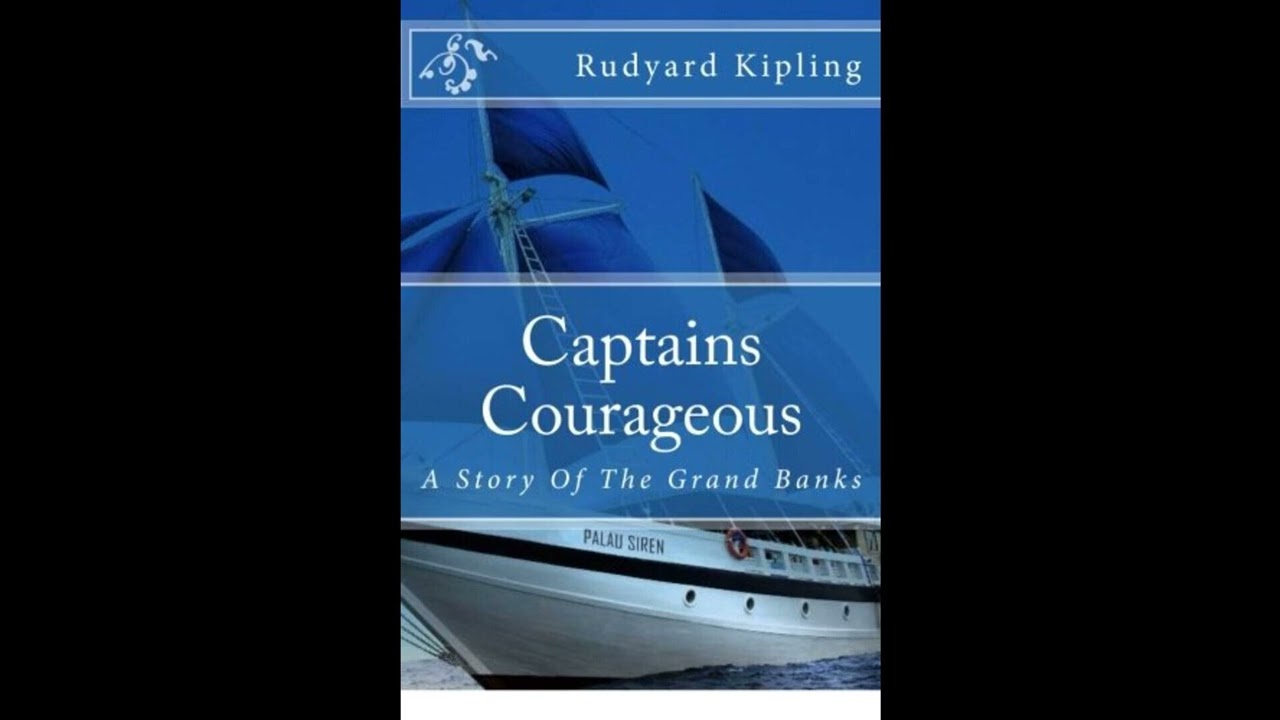
Captains Courageous: A Story Of The Grand Banks
Step onto the rolling decks of a Grand Banks fishing schooner, where the Atlantic heaves and groans, and the salt spray bites at your face. Rudyard Kipling's Captains Courageous is a bracing story of adventure, survival, and a spoiled boy's dramatic coming-of-age, one that rips him from a life of pampered luxury and thrusts him into the harsh, honest world of manual labor and brotherhood at sea. It's a gripping tale that speaks powerfully to anyone who has ever felt out of their depth, reminding us that true character is often forged not in comfort, but in the crucible of challenge and genuine effort. For today's listener, this classic narrative offers a profound meditation on privilege, responsibility, and the unexpected paths to self-discovery, proving that lessons learned the hard way often stick the best. The story begins with Harvey Cheyne, the fifteen-year-old son of an American railroad magnate. Traveling first-class across the Atlantic on a luxurious ocean liner, Harvey is every inch the overindulged heir: arrogant, dismissive, and utterly disconnected from the realities of the working world. His life is one of private tutors, lavish meals, and unquestioning obedience from servants. However, this privileged existence is abruptly shattered when, during a moment of seasickness and smoking a forbidden cigar, he falls overboard in the dense fog of the North Atlantic. Adrift and alone, his cries for help are answered by the unlikely appearance of a fishing dory, and he is pulled from the frigid waters by the crew of the We're Here, a Gloucester schooner on a cod-fishing run in the Grand Banks. Rescued but far from home, Harvey quickly finds his accustomed charm and demands hold no sway with Captain Disko Troop or his rough-hewn crew. His tales of immense wealth are met with amused skepticism, and his attempts to buy his way off the boat are rebuffed. Troop, a man of profound practicality and a strict moral compass, gives Harvey a choice: work his passage for the three months remaining in the fishing season, or face being set ashore at the nearest port, penniless. With no other option, Harvey is initiated into the brutal rhythms of deep-sea fishing. Under the stern guidance of the captain and the surprising camaraderie of Troop's son, Dan, Harvey gradually sheds his indolence and arrogance, learning to bait hooks, clean fish, and handle the lines with the diligence demanded by the unforgiving sea. The story follows his slow but sure transformation, charting his growth from a useless burden to an indispensable member of the crew, earning respect not through his father's money, but through the sweat of his own brow. Rudyard Kipling, the author, was born in Bombay (now Mumbai), India, in 1865, to English parents. His early life was marked by a profound sense of displacement and belonging, themes that often echo through his narratives. At the age of five, he was sent to England for schooling, an experience of loneliness and harsh discipline that deeply influenced his perspective on authority and the formation of character, later reflected in semi-autobiographical works like Stalky & Co. Returning to India as a young man, Kipling became a journalist and rapidly gained fame for his vivid short stories and poems that captured the sights, sounds, and social complexities of colonial India. Kipling's literary star rose quickly, making him one of the most popular writers in the English-speaking world by the turn of the century. His extensive travels across Asia, America—including a period living in Vermont—and South Africa provided him with a vast canvas for his storytelling. He wrote enduring classics such as The Jungle Book, with its tales of Mowgli and the animal kingdom, and the espionage novel Kim, set against the backdrop of the Great Game in colonial India. In 1907, he was awarded the Nobel Prize in Literature, making him the first English-language writer to receive the honor and, at 41, its youngest recipient to date. Though his work sometimes reflected the imperialistic attitudes of his era, his profound narrative skill, his keen observation of human nature, and his powerful command of language have ensured his lasting place in the literary canon. He died in 1936 in England. At its core, Captains Courageous presents a powerful argument for the transformative power of hard work and self-reliance. Harvey's initial disdain for the laboring class quickly dissolves as he learns the intricate skills and immense physical demands of deep-sea fishing. We witness him, for example, struggling to bait a thousand-hook trawling line, his soft hands blistering, only to eventually master the task, gaining a deep, earned satisfaction he never knew from his inherited wealth. This theme of "education through adversity" is central, showing how genuine competence and respect are forged through struggle, not bestowed by birthright. Another significant theme woven throughout the narrative is the stark contrast and eventual bridging of social classes. Harvey's millionaire background is utterly meaningless on the We're Here; his money cannot buy food, comfort, or passage home. Instead, he must earn his place alongside men like Captain Disko, a shrewd and honorable fisherman whose wisdom is born of direct experience with the sea, not formal schooling. This leveling effect of nature – specifically the perilous environment of the Grand Banks – underscores how shared hardship can break down artificial social barriers, revealing the inherent dignity and value in every individual, regardless of their station. The book celebrates practical skill, camaraderie, and the unwritten laws of the sea as truly binding forces. When Captains Courageous was published in 1897, the world was on the cusp of a new century, experiencing rapid industrialization and profound social shifts. The United States, in particular, was seeing the rise of vast fortunes alongside growing anxieties about the social impact of unchecked capitalism and the perceived moral decay of the leisure class. Kipling's story emerged at a time when traditional trades and maritime life, while still vital, were slowly being overshadowed by the machinery of the modern age. The book captures a specific moment in American maritime history, preserving the vivid details of the Gloucester fishing industry, a demanding way of life that required immense courage, skill, and communal reliance. Kipling's own fascination with different forms of work and the "men who do things" aligns perfectly with the story's emphasis on practical knowledge and earned respect over inherited privilege. Listening to Captains Courageous as an audiobook offers a uniquely immersive way to experience this powerful narrative. The rhythmic sweep of the ocean, the creak of the schooner, and the shouted commands of the crew come alive through a skilled narrator's voice, transporting you directly onto the deck of the We're Here. The diverse accents and salty dialect of the fishermen become distinct and memorable, adding texture and authenticity to the exchanges between Harvey and his newfound companions, particularly the steady, guiding presence of Dan. With its several hours of compelling storytelling, this production provides a sustained and engaging escape, perfect for long drives, quiet evenings, or any time you wish to lose yourself in a tale of transformation and adventure where the roar of the sea is as much a character as any man on board.
Enjoyed Captains Courageous: A Story Of The Grand Banks? A few ways to support us
Audible & Amazon links are affiliate; we may earn a small commission at no extra cost.
About this production
Human narration by a volunteer reader from LibriVox.org, the public-domain audiobook project. LibriVox volunteers record literary works whose copyright has expired in the United States, releasing the resulting recordings into the public domain.
Captains Courageous: A Story Of The Grand Banks by Rudyard Kipling. The underlying text is in the U.S. public domain. We do not republish any modern copyrighted edition, translation, or commentary.
The 4K cinematic visuals accompanying this audiobook are generated by an AI image model from prompts derived from the source text. No copyrighted photos, paintings, or stock footage are used. AI generation is disclosed on every video on our YouTube channel as required by YouTube's altered/synthetic content policy.
English subtitles are transcribed from the LibriVox recording with OpenAI Whisper. Translations into the 11 other supported languages are produced by Meta's NLLB-200 neural translation model. No human translator's copyrighted translation is used.
Questions about sourcing or rights? See our DMCA & Sourcing policy or contact us.
Enjoyed this audiobook?
If you'd like to own a copy of Captains Courageous: A Story Of The Grand Banks or hear a professionally produced edition, the links below help support free audiobook production at no extra cost to you.
As an Amazon Associate we earn from qualifying purchases. Audible / print links are affiliate.