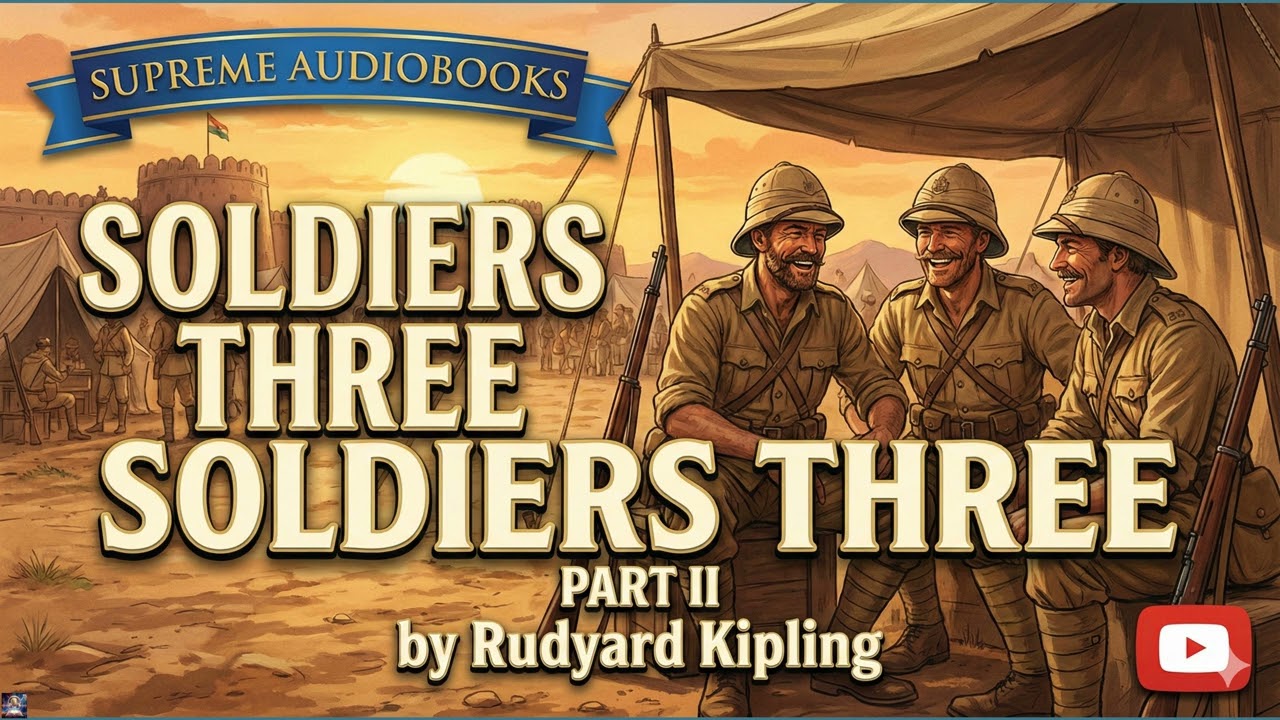
Soldiers Three Part II
Step into the sun-drenched, dust-choked world of the British Raj with Soldiers Three Part II, a collection that breathes new life into Rudyard Kipling's unforgettable trio of private soldiers. These are not merely tales of empire and distant lands; they are vivid portraits of enduring human nature, of camaraderie forged in hardship, and of the unique spirit of individuals often overlooked by history. Kipling's remarkable skill at crafting compelling characters and sharp dialogue ensures that even today, listeners will find themselves drawn into the lively, sometimes poignant, always entertaining escapades of Mulvaney, Ortheris, and Learoyd. This is essential listening for anyone who appreciates a good story well told, a window into a pivotal historical era, and the universal bonds that tie men together against the odds. The setting for these continued adventures is India in the closing decades of the nineteenth century, a period when the British Empire held sway over vast territories. We find ourselves transported to dusty cantonments, remote outposts, and the bustling barracks where the Queen's soldiers live out their days. The central figures are three privates from different corners of the United Kingdom, bound by their shared military life and an unbreakable friendship: Terence Mulvaney, the eloquent, quick-witted Irishman with a penchant for drink and grand storytelling; Stanley Ortheris, the sharp-tongued, quick-footed Cockney from London; and John Learoyd, the stoic, brawny Yorkshireman, dependable and quietly observing. Together, they navigate the mundane routines and unexpected dangers of service abroad. Each story within this collection offers a distinct glimpse into their lives, often narrated by Mulvaney himself, whose rich brogue and imaginative flair lend a unique perspective to their shared experiences. From minor skirmishes with local tribes and encounters with formidable military officers to romantic entanglements and attempts to outwit their superiors, the central conflict often lies in the friction between military discipline and the soldiers' innate human desires. These are not grand battles, but the everyday struggles of men trying to make their way in a foreign land under strict rules, all while maintaining their individuality, their sense of humor, and their unshakeable loyalty to one another. The stories paint a broad picture of their day-to-day existence, showcasing their resilience and the unique blend of pragmatism and poetry that defines their collective spirit, without revealing the specific outcome of their many predicaments. The author, Rudyard Kipling, born in Bombay (now Mumbai), India, in 1865, had an extraordinary life that deeply informed his literary output. Sent to England for schooling at a young age, a period he later described with some bitterness, he returned to India in 1882 to work as a journalist. It was during these years that he began writing the short stories that would make him famous, many of which were collected in Plain Tales from the Hills. Kipling's intimate understanding of both Indian culture and the lives of the British expatriates and soldiers stationed there gave his writing an authenticity that was rare for his time. He became an international sensation, celebrated for his storytelling prowess and his acute observations of human character. Kipling's fame grew rapidly, leading him to live in various places including London and Vermont, United States, before settling back in England. He received the Nobel Prize in Literature in 1907, becoming the first English-language writer to be so honored. His extensive body of work includes beloved children's books like The Jungle Book and Kim, powerful poetry such as "If—", and numerous other short story collections and novels. Though his legacy has been debated over time due to his association with British imperialism, his command of language, narrative structure, and his ability to create memorable characters remain undeniably powerful, securing his place as one of the most significant figures in English literature, especially recognized for his mastery of the short story form. He passed away in 1936. A central thread woven through Soldiers Three Part II is the powerful theme of camaraderie and the bond of brotherhood. Despite their different backgrounds – the Cockney, the Irishman, the Yorkshireman – Mulvaney, Ortheris, and Learoyd share an unspoken understanding and a fierce loyalty. We see this enacted time and again, whether they are defending each other against a harsh sergeant, pooling their meager resources for a shared pleasure, or simply offering a sympathetic ear during moments of personal distress. Their friendship is the bedrock of their survival and sanity in an often-unforgiving environment, demonstrating how shared experience and mutual respect can transcend class and cultural divides to form an enduring human connection. Another significant theme is storytelling itself, with Mulvaney serving as the primary conduit for many of the anecdotes. His ability to spin a yarn, often embellished for dramatic effect, highlights the power of narrative to shape perception, to entertain, and to pass on wisdom and experience within a close-knit group. The book also addresses the complexities of colonialism and the British Empire from the perspective of the common soldier. Kipling subtly reveals the absurdities, injustices, and often harsh realities of imperial rule, not through overt political statements, but through the daily grind and limited understanding of the private soldiers. They are both agents and subjects of the empire, dealing with its strictures and occasionally its moral compromises, while simply trying to survive. One example might be their interactions with local populations, sometimes marked by cultural misunderstanding, sometimes by a surprising degree of mutual respect, showing the nuances of life under the Raj beyond simplistic interpretations. The author presents the empire as a lived experience rather than an abstract concept, showcasing its impact on individuals caught within its machinery. These stories emerged during a remarkable period in history, the late nineteenth century, when the British Empire was at its height, and India was indeed considered the "Jewel in the Crown." Victorian society in Britain was rigidly structured, but for the common soldier serving overseas, many of these conventions blurred or broke down under the unique pressures of military life in a foreign land. The literary world of the time was seeing a rise in realism, a move away from purely romantic ideals towards more grounded, often grittier depictions of life. Kipling, with his firsthand experience of India and the military, was perfectly positioned to give voice to the Anglo-Indian experience, particularly that of the rank-and-file soldier, a segment of society rarely featured with such intimate detail and individual characterization in serious literature. His writing helped to define the burgeoning genre of imperial adventure stories while simultaneously offering a keen, often critical, look at the human cost and complexity of empire. Listening to Soldiers Three Part II as an audiobook offers a uniquely immersive way to experience Kipling's masterful prose. The oral tradition inherent in Mulvaney's storytelling, and indeed in much of Kipling's work, truly comes alive when read aloud. A skilled narrator can bring out the distinct accents and personalities of the three soldiers – Mulvaney's lyrical Irish cadences, Ortheris's sharp Cockney wit, and Learoyd's steady Yorkshire tones – allowing the listener to fully appreciate their banter, their arguments, and their heartfelt confessions. With a run length of several hours, these stories are ideal for extended listening sessions, whether you are on a long drive, tending to tasks around the house, or simply settling in for an evening of engaging literature. The pacing of the narration, the subtle shifts in voice, and the atmospheric details will transport you directly into the barracks and sun-baked landscapes of British India, allowing the humor, pathos, and enduring spirit of Kipling's "Soldiers Three" to resonate long after the final words.
Enjoyed Soldiers Three Part II? A few ways to support us
Audible & Amazon links are affiliate; we may earn a small commission at no extra cost.
About this production
Human narration by a volunteer reader from LibriVox.org, the public-domain audiobook project. LibriVox volunteers record literary works whose copyright has expired in the United States, releasing the resulting recordings into the public domain.
Soldiers Three Part II by Rudyard Kipling. The underlying text is in the U.S. public domain. We do not republish any modern copyrighted edition, translation, or commentary.
The 4K cinematic visuals accompanying this audiobook are generated by an AI image model from prompts derived from the source text. No copyrighted photos, paintings, or stock footage are used. AI generation is disclosed on every video on our YouTube channel as required by YouTube's altered/synthetic content policy.
English subtitles are transcribed from the LibriVox recording with OpenAI Whisper. Translations into the 11 other supported languages are produced by Meta's NLLB-200 neural translation model. No human translator's copyrighted translation is used.
Questions about sourcing or rights? See our DMCA & Sourcing policy or contact us.
Enjoyed this audiobook?
If you'd like to own a copy of Soldiers Three Part II or hear a professionally produced edition, the links below help support free audiobook production at no extra cost to you.
As an Amazon Associate we earn from qualifying purchases. Audible / print links are affiliate.