Two Tales about Aviation
Imagine a world where the skies are not merely a domain for birds, but a carefully charted highway of human endeavor, traversed by colossal airships linking continents with unerring precision. This isn’t a recent sci-fi blockbuster, but the visionary landscape crafted by Rudyard Kipling in his prescient collection, Two Tales about Aviation. Published at the very dawn of powered flight, these stories invite us into a future where humanity has conquered the air, not just as a feat of engineering, but as a system of global governance and social order. To listen to these narratives today is to witness an extraordinary mind grappling with the promise and peril of technological advancement, offering a perspective that remains startlingly relevant in our own age of rapid change and interconnectedness. Kipling’s tales are more than predictions; they are profound meditations on control, freedom, and the enduring human spirit against a backdrop of breathtaking innovation. The first of these remarkable narratives, "With the Night Mail," transports us to the year 2000, aboard a transatlantic airship. We join the crew and passengers of Postal Packet 162 as it navigates the highly regulated airways, under the watchful eye of the Aerial Board of Control, or ABC. Kipling meticulously details the mechanics of flight, the complex weather systems, and the strict protocols governing every aspect of air travel. There is no central conflict in the traditional sense; instead, the story functions as an immersive experience, a guided tour through a future where humanity has achieved a kind of technological utopia, but one rigidly maintained by an unseen, all-powerful authority. The tension comes from the sheer scale of the operation, the constant vigilance required, and the subtle implication that while the world has shrunk, the sense of individual agency might have diminished. We witness the precision, the efficiency, and the almost spiritual dedication of those who run this global network. Building upon this foundation, the second tale, "As Easy As A.B.C.," jumps ahead another sixty-five years to 2065. Here, the Aerial Board of Control has evolved into the de facto world government, having long since taken over the management of all global affairs. The story centers on a small team of ABC agents dispatched to the province of Chicago, where a localized rebellion—fueled by a longing for what the citizens call "liberty" and "spontaneity"—threatens the perfect order established by the Board. The conflict emerges from the clash between the ABC's benevolent but absolute control, which ensures peace and prosperity by suppressing large gatherings and strong emotions, and the inherent human desire for freedom and self-expression. The agents, armed with advanced technology and an unshakeable belief in their system, must diffuse the situation without resorting to overt force, showcasing Kipling’s vision of a future where order is paramount, even if it comes at a societal cost. Rudyard Kipling, born in Bombay (now Mumbai), British India, in 1865, possessed a life story as colorful and impactful as his fiction. Sent to England for schooling at a young age, he later returned to India as a journalist, where his observations of colonial life and Indian culture profoundly shaped his early works. His initial collections of short stories and poems, like Plain Tales from the Hills and Departmental Ditties, quickly brought him fame for their vivid characters and keen insights into the British Raj. Later, after marrying an American woman, Caroline Balestier, he lived for several years in Vermont, a period during which he penned some of his most beloved children's stories, including The Jungle Book and Captains Courageous. Kipling's prolific output spanned novels such as Kim, one of his most celebrated works, and countless poems, among them "If—" and "Gunga Din," which cemented his place in the literary canon. He was awarded the Nobel Prize in Literature in 1907, becoming the first English-language author to receive the honor. Though often associated with British imperialism—a complex and frequently debated aspect of his legacy—Kipling's literary skill lay in his masterful prose, his ear for dialect, and his ability to conjure entire worlds with precise, evocative language. He died in England in 1936, leaving behind an oeuvre that continues to provoke discussion and admiration for its imaginative power and storytelling artistry. These aviation tales enact several profound themes. Primarily, they concern technological progress and its societal impact. Kipling doesn't just present airships; he meticulously outlines how they reshape global politics, commerce, and daily life. In "With the Night Mail," the detailed description of aerial traffic lanes, meteorological controls, and the specialized language of air-crew demonstrates how new technology creates entirely new industries and professions. The intricate system of fines and regulations enforced by the ABC highlights how societies adapt to manage the power and potential dangers of such advancements. The sky, once a symbol of wild freedom, becomes a highly regulated domain, illustrating how human ingenuity can both liberate and constrain. Another central theme is the perennial conflict between order and individual freedom. The Aerial Board of Control represents a world where absolute order has been achieved, eliminating war, famine, and even significant social unrest. However, this order comes at a cost. In "As Easy As A.B.C.," the citizens of Chicago chafe under rules that prevent spontaneous gatherings, loud expressions of emotion, and any disruption to the Board's meticulous global management. The uprising, though seemingly minor, underscores humanity's inherent need for self-determination and the potential for discontent even in a perfectly optimized society. Kipling suggests that while efficiency and peace are desirable, a world stripped of passion and unpredictability might also lose something essential to the human experience. The stories also touch on global governance and the concept of a powerful, benevolent authority shaping human destiny, a precursor to many later speculative fictions. Kipling penned "With the Night Mail" in 1905 and its sequel, "As Easy As A.B.C.," in 1912. This period was a crucible of change, particularly in the realm of technology. The Wright Brothers had achieved their first successful powered flight just two years before the first story was published, in 1903. The public imagination was utterly captivated by the nascent possibilities of aviation, with pioneers pushing the boundaries of flight daily. Zeppelin airships, though still cumbersome, were symbols of future travel and luxury. This was a time of burgeoning industrialization, global empires, and increasing interconnectedness through steamships, railways, and telegraphs. Kipling, a keen observer of human nature and progress, was uniquely positioned to extrapolate from these early developments. He envisioned not just the machines themselves, but the profound social, political, and cultural shifts they would instigate, creating a future that was both marvelous and somewhat disquieting. His tales emerged from an era intoxicated by progress, yet also wary of its implications, capturing both the utopian dreams and the subtle anxieties of the early twentieth century. Listening to Two Tales about Aviation as an audiobook offers a unique gateway into Kipling's visionary mind. A skilled narrator can bring to life the rhythmic, almost hypnotic cadence of Kipling's prose, particularly in "With the Night Mail," where the detailed descriptions of airship operations and meteorological phenomena demand a voice that conveys both scientific precision and a sense of wonder. The subtle shift in tone between the awe-struck observation of the first tale and the more politically charged dialogue of the second can be beautifully modulated, allowing the listener to fully appreciate the evolution of Kipling's imagined future. The run length of several hours makes this an ideal companion for a long commute, a contemplative afternoon, or any occasion where you wish to immerse yourself in a world both familiar and startlingly new. Focus on the deliberate pacing, the distinct voices of the airship crew and the ABC agents, and how the atmosphere transitions from pure technological marvel to a nuanced commentary on human nature. It's an opportunity to hear Kipling's future unfold, word by careful word, just as he might have heard it in his own imagination.
Enjoyed Two Tales about Aviation? A few ways to support us
Audible & Amazon links are affiliate; we may earn a small commission at no extra cost.
About this production
Human narration by a volunteer reader from LibriVox.org, the public-domain audiobook project. LibriVox volunteers record literary works whose copyright has expired in the United States, releasing the resulting recordings into the public domain.
Two Tales about Aviation by Rudyard Kipling. The underlying text is in the U.S. public domain. We do not republish any modern copyrighted edition, translation, or commentary.
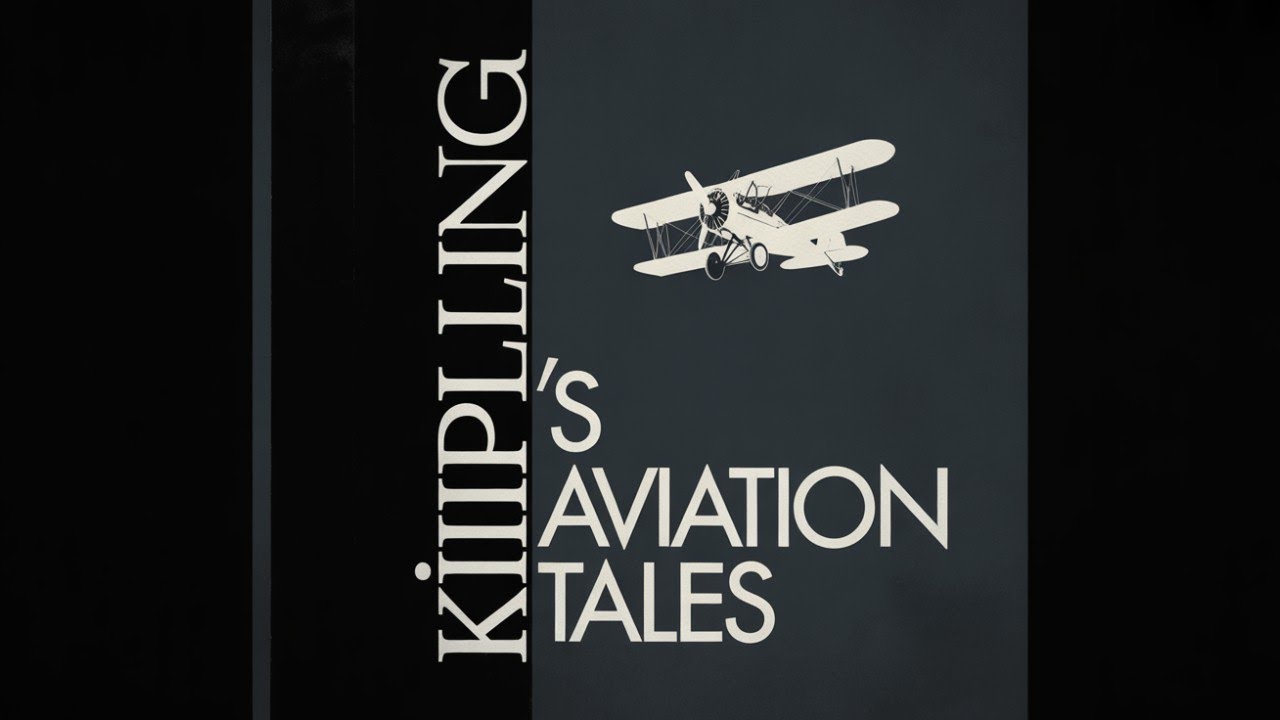
The 4K cinematic visuals accompanying this audiobook are generated by an AI image model from prompts derived from the source text. No copyrighted photos, paintings, or stock footage are used. AI generation is disclosed on every video on our YouTube channel as required by YouTube's altered/synthetic content policy.
English subtitles are transcribed from the LibriVox recording with OpenAI Whisper. Translations into the 11 other supported languages are produced by Meta's NLLB-200 neural translation model. No human translator's copyrighted translation is used.
Questions about sourcing or rights? See our DMCA & Sourcing policy or contact us.
Enjoyed this audiobook?
If you'd like to own a copy of Two Tales about Aviation or hear a professionally produced edition, the links below help support free audiobook production at no extra cost to you.
As an Amazon Associate we earn from qualifying purchases. Audible / print links are affiliate.