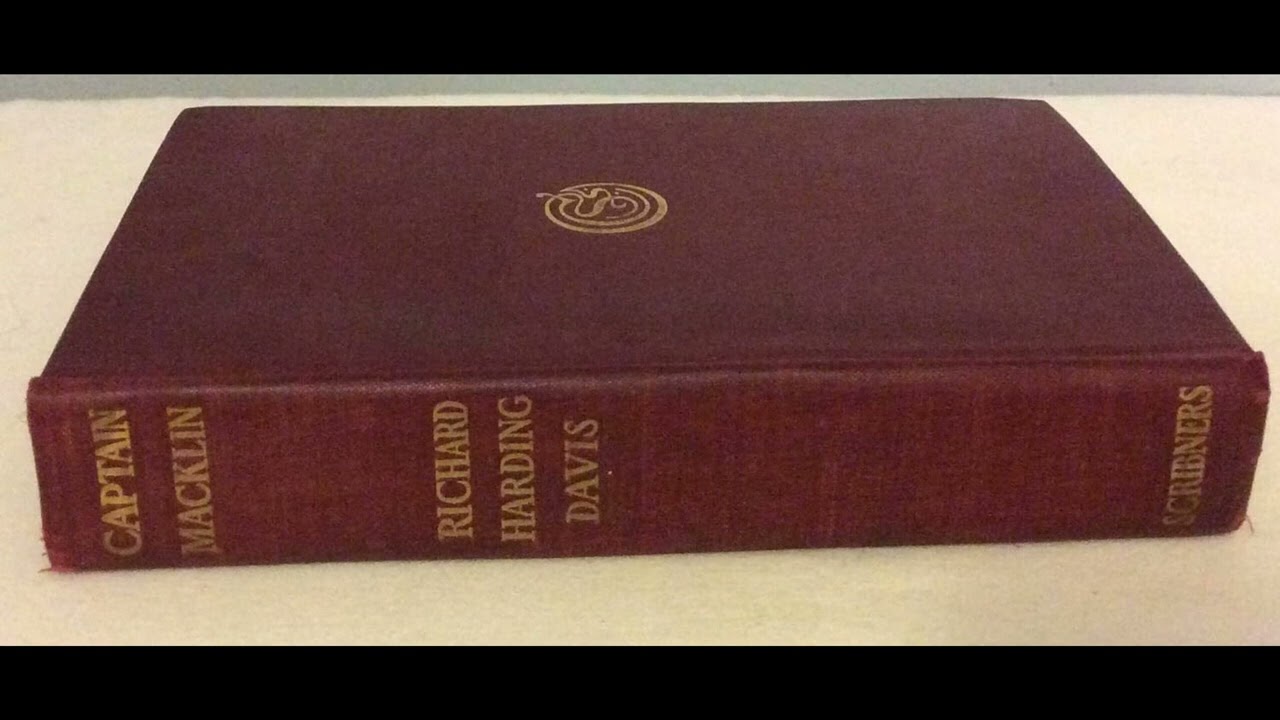
Captain Macklin His Memoirs
Step into a world where youthful idealism collides head-on with the messy realities of power, where the grand pronouncements of honor echo against the squalid backdrop of political intrigue. Richard Harding Davis’s Captain Macklin His Memoirs transports listeners to the cusp of the twentieth century, a period brimming with romantic notions of military glory and national adventure, yet one also shadowed by the grimmer truths of conflict. This story offers more than just a thrilling ride through distant battlefields; it provides a piercing look at the formation of character, the education of a young man caught between his inherited code of conduct and the morally ambiguous choices demanded by the real world. For anyone who has ever dreamed of a life of purpose, or wondered at the true cost of principle, Royal Macklin’s earnest, often deluded, and ultimately revealing account continues to resonate with stark relevance today. The memoirs introduce us to Royal Macklin, a young American of impeccable lineage and an unwavering devotion to the military code he has absorbed since childhood. Orphaned and raised with a strong sense of duty, Macklin’s destiny seems clear: a distinguished career in the armed forces. However, a moment of principled defiance at a prestigious military academy leads to his expulsion, shattering his carefully constructed future. Undeterred, and with an almost anachronistic belief in chivalry, Macklin resolves to find a cause worthy of his talents and his rigorous training, determined to prove his worth despite the setback. He is not merely seeking a job; he is seeking a stage upon which to enact his heroic ideals, to live up to the grand traditions he holds dear. His quest soon leads him to the tumultuous, fictional Central American republic of Olancho, a hotbed of perpetual revolutions and political instability. Here, Macklin, with his disciplined bearing and impressive military knowledge, quickly finds himself drawn into a burgeoning coup d'état. He serves as an aide-de-camp to a charismatic revolutionary leader, hoping to restore a deposed president he believes to be legitimate. The unfolding events throw Macklin into a whirlwind of clandestine meetings, daring maneuvers, and the visceral reality of armed conflict. He grapples with the complexities of loyalty, the motivations of his fellow combatants, and the gap between his romanticized vision of war and the harsh, often inglorious truth of what unfolds on the ground. Richard Harding Davis, the author of these compelling memoirs, was an iconic figure in American letters during the late nineteenth and early twentieth centuries. Born in Philadelphia in 1864, he was the son of noted journalist and writer L. Clarke Davis and Rebecca Harding Davis, a significant literary voice in her own right. Davis himself became a celebrated journalist, short story writer, novelist, and playwright, known for his adventurous spirit and his unparalleled ability to capture the drama of contemporary events. His career spanned an era of intense global change and American expansion, and he reported from the front lines of numerous conflicts, including the Greco-Turkish War, the Spanish-American War, the Second Boer War, and even the early stages of World War I. Davis's experiences as a war correspondent deeply informed his fiction, lending it an authenticity and immediacy that few of his contemporaries could match. He was more than a reporter; he was an interpreter of a new, rapidly shrinking world, chronicling events from Cuba to South Africa with a blend of journalistic rigor and narrative flair. His output included popular novels like Soldiers of Fortune and The Bar Sinister, and collections of short stories that often featured dashing heroes and exotic settings. Davis became a public personality, embodying a kind of muscular American idealism and resourcefulness that appealed strongly to the national mood of his time. He was, in many ways, the literary counterpart to Theodore Roosevelt’s "Rough Riders," blending adventurous action with a distinctly American brand of honor and ambition before his death in 1916. Captain Macklin His Memoirs masterfully engages with the powerful theme of idealism clashing with reality. Macklin, steeped in a rigid code of honor and chivalry, consistently confronts situations that defy his expectations. His belief in fair play and gentlemanly conduct is repeatedly tested by the ruthless pragmatism of revolutionary warfare, where political expediency often trumps moral rectitude. For instance, when Macklin witnesses the casual brutality of the mercenary soldiers or the cynical betrayals among the Olanchan factions, his inherited sense of military glory begins to fray, exposing the chasm between his upbringing and the realpolitik of the battlefield. Another central theme lies in the romanticization of war, a pervasive sentiment in the period Davis documented and critiqued. Macklin’s initial motivations are driven by a picturesque vision of battle and heroism, fueled by stories and traditions rather than direct experience. He cherishes the idea of the uniform, the drill, the disciplined maneuver, and the grand, decisive charge. However, the narrative subtly undermines these romantic notions by showing the gritty, often inglorious specifics of conflict: the discomfort, the fear, the confusion, and the ultimately messy business of seizing power. The book uses Macklin’s internal monologue to show the slow, painful process of disillusionment as he confronts the true nature of the violence he so eagerly sought. When Richard Harding Davis wrote Captain Macklin, the world stood on the brink of profound geopolitical shifts. The late 19th and early 20th centuries were characterized by American expansionism, the afterglow of the Spanish-American War, and a growing interest in international affairs. Publications like Scribner’s Magazine and Collier’s Weekly, where Davis’s work often appeared, fueled public fascination with adventure, empire, and military exploits in exotic locales. Davis himself was instrumental in shaping public perception of these events, his dispatches often presenting a romanticized, yet vivid, picture of conflict and foreign intrigue. The novel reflects this broader cultural context, tapping into a societal appetite for tales of derring-do in distant lands. It captures the spirit of a generation that saw military service as a noble calling, an opportunity for personal glory and national assertion, before the unprecedented horrors of the First World War would irrevocably alter such perceptions. Macklin’s story, therefore, becomes a lens through which to examine a specific moment in American history—a period of transition, where old-world ideals of honor were beginning to contend with the emerging complexities of modern warfare and global politics. The book emerges from a time when adventure was still often viewed through a relatively untarnished lens. Listening to Captain Macklin His Memoirs as an audiobook offers a unique gateway into the earnest, sometimes naive, yet always compelling mind of its protagonist. A skilled narrator brings Royal Macklin’s voice to life, conveying his youthful bravado, his unshakeable principles, and the subtle shifts in his understanding as he faces increasingly complex dilemmas. You hear the crisp formality of his early pronouncements and the growing weariness in his later reflections, capturing the nuanced emotional arc of his coming-of-age. The pacing of the narration can perfectly match the rhythm of Macklin’s adventures, from the meticulous descriptions of military drills to the quickening pulse of a sudden skirmish, or the tense quiet of political maneuvering. The distinctive dialogue, often formal and self-aware, provides texture to the various characters he encounters, from the cynical mercenaries to the fervent revolutionaries, enveloping you in the unique atmosphere of a bygone era and its grand, sometimes misguided, ambitions.
Enjoyed Captain Macklin His Memoirs? A few ways to support us
Audible & Amazon links are affiliate; we may earn a small commission at no extra cost.
About this production
Human narration by a volunteer reader from LibriVox.org, the public-domain audiobook project. LibriVox volunteers record literary works whose copyright has expired in the United States, releasing the resulting recordings into the public domain.
Captain Macklin His Memoirs by Richard Harding Davis. The underlying text is in the U.S. public domain. We do not republish any modern copyrighted edition, translation, or commentary.
The 4K cinematic visuals accompanying this audiobook are generated by an AI image model from prompts derived from the source text. No copyrighted photos, paintings, or stock footage are used. AI generation is disclosed on every video on our YouTube channel as required by YouTube's altered/synthetic content policy.
English subtitles are transcribed from the LibriVox recording with OpenAI Whisper. Translations into the 11 other supported languages are produced by Meta's NLLB-200 neural translation model. No human translator's copyrighted translation is used.
Questions about sourcing or rights? See our DMCA & Sourcing policy or contact us.
Enjoyed this audiobook?
If you'd like to own a copy of Captain Macklin His Memoirs or hear a professionally produced edition, the links below help support free audiobook production at no extra cost to you.
As an Amazon Associate we earn from qualifying purchases. Audible / print links are affiliate.