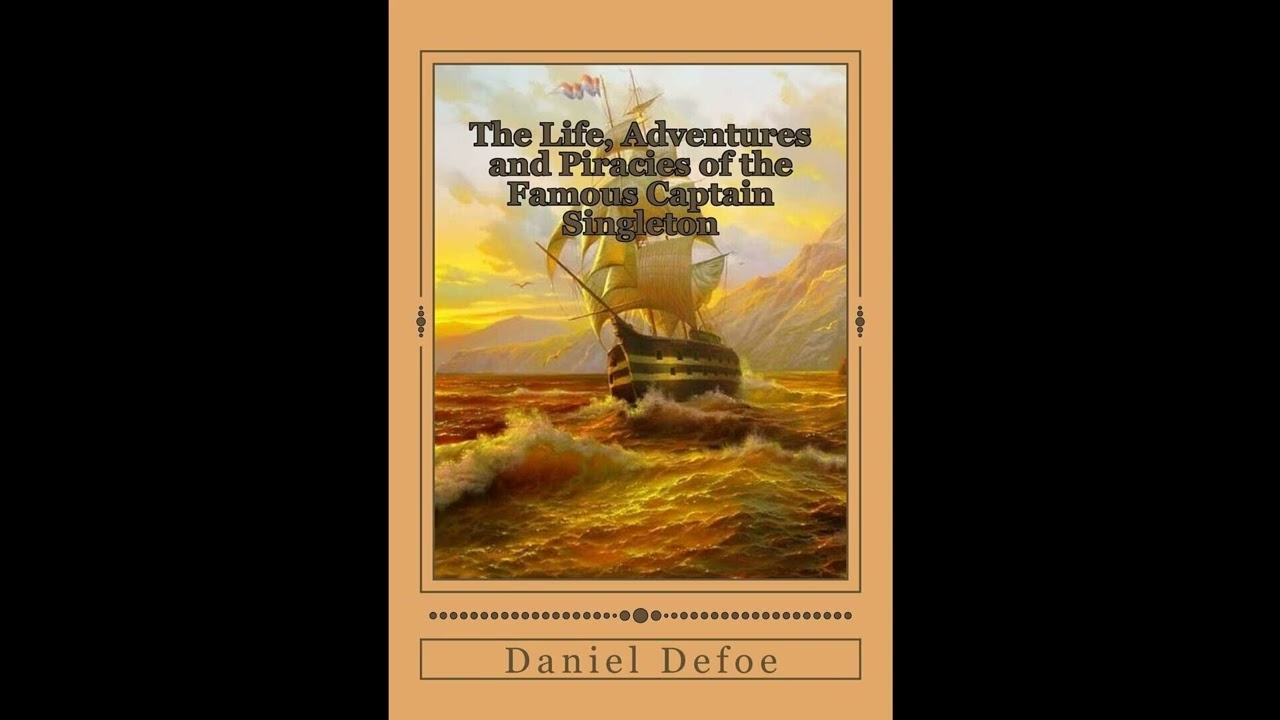
The Life, Adventures and Piracies of the Famous Captain Singleton
Step into a world of daring maritime escapades, unlikely transformations, and the complex morality of survival with Daniel Defoe's The Life, Adventures and Piracies of the Famous Captain Singleton. This gripping narrative, first published in 1720, casts a long shadow over the adventure genre, offering more than just tales of buried treasure and cutlass duels. It is a profound meditation on human nature, ambition, and the choices that define a person when removed from the strictures of society. What makes a man turn pirate? How does one forge a path in a lawless world? Defoe, with his characteristic psychological depth and unflinching realism, invites listeners to confront these questions through the eyes of a character who embodies the ultimate self-made man, albeit one operating far outside the law. His story remains a potent examination of reinvention and the blurred lines between legitimate commerce and outright criminality. The story begins in the stark reality of 17th-century London, where our protagonist, a nameless orphan, is cast out into the world. Raised by a poor woman and then apprenticed to a harsh master, the young boy's life is defined by hardship and an almost accidental drift into a life at sea. His first major turning point arrives aboard a merchant ship bound for the East Indies, where a mutiny erupts. Swept along by the current of events, he finds himself marooned on the island of Madagascar with the other mutineers. Rather than succumb to despair, this unforeseen exile sparks a remarkable overland trek across the vast, uncharted continent of Africa—a feat of endurance and ingenuity that showcases the protagonist's burgeoning resourcefulness and leadership. This incredible journey, filled with encounters with diverse native peoples and the relentless challenges of the wilderness, serves as a crucible, hardening him into the formidable figure who will eventually call himself Captain Singleton. Having navigated the perilous African interior and eventually secured passage back to civilization, Singleton finds himself unable to settle into an ordinary existence. The taste of freedom, the thrill of survival against overwhelming odds, and the promise of untold riches beckon him towards a life of piracy. He gathers a crew, obtains a ship, and quickly establishes himself as a feared and successful privateer, primarily operating in the lucrative waters of the Indian Ocean. His adventures involve spectacular hauls of treasure, cunning naval battles, and the difficult art of managing a motley crew of desperadoes. It is during this period that he forms a crucial partnership with William, an older, pragmatic Quaker who becomes Singleton's confidant and a surprising moral compass amidst their lawless endeavors. William’s influence introduces a nuanced dimension to their piratical enterprises, advocating for restraint and calculated cruelty over wanton violence, all while amassing an astonishing fortune. The narrative carefully follows their growing wealth and their increasing desire to find a way to escape their dangerous profession and return to an anonymous, respectable life in England. Daniel Defoe, born around 1660 in London, was a true polymath whose personal history rivaled the dramatic lives of his fictional characters. The son of a butcher, he initially trained for the Presbyterian ministry but instead turned to trade, journalism, and politics. His life was marked by incredible swings of fortune, including periods of prosperity as a merchant, imprisonment for political pamphleteering, and even standing in the pillory—an experience he famously satirized in his "Hymn to the Pillory." Despite these setbacks, Defoe’s resilience and sharp intellect never faltered. He served as a spy for the government, founded influential journals like The Review, and became a prolific writer across an astonishing range of subjects, from economics and religion to satire and social commentary. Defoe’s place in literary history is primarily secured by his groundbreaking contribution to the development of the English novel. Although he began writing fiction relatively late in life, his works are considered foundational texts of the genre. His most famous novel, Robinson Crusoe (1719), published just a year before Captain Singleton, is widely regarded as one of the first English novels. Other notable works such as Moll Flanders (1722) and A Journal of the Plague Year (1722) further cemented his reputation for realistic narrative, detailed observation, and a focus on individual experience. Defoe helped shift literature away from allegorical tales towards a style that foregrounded believable characters, specific settings, and a direct, unadorned prose that resonated with the burgeoning middle class of his era. He brought a journalistic eye to fiction, lending his stories an unprecedented sense of authenticity and immediate experience. At its core, Captain Singleton confronts the profound theme of survival and self-reliance. From the moment Singleton is orphaned and later marooned, his life becomes a testament to human adaptability. The overland trek across Africa, for instance, is not merely an exciting episode; it is a meticulously detailed account of resourcefulness, where the group must fashion tools, hunt for food, navigate by the stars, and negotiate with unknown tribes, all to simply stay alive. This relentless struggle against nature and circumstance highlights humanity's innate drive to endure, no matter the odds. Coupled with this is the constant negotiation of morality and pragmatism. William the Quaker, despite participating in acts of piracy, consistently advocates for a calculated approach to violence and profit. When a crew member suggests unnecessary cruelty, William might argue for a more efficient, less destructive method of obtaining their goal, framing it not as a moral stand but as a practical one that ensures their long-term success and reduces unnecessary risk. This interplay between ethical consideration and cold expediency gives the narrative its distinctive edge. Another significant theme is the pervasive influence of ambition and the pursuit of wealth. Singleton's turn to piracy is not born solely of malice but from a desire for security and status that was denied to him by birth. His relentless accumulation of treasure—gold, silver, diamonds, and silks—is a tangible manifestation of this ambition. The novel meticulously details the mechanics of their gains, the division of spoils, and the constant strategizing for more, illustrating how the lure of riches can reshape an individual's entire purpose. Implicit within the narrative, though not explicitly criticized by Defoe, is the burgeoning reality of colonial exploitation. Singleton's voyages take him to distant lands, where encounters with native populations often involve unequal trade or outright seizure of resources, mirroring the mercantile and imperialistic practices of European powers during the period. The adventures, while thrilling, reveal the often-brutal undercurrents of global expansion and the acquisition of wealth at others' expense. The Life, Adventures and Piracies of the Famous Captain Singleton emerged during a period of immense change in England and across the globe. The early 18th century, a time roughly coinciding with the Georgian era, saw the rapid expansion of Britain's mercantile empire, the flourishing of global trade routes, and intense fascination with distant, exotic lands. Piracy was not just a romantic notion; it was a real and pressing issue that disrupted commerce and challenged national authority, making Defoe's fictionalized account incredibly timely and relevant to contemporary anxieties and public interest. Culturally, this was the Age of Enlightenment, a time marked by a growing emphasis on reason, individual experience, and the rise of a literate middle class eager for new forms of entertainment and instruction. Literarily, Defoe’s work was at the forefront of the novel's development, moving away from older forms of heroic romance and moral allegory towards a more direct, realistic portrayal of everyday life and individual psychology. His characters, often drawn from the marginalized or the enterprising fringes of society, resonated with an audience intrigued by tales of social mobility, personal triumph, and the grittier realities of the human condition. Captain Singleton, with its detailed accounts of navigation, trade, and survival, reflected this contemporary hunger for factual realism, even within an adventurous, fictional framework. It speaks to a society grappling with the complexities of its expanding world, its economic aspirations, and the ever-present tension between law and lawlessness. Listening to The Life, Adventures and Piracies of the Famous Captain Singleton as an audiobook transforms the already immersive narrative into a truly enveloping experience. The direct, often conversational prose of Defoe lends itself perfectly to spoken word, allowing the listener to feel as though they are receiving a personal account directly from Captain Singleton himself. The narrative's episodic structure, detailing one incredible adventure after another, makes it an ideal companion for long commutes, engaging chores, or quiet evenings. A skilled narrator brings out the subtle nuances of Singleton’s transformation, the pragmatic wisdom of William the Quaker, and the vivid, sometimes harsh atmosphere of life at sea and in distant, unknown lands. Listen for the precise, unadorned dialogue that drives the plot forward, the carefully paced descriptions of survival and battle, and the underlying current of philosophical reflection that gives this early novel its enduring power. It is an invitation to witness the making of a legend, told with Defoe’s unparalleled voice.
Enjoyed The Life, Adventures and Piracies of the Famous Captain Singleton? A few ways to support us
Audible & Amazon links are affiliate; we may earn a small commission at no extra cost.
About this production
Human narration by a volunteer reader from LibriVox.org, the public-domain audiobook project. LibriVox volunteers record literary works whose copyright has expired in the United States, releasing the resulting recordings into the public domain.
The Life, Adventures and Piracies of the Famous Captain Singleton by Daniel Defoe. The underlying text is in the U.S. public domain. We do not republish any modern copyrighted edition, translation, or commentary.
The 4K cinematic visuals accompanying this audiobook are generated by an AI image model from prompts derived from the source text. No copyrighted photos, paintings, or stock footage are used. AI generation is disclosed on every video on our YouTube channel as required by YouTube's altered/synthetic content policy.
English subtitles are transcribed from the LibriVox recording with OpenAI Whisper. Translations into the 11 other supported languages are produced by Meta's NLLB-200 neural translation model. No human translator's copyrighted translation is used.
Questions about sourcing or rights? See our DMCA & Sourcing policy or contact us.
View 10 famous quotes from this book →
Enjoyed this audiobook?
If you'd like to own a copy of The Life, Adventures and Piracies of the Famous Captain Singleton or hear a professionally produced edition, the links below help support free audiobook production at no extra cost to you.
As an Amazon Associate we earn from qualifying purchases. Audible / print links are affiliate.