The Turn of the Screw
Imagine a story whispered through generations, one that coils around the mind and refuses to let go, leaving listeners to question not only what they believe about ghosts, but what they believe about human perception itself. Henry James’s The Turn of the Screw, first published in 1898, remains a chilling and profoundly unsettling work, a psychological labyrinth that has haunted literary discourse for well over a century. More than just a ghost story, it is a meticulously constructed enigma, a study in dread that invites—demands, even—repeated examination. Its power lies not in cheap scares, but in the relentless erosion of certainty, making it as relevant today for its exploration of truth and unreliable witness as it was for its Victorian audience’s fascination with the unseen. The narrative unfolds through the eyes of a young, inexperienced governess who accepts a position overseeing two orphaned children, Flora and Miles, at a remote English country estate named Bly. Her employer, a charming and wealthy man, gives her absolute charge over the children but imposes a strict condition: she is never to trouble him with their affairs, no matter the circumstance. Intrigued by the challenge and perhaps by the employer’s magnetic personality, the governess travels to Bly, a place that initially appears idyllic, bathed in sunshine and rural peace. She quickly falls in love with the seemingly angelic children, nine-year-old Miles and eight-year-old Flora, whose beauty, intelligence, and composure are almost unnerving in their perfection. Yet, this pastoral façade soon begins to crack. The governess starts to glimpse figures—a man on the distant tower, a woman across the lake—that no one else seems to see, or at least acknowledge. Gradually, she comes to believe these are the apparitions of Peter Quint, the former valet, and Miss Jessel, the previous governess, both deceased under mysterious circumstances and rumored to have had a scandalous, corrupting influence over the children. Convinced that these malevolent spirits are haunting Bly and, more terrifyingly, attempting to possess or corrupt the innocent children, the governess dedicates herself to protecting Flora and Miles, drawing the quiet, watchful housekeeper, Mrs. Grose, into her growing web of suspicion and fear. Her struggle becomes an increasingly isolated and desperate battle against unseen forces, as the children’s disturbing behavior and cryptic remarks only deepen her conviction that they are in grave danger from the otherworldly presences she alone perceives. The tension builds to an almost unbearable pitch as she grapples with the question of how to save them without breaking her promise to their uncle, leading to confrontations that will leave the listener questioning everything they thought they understood. The architect of this psychological marvel, Henry James, was a literary giant whose life spanned much of the nineteenth and early twentieth centuries (1843-1916). Born in New York City into an intellectually prominent family—his elder brother was the renowned philosopher and psychologist William James—Henry spent a significant portion of his adult life living abroad, primarily in England, eventually becoming a British citizen shortly before his death. This transatlantic existence profoundly influenced his fiction, leading to what critics often refer to as the "international theme": the clash of American innocence and European experience, often highlighting cultural differences, social expectations, and moral ambiguities. James was a meticulous craftsman of prose, known for his complex sentence structures, precise psychological observation, and the intricate unfolding of his characters’ inner lives. His extensive body of work includes novellas, short stories, and criticism, but he is perhaps best remembered for his substantial novels, among them Daisy Miller, which examined American naiveté abroad; The Portrait of a Lady, a profound study of an American woman’s fate in Europe; and the later, highly experimental works like The Wings of the Dove and The Ambassadors, which further cemented his reputation as a master of psychological realism. His influence on modern literature is immense, marking a pivotal transition from Victorian storytelling to the more introspective and nuanced narratives that would define the twentieth century, securing his place as one of the most significant figures in English literature. At its core, The Turn of the Screw forces a profound engagement with the very nature of perception and belief, establishing its enduring literary significance. One of its central themes is the unreliability of narration, famously leaving the listener to decide whether the governess is a brave heroine battling genuine spectral forces or a disturbed woman succumbing to delusion. James meticulously constructs the narrative from her singular, subjective viewpoint, meaning every chilling encounter, every unsettling glance from the children, every whispered suspicion is filtered through her increasingly strained mental state. For example, the instances where she sees Quint on the tower or Miss Jessel across the lake are never corroborated by Mrs. Grose or the children in a way that definitively confirms their reality, pushing the listener to constantly re-evaluate her sanity. This ambiguity doesn’t just create suspense; it transforms the story into a profound psychological puzzle. Alongside this, the novella powerfully examines the corruption of innocence. The governess arrives at Bly prepared to find perfect, unsullied children, but her experiences gradually lead her to believe that Flora and Miles are not merely aware of the spectral presences but are actively in league with them, secretly engaging in unspeakable acts and harboring dark knowledge. This perceived shift from angelic purity to disturbing complicity—evidenced by Flora’s sudden outbursts, Miles’s expulsion from school for "injuring" others, and their shared, knowing silences—taps into a deep cultural anxiety about the vulnerability of childhood and the potential for evil to infiltrate even the most hallowed spaces. The story’s genius lies in making this corruption ambiguous; is it supernatural, or a projection of the governess’s own anxieties? A third potent theme is repression and unspoken desires. The governess herself is a young, unattached woman in a largely isolated position, and her intense emotional attachment to the children, particularly Miles, and her fascination with the charismatic uncle hint at a lonely, yearning inner world. The "unspeakable acts" attributed to Quint and Jessel, and by extension the children, are never explicitly defined, but their suggestive nature hints at unspoken sexual or moral transgressions, reflecting the era’s anxieties about propriety and the dark undercurrents of human nature. The novella emerged from a fascinating period in the late nineteenth century, a time marked by significant cultural and intellectual shifts. The Victorian era, with its strict social codes and deeply ingrained sense of propriety, was drawing to a close, giving way to an increasing public interest in psychology and the inner workings of the human mind. James’s brother, William James, was a pioneering figure in psychology, and the intellectual air was thick with emerging ideas about the subconscious, hysteria, and mental illness, even as Sigmund Freud’s work was beginning to take shape. This nascent understanding of the psyche provided fertile ground for stories that blurred the lines between external reality and internal perception, making the governess’s potentially fragile mental state a particularly resonant theme. Furthermore, the late 1800s saw a resurgence of the Gothic tradition in literature, often tinged with supernatural elements, but also an increasing sophistication in how these stories were told. While earlier Gothic tales might have relied on overt supernatural occurrences, writers like James began to use the supernatural as a lens through which to examine psychological states, moral dilemmas, and societal anxieties. The era was also fascinated with spiritualism and the occult, a widespread interest that made ghost stories not just entertainment but often a reflection of deeper societal questions about life, death, and the unseen world. The Turn of the Screw, with its masterful blend of ghostly apparitions and deep psychological suspense, perfectly captured the spirit of a time grappling with its own changing understanding of reality. Hearing The Turn of the Screw read aloud as an audiobook offers an unparalleled opportunity to immerse oneself in its chilling atmosphere and intricate psychological layers. The nearly five-hour run length is perfectly suited for absorbing the gradual build of dread, perhaps over several focused listening sessions, allowing the listener to truly dwell on each ambiguous encounter and the governess’s escalating terror. A skilled narrator can deftly navigate the governess's shifting emotional landscape, giving voice to her initial enthusiasm, her growing unease, and her eventual, desperate conviction, without ever fully betraying the story's core ambiguity. The nuances in pacing, the subtle inflections in dialogue, and the way descriptions of Bly's seemingly idyllic setting become imbued with sinister undertones through the narrator's voice, all contribute to the story's profound impact. Listening allows the listener to surrender to the tale, letting the narrator’s performance highlight the unsaid, the inferred, and the deeply unsettling questions that linger long after the final word.
Enjoyed The Turn of the Screw? A few ways to support us
Audible & Amazon links are affiliate; we may earn a small commission at no extra cost.
About this production
Human narration by a volunteer reader from LibriVox.org, the public-domain audiobook project. LibriVox volunteers record literary works whose copyright has expired in the United States, releasing the resulting recordings into the public domain.
The Turn of the Screw, first published in 1898 by Henry James. The underlying text is in the U.S. public domain. We do not republish any modern copyrighted edition, translation, or commentary.
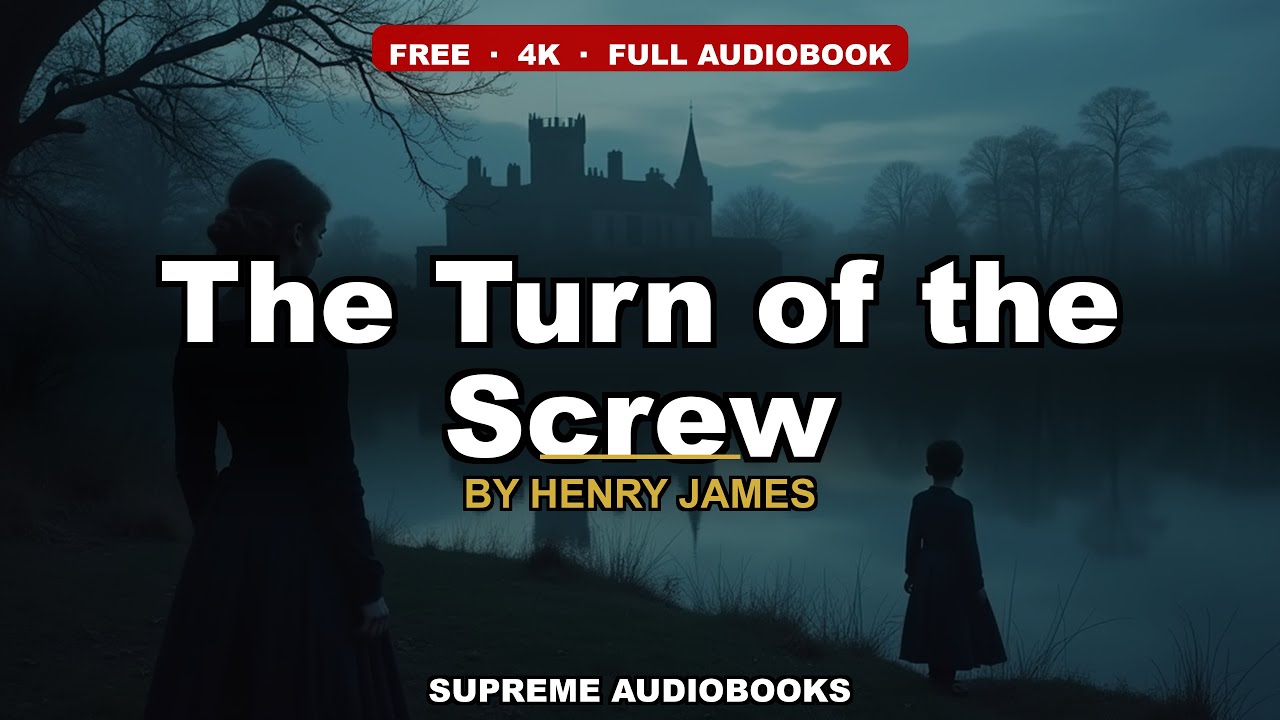
The 4K cinematic visuals accompanying this audiobook are generated by an AI image model from prompts derived from the source text. No copyrighted photos, paintings, or stock footage are used. AI generation is disclosed on every video on our YouTube channel as required by YouTube's altered/synthetic content policy.
English subtitles are transcribed from the LibriVox recording with OpenAI Whisper. Translations into the 11 other supported languages are produced by Meta's NLLB-200 neural translation model. No human translator's copyrighted translation is used.
Questions about sourcing or rights? See our DMCA & Sourcing policy or contact us.
View 10 famous quotes from this book →
Enjoyed this audiobook?
If you'd like to own a copy of The Turn of the Screw or hear a professionally produced edition, the links below help support free audiobook production at no extra cost to you.
As an Amazon Associate we earn from qualifying purchases. Audible / print links are affiliate.