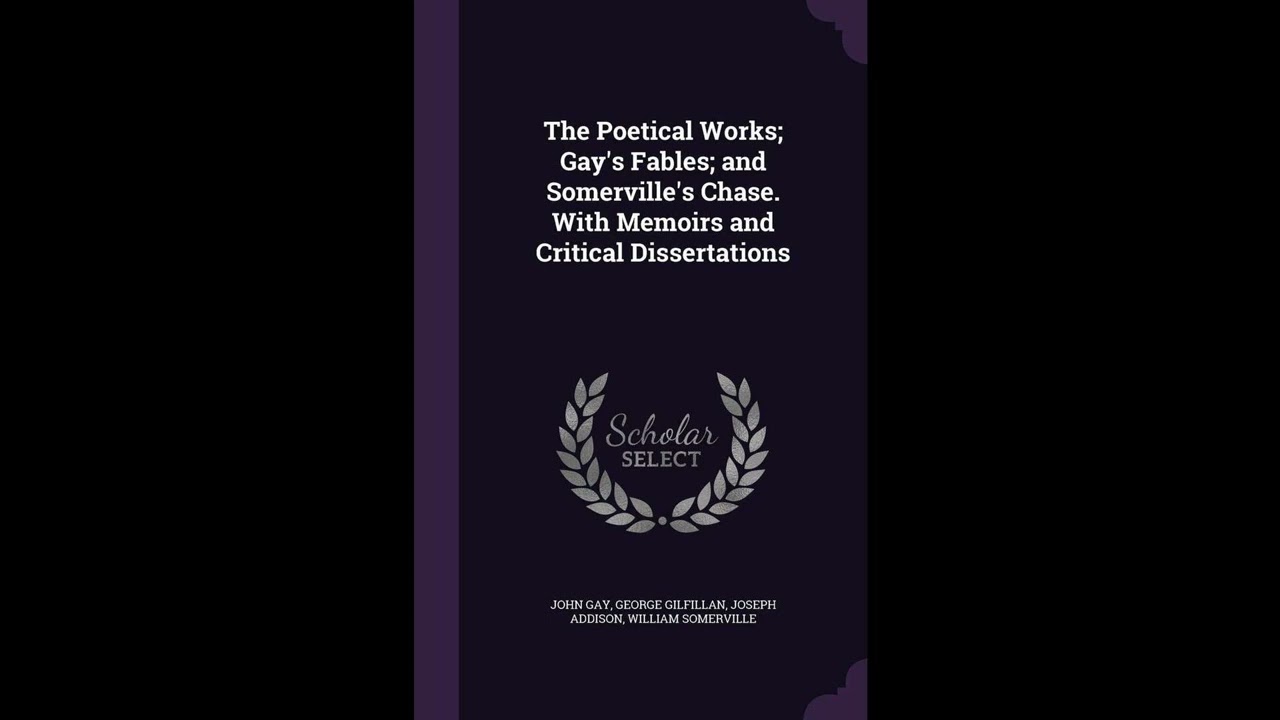
The Poetical Works; Gay's Fables; and Somerville's Chase. With Memoirs and Critical
Step into a world where wit dances with wisdom and the English countryside unfolds in vivid, rhythmic verse. This unique collection, gathering "The Poetical Works," the celebrated Gay's Fables, and Somerville's spirited The Chase, offers more than just a glimpse into eighteenth-century literary tradition; it provides a vital, living connection to the Enlightenment mind. Here, astute social commentary, delivered through talking animals and satirical vignettes, stands alongside breathtaking descriptive poetry that immerses the listener in the sights and sounds of a bygone era. For anyone curious about the foundational voices that shaped modern literature, or simply seeking clever stories and engaging natural observation, this compilation stands as a remarkable testament to the enduring power of poetry to both instruct and delight, its lessons and beauty still resonant today. At the heart of this anthology lie the brilliant Fables of John Gay, a series of short, allegorical narratives designed to entertain while subtly — or sometimes overtly — critiquing human folly and societal norms. Often set in animal kingdoms or simple human interactions, these tales introduce a cast of anthropomorphic characters: a discerning dog, a pompous peacock, a wily fox, or a naive lamb. Each fable presents a miniature drama, a moral dilemma, or a character flaw, typically resolving with a clear, often witty, lesson about virtue, vice, politics, or friendship. While individual stories are self-contained, a cumulative effect builds a portrait of human nature observed with sharp intelligence and a keen, often satirical, eye. There is no overarching plot in the conventional sense, but rather a consistent thematic exploration of morality and the often-absurd behavior of humankind, all presented with disarming clarity and charm. Complementing Gay’s urbanity and satire is William Somerville’s magnificent didactic poem, The Chase. This expansive work plunges the listener into the world of rural sport and the meticulous art of hunting. Set against the backdrop of the changing seasons in the English countryside, the poem follows the hunter from the training of hounds and horses, through the thrill of the chase itself, detailing every aspect of the pursuit of various game. Somerville’s keen observational skills bring to life the scents of the morning air, the cries of the hounds, the strategies of the huntsman, and the frantic flight of the stag or fox. Rather than a linear plot with character development, The Chase offers a rich, descriptive unfolding of a specific cultural activity, meticulously detailing its practices and celebrating its pleasures, creating an immersive atmospheric account of a gentleman’s pursuit that was central to the life of the period. This collection, curated from the works of such prominent eighteenth-century figures, speaks to a particular literary moment. John Gay, born in 1685 in Barnstaple, Devon, became a celebrated figure in London’s literary circles. He was a close friend to literary giants like Alexander Pope and Jonathan Swift, and a key member of the Scriblerus Club, a satirical society dedicated to lampooning literary pretension. While his Fables brought him considerable renown and royal patronage, it was his groundbreaking ballad opera, The Beggar’s Opera, in 1728, that cemented his place in history, a biting political and social satire that captivated audiences and influenced musical theater for generations. Gay was a master of accessible verse, skilled at weaving profound observations into seemingly simple forms, making complex ideas palatable and entertaining to a broad public. He died in 1732, leaving behind a legacy of wit, social commentary, and pioneering dramatic work. William Somerville, a slightly older contemporary, born in 1675 at Edstone Hall, Warwickshire, represented a different facet of the Augustan literary scene. A country gentleman, justice of the peace, and a keen fox hunter, Somerville embodied the rural gentry and infused his poetry with an intimate knowledge of the land and its traditions. While he wrote various occasional verses, his lasting contribution is The Chase, published in 1735. This work, didactic in its intent, served both as a guide for aspiring hunters and a celebration of a particular way of life, reflecting the values and pursuits of the landed class. Somerville, who passed away in 1742, bridged the neoclassical emphasis on form and order with a growing appreciation for detailed natural description, subtly foreshadowing the rise of Romanticism’s focus on landscape and personal experience. His voice, alongside Gay’s, reveals the breadth of early eighteenth-century English poetry, from urban satire to pastoral celebration. The works presented here are unified by several compelling themes, offering fertile ground for reflection. One prominent thread is satire and social critique, especially evident in Gay’s Fables. With keen observation and often playful irony, Gay dissects human vanity, political corruption, and the hypocrisies of his age. For example, in "The Lion and the Cub," he subtly critiques the abuse of power, while "The Monkey Who Had Seen the World" pokes fun at superficial sophistication and the foolishness of adopting foreign trends without genuine understanding. Through these animal proxies, Gay delivered pointed commentary that resonated with his contemporaries and continues to offer insights into human behavior across centuries. A second, equally powerful theme is the celebration and detailed depiction of nature and country life, most powerfully embodied in Somerville’s The Chase. The poem meticulously describes the English landscape, the changing seasons, and the intricate dynamics of the hunt. Somerville’s lines paint scenes with exquisite precision: the eager hounds straining at the leash, the swift flight of the deer through the thicket, the invigorating chill of a dawn ride. He doesn't merely observe nature; he engages with it, conveying both its raw beauty and its role as a stage for human activity. This detailed naturalism not only provides a historical snapshot of rural pursuits but also speaks to an enduring human connection to the land. Furthermore, both authors touch upon moral instruction, Gay explicitly through the conclusions of his fables, and Somerville implicitly by presenting a structured, almost ritualistic engagement with nature. These works emerged during England’s Augustan Age, a period roughly spanning the late 17th to mid-18th centuries, characterized by relative political stability following the Glorious Revolution, but also by intense partisan debate and social change. It was an era that revered classical models, emphasizing reason, order, wit, and decorum in literature. The rise of the printing press and a growing middle class meant a broader readership, and coffee houses became centers of intellectual and literary discussion. Writers like Gay and Somerville flourished in this environment. Gay's satire found its perfect target in the burgeoning commercialism and political machinations of Walpole's government, reflecting a society grappling with new forms of wealth and power. Somerville’s commitment to detailing country sports echoed the values of a landed gentry trying to maintain its traditional authority in a changing world, providing a window into the cultural pursuits and aesthetic sensibilities of their class. Both writers, though distinct in their focus, capture the intellectual curiosity and the societal tensions that defined their fascinating century. Listening to these poetical works as an audiobook offers a singular opportunity to connect with the rhythm and musicality of eighteenth-century verse. The precise meters, the carefully chosen rhymes, and the often-formal diction come alive through the spoken word in a way that silent reading cannot fully convey. A skilled narrator can bring out the precise wit and comic timing in Gay’s Fables, making the animals’ dialogues sparkle with personality and the moral lessons land with impactful clarity. Similarly, Somerville’s descriptive passages in The Chase gain immense power when articulated by a voice that can evoke the brisk air, the rush of the hunt, and the cries of the hounds. The run length, encompassing several hours, allows for sustained immersion, making this a perfect companion for long commutes or leisurely afternoons, letting the language and the period’s sensibility wash over you, allowing the subtleties of expression to truly sink in.
Enjoyed The Poetical Works; Gay's Fables; and Somerville's Chase. With Memoirs and Critical? A few ways to support us
Audible & Amazon links are affiliate; we may earn a small commission at no extra cost.
About this production
Human narration by a volunteer reader from LibriVox.org, the public-domain audiobook project. LibriVox volunteers record literary works whose copyright has expired in the United States, releasing the resulting recordings into the public domain.
The Poetical Works; Gay's Fables; and Somerville's Chase. With Memoirs and Critical. The underlying text is in the U.S. public domain. We do not republish any modern copyrighted edition, translation, or commentary.
The 4K cinematic visuals accompanying this audiobook are generated by an AI image model from prompts derived from the source text. No copyrighted photos, paintings, or stock footage are used. AI generation is disclosed on every video on our YouTube channel as required by YouTube's altered/synthetic content policy.
English subtitles are transcribed from the LibriVox recording with OpenAI Whisper. Translations into the 11 other supported languages are produced by Meta's NLLB-200 neural translation model. No human translator's copyrighted translation is used.
Questions about sourcing or rights? See our DMCA & Sourcing policy or contact us.
Enjoyed this audiobook?
If you'd like to own a copy of The Poetical Works; Gay's Fables; and Somerville's Chase. With Memoirs and Critical or hear a professionally produced edition, the links below help support free audiobook production at no extra cost to you.
As an Amazon Associate we earn from qualifying purchases. Audible / print links are affiliate.