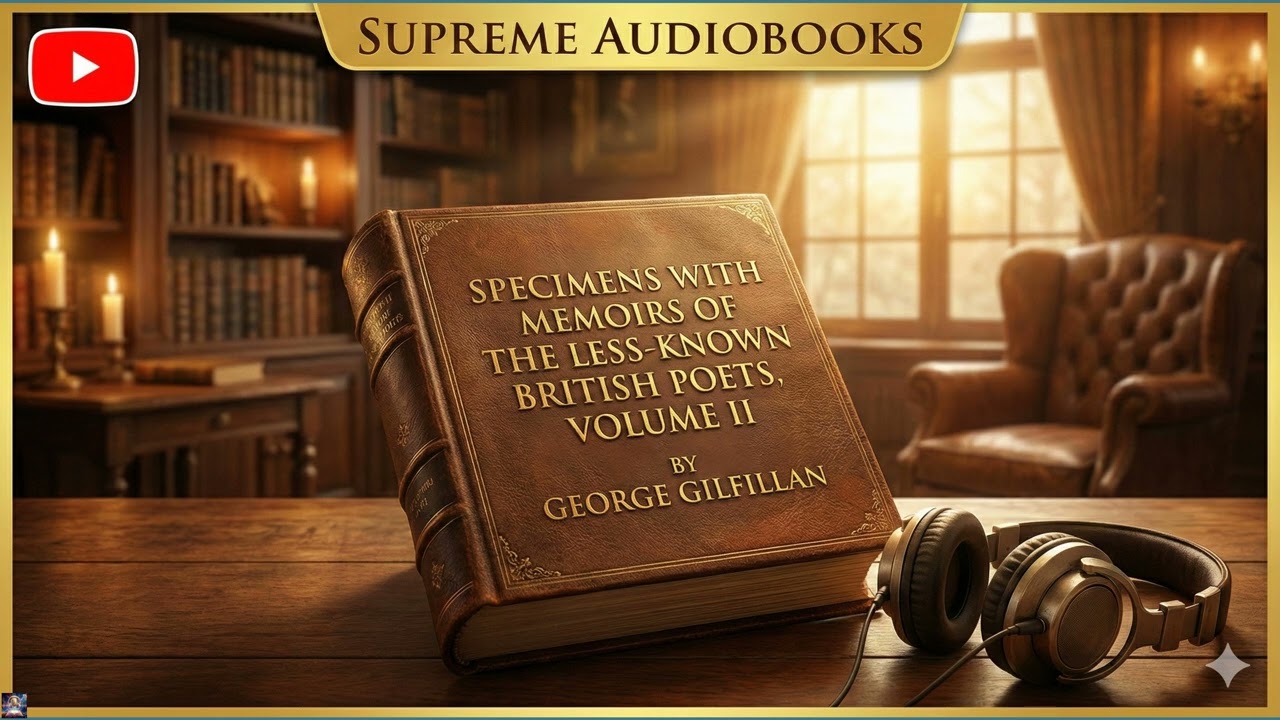
Specimens with Memoirs of the Less-Known British Poets, Volume II
Enter a world where forgotten voices find their breath once more, where the quiet triumphs of poets long overshadowed are brought into the light. George Gilfillan’s Specimens with Memoirs of the Less-Known British Poets, Volume II isn’t merely an anthology; it’s an act of literary rescue, a passionate argument for expanding our understanding of genius and beauty beyond the familiar names etched in the canon. This is a chance to wander through the hidden groves of British verse, guided by a discerning, often eloquent, critic who believed that true poetry, no matter how obscure, deserved to be heard. For modern listeners, it offers not just a historical curiosity, but a profound invitation to question what we value in art and to rediscover the unexpected pleasures lurking in the byways of literary history. Gilfillan’s ambitious undertaking begins with a compelling premise: that the wealth of British poetic talent extends far beyond the handful of celebrated figures taught in schools. As listeners make their way through this second volume, they are placed squarely in the role of a curious literary traveler, accompanying Gilfillan on his mission. The setting for this critical adventure is the expansive sweep of British literary history, from the dawn of English verse through the burgeoning Romantic and early Victorian periods. Rather than focusing on a chronological or thematic organization that dictates a rigid path, Gilfillan’s approach feels more like a carefully curated gallery, where each portrait – a poet’s memoir – is followed by an exhibition of their work. He introduces figures who, for various reasons, never achieved the widespread acclaim of a Shakespeare, a Milton, or a Wordsworth, yet whose contributions he argues possess unique charm, power, or insight. The central conflict of this collection isn't one of clashing characters within a narrative, but rather a profound struggle against the tide of literary oblivion. Gilfillan positions himself as the chief advocate for these neglected bards, waging a quiet, scholarly battle against the dictates of passing fashion and the narrow scope of established taste. He works to dismantle the notion that only a select few are worthy of remembrance, revealing instead a broader, more democratic landscape of poetic endeavor. Each entry represents a small victory in this larger campaign, a testament to Gilfillan’s conviction that merit should not be judged solely by fame. The arc of this literary journey, therefore, isn’t about a grand resolution, but about the cumulative effect of discovering numerous individual voices, each contributing to a richer, more nuanced understanding of British poetic heritage. Listeners witness Gilfillan’s meticulous process of selection, his impassioned defense of particular stanzas or sentiments, and his sustained effort to build a case for each poet’s enduring, if understated, legacy. George Gilfillan, a prominent figure in Victorian literary circles, was born in Comrie, Perthshire, Scotland, in 1813. His life was one deeply immersed in both spiritual and intellectual pursuits. After studying at Glasgow University, he was ordained as a minister of the United Presbyterian Church, and later, the Free Church of Scotland, spending the majority of his career in Dundee. Here, he became celebrated for his eloquent sermons, which often blended theological discourse with a passionate engagement with contemporary literature and social issues. Gilfillan was not merely a preacher confined to the pulpit; he was a prolific writer and influential critic whose reviews and essays frequently appeared in leading periodicals of the day. Beyond his pastoral duties, Gilfillan dedicated much of his life to literary scholarship and promotion. He became known for his "Gallery of Literary Portraits" and "Bards of the Bible," works that showcased his eclectic tastes and his distinctive, often flamboyant, critical style. His most monumental literary project, however, was his thirty-six-volume edition of the "British Poets," published between 1853 and 1860, which included both canonical figures and, crucially, the less-known poets featured in the collection at hand. Gilfillan’s place in the literary canon is that of a significant Victorian critic who, while sometimes criticized for his effusive prose or subjective judgments, played a vital role in broadening the scope of literary appreciation and advocating for writers who might otherwise have faded from memory. He stood as a champion of overlooked talent, his assessments offering a counterpoint to the more rigid critical standards of some of his contemporaries. He died in 1878, leaving behind a substantial body of work that continues to offer insights into 19th-century literary thought. One of the central themes woven through Gilfillan's Specimens with Memoirs is the reclamation of overlooked genius. He acts as a dedicated literary archaeologist, sifting through centuries of verse to unearth poets whose brilliance, though perhaps modest, offers genuine aesthetic pleasure and intellectual stimulation. For example, he might present a lyric from Anne Bradstreet, a Puritan poet writing in colonial America but rooted in British tradition, or the poignant verses of a forgotten cleric like Ebenezer Elliott. In each case, Gilfillan's "Memoirs" elevate these figures from mere footnotes to fully fledged literary personalities, demonstrating how their particular circumstances shaped their unique poetic voice and contributed to the larger cultural conversation. He shows us how a seemingly minor poet's keen observation of nature, their innovative use of meter, or their deep emotional resonance can leave an indelible mark, proving that poetic value is not solely measured by widespread popularity during one's lifetime. Another significant theme is the interplay between biography and artistic expression. Gilfillan’s decision to include "Memoirs" alongside "Specimens" highlights a distinctly Victorian sensibility: the belief that understanding a poet’s life – their struggles, joys, beliefs, and personal tragedies – is essential to fully appreciating their work. He does not simply present poems; he introduces us to the individuals behind them, often painting vivid, if sometimes idealized, portraits. For instance, he might recount the humble beginnings of a self-taught poet or the tragic early demise of another, drawing direct connections between their life experiences and the emotional landscape of their verse. This approach encourages a deeper, more empathetic engagement with the poetry, transforming abstract words on a page into the direct utterance of a lived human experience. It underscores the idea that even in the "less-known," there is profound humanity waiting to be discovered. The publication of Gilfillan’s Specimens with Memoirs in 1860 places it firmly within the Victorian era, a period marked by profound social, political, and intellectual ferment. Culturally, Britain was experiencing an explosion of print culture, with rising literacy rates and an expanding middle-class readership hungry for both entertainment and instruction. This created a fertile ground for extensive literary surveys and anthologies, as publishers and critics sought to define and disseminate the national literary heritage. There was a burgeoning interest in scholarly pursuits, a drive to categorize and understand the past, which extended to literary history. Gilfillan's work emerges from this context, yet it also represents a counter-current to the prevailing trend of solidifying a narrow, heroic literary canon. While many anthologists focused on the established giants, Gilfillan championed the notion that true literary appreciation demanded a broader scope, a willingness to look beyond the immediately obvious. Politically, the era was one of evolving reforms and imperial expansion, yet Gilfillan's project remained largely within the realm of intellectual and aesthetic exploration, reflecting the era's capacity for intense self-reflection and the celebration of individual creative expression. His Scottish background also informed his perspective, providing a nuanced lens through which to view British, rather than solely English, poetic traditions. Listening to Specimens with Memoirs of the Less-Known British Poets, Volume II as an audiobook offers a singular opportunity to connect with this material in a deeply personal and immediate way. The spoken word brings George Gilfillan’s critical voice to life, allowing his often passionate, sometimes florid, prose to unfold with all its intended rhythm and emphasis. A skilled narrator can artfully distinguish Gilfillan’s biographical introductions and critical commentary from the actual poetic specimens themselves, shifting tone and cadence to honor the individual voices of the poets he presents. The "several hours" run length makes for an absorbing listening experience, perfect for extended periods of contemplation or for dipping into during daily routines, allowing the listener to truly settle into the world Gilfillan meticulously reconstructs. Listen for the narrator’s subtle modulations as they transition from the critic’s advocacy to the varied meters and emotional depths of the poems, creating an atmosphere of intellectual discovery and quiet, reflective beauty, as if Gilfillan himself is reading aloud from his personal library.
Enjoyed Specimens with Memoirs of the Less-Known British Poets, Volume II? A few ways to support us
Audible & Amazon links are affiliate; we may earn a small commission at no extra cost.
About this production
Human narration by a volunteer reader from LibriVox.org, the public-domain audiobook project. LibriVox volunteers record literary works whose copyright has expired in the United States, releasing the resulting recordings into the public domain.
Specimens with Memoirs of the Less-Known British Poets, Volume II by George Gilfill. The underlying text is in the U.S. public domain. We do not republish any modern copyrighted edition, translation, or commentary.
The 4K cinematic visuals accompanying this audiobook are generated by an AI image model from prompts derived from the source text. No copyrighted photos, paintings, or stock footage are used. AI generation is disclosed on every video on our YouTube channel as required by YouTube's altered/synthetic content policy.
English subtitles are transcribed from the LibriVox recording with OpenAI Whisper. Translations into the 11 other supported languages are produced by Meta's NLLB-200 neural translation model. No human translator's copyrighted translation is used.
Questions about sourcing or rights? See our DMCA & Sourcing policy or contact us.
View 10 famous quotes from this book →
Enjoyed this audiobook?
If you'd like to own a copy of Specimens with Memoirs of the Less-Known British Poets, Volume II or hear a professionally produced edition, the links below help support free audiobook production at no extra cost to you.
As an Amazon Associate we earn from qualifying purchases. Audible / print links are affiliate.
More Audiobooks
The Poetical Works of John Dryden Volume 2: With Life Critical Dissertation and Expl- Full Audiobook
Poems in Two Volumes, Volume 2: By William Wordsworth
Selections From Wordsworth and Tennyson
"Poems in Two Volumes, Volume 1"