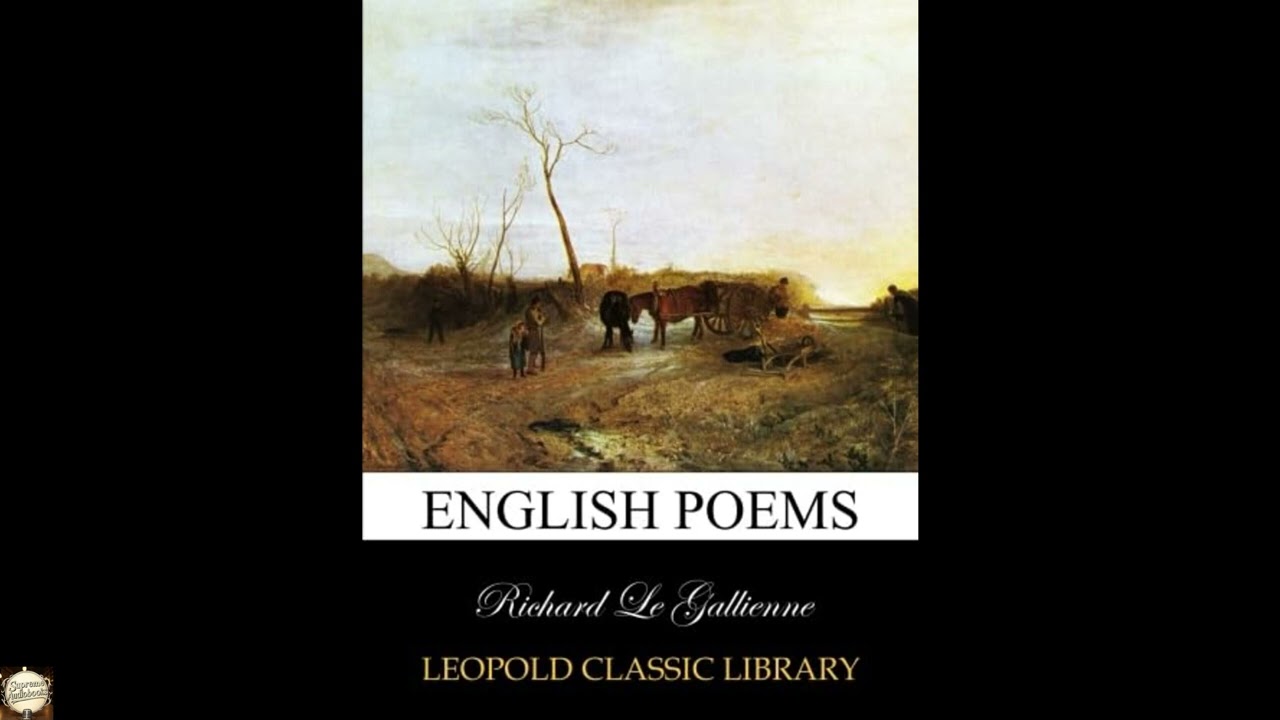
English poems
Dive into the exquisite lyrical world of Richard Le Gallienne’s English Poems, a collection that, even over a century after its initial publication, continues to resonate with a haunting beauty and a deeply human sensibility. This seminal work from a pivotal figure of the fin-de-siècle offers listeners a direct communion with a voice that was both a product of its time and remarkably ahead of it, articulating a quest for meaning and beauty amidst the complexities of existence. It is a work that speaks to the enduring questions of love, loss, and the nature of artistic expression, presented with an elegance and musicality that feel as fresh and poignant today as they did to its original readers. Prepare to be drawn into a realm where every line sings with a quiet intensity, inviting contemplation and introspection. Within these poems, Le Gallienne crafts an atmospheric landscape that is primarily emotional and internal, yet often grounded in tangible images of the natural world and urban settings. The speaker, a recurring persona often reflective of the author's own sensibilities, acts as our guide through a series of contemplations and observations. There isn’t a single linear narrative in the conventional sense, but rather a progression of moods, meditations, and lyrical snapshots, each contributing to a broader emotional arc that flows from rapturous adoration to profound melancholy, from the celebration of ephemeral beauty to the quiet acceptance of transient life. The "story" here is the unfolding of a sensitive soul grappling with universal experiences. Listeners will find themselves moving through intimate verses dedicated to love's tender beginnings and its inevitable partings, alongside introspective pieces on the quiet dignity of nature and the fleeting nature of human endeavor. Recurring motifs of flowers, stars, the changing seasons, and the passage of time weave through the collection, creating a sense of continuity. The central conflict, if one can term it such, arises from the speaker’s yearning for an ideal beauty and truth in a world that often falls short, a struggle to reconcile the spiritual with the material, and the eternal with the momentary. While no grand climactic event unfolds, the collection builds to a quiet crescendo of emotional wisdom, leaving a lasting impression of poetic grace and profound feeling without resorting to easy answers or definitive conclusions. Richard Le Gallienne, born in Liverpool in 1866, was a prominent English man of letters who became a significant voice during the Aesthetic and Decadent movements of the late Victorian era. His career began in journalism before he fully dedicated himself to poetry, criticism, and essay writing. He quickly established himself as a darling of the literary circles often associated with The Yellow Book, a highly influential quarterly magazine that defined much of the artistic temperament of the 1890s. Le Gallienne was known for his bohemian lifestyle, his charm, and his relentless pursuit of beauty in art and life, often embodying the very ideals he espoused in his writings. His move to America later in life saw him continuing his prolific output, translating classical works, and publishing novels like The Quest of the Golden Girl, which was a popular success. Despite living until 1947, his most impactful work and his place in the literary canon are firmly rooted in the fin-de-siècle period, where he stood alongside figures such as Oscar Wilde and Aubrey Beardsley. Le Gallienne's oeuvre, including works like The Religion of a Literary Man and his celebrated translations of Omar Khayyam's Rubaiyat, cemented his reputation as a cultured, sensitive, and deeply philosophical writer whose contribution to English letters, though sometimes overshadowed by his more flamboyant contemporaries, remains vital for understanding the poetic sensibilities of his age. The poetry collected here enacts several potent themes. Foremost among them is the pursuit and fragility of beauty. Le Gallienne frequently paints vignettes of natural splendor—a solitary rose, the twilight glow over a city street, a moonlit garden—only to immediately imbue them with an awareness of their fleeting nature. One passage might celebrate the perfect curve of a petal, while the next gently laments its inevitable wilting, showing how beauty's intense presence is inseparable from its eventual disappearance. Another core theme is melancholy and loss, often intertwined with romantic love. The poems frequently lament an absent lover or a love that has passed, not with bitterness, but with a wistful, almost tender sadness. The speaker finds solace in memory, suggesting that even in sorrow, there is a certain aesthetic value and a profound truth to be acknowledged. The collection also touches upon the solace of nature and the quest for spiritual meaning in an increasingly secular world. Le Gallienne often turns to the vastness of the cosmos or the simple grandeur of a landscape as a counterpoint to human concerns, finding a quiet comfort and a sense of scale in the non-human world. He presents nature not merely as a backdrop, but as a source of profound wisdom and enduring peace. This interplay of intense human emotion with the vast, indifferent, yet beautiful natural world lends his verse a layered depth, prompting reflection on our place within the grand scheme of things. English Poems emerged from a fascinating and tumultuous period in British history—the tail end of the Victorian era, often referred to as the fin-de-siècle or "Yellow Nineties." This was a time marked by profound cultural shifts: industrialization had irrevocably altered the landscape, scientific advancements were challenging traditional religious beliefs, and a pervasive sense of weariness with Victorian moralism was taking hold. Artistically, there was a reaction against the didacticism and realism of earlier Victorian literature. The Aesthetic movement, to which Le Gallienne wholeheartedly belonged, championed the idea of "art for art's sake," prioritizing beauty, form, and sensory experience over moral or social utility. This period saw a rise in bohemianism and a fascination with symbolism and decadence, drawing inspiration from French poets like Charles Baudelaire and Paul Verlaine. Le Gallienne’s poetry, with its exquisite language, its focus on individual emotion, and its melancholic appreciation for beauty, perfectly encapsulated this spirit, providing an elegant and introspective counter-narrative to the prevailing anxieties and rapidly modernizing world around it. It was a moment when poetry offered an escape into refined sensation and personal contemplation. Listening to English Poems as an audiobook offers a singular experience, allowing the musicality and rhythmic nuances of Le Gallienne's verse to truly unfold. A skilled narrator breathes life into the cadences, enhancing the subtle alliteration and assonance that are so integral to his style. The "several hours" runtime allows for a leisurely engagement, perfect for quiet contemplation during a solitary walk, a commute, or an evening by the fire. Listen for the narrator’s pacing, how they allow certain resonant phrases to linger, and how their voice captures the specific emotional tint—be it a whispered tenderness, a gentle lament, or a serene acceptance—that defines each piece. The auditory presentation transforms these written verses into a living, breathing performance, allowing the atmosphere of Le Gallienne’s poetic world to envelop the listener completely.
Enjoyed English poems? A few ways to support us
Audible & Amazon links are affiliate; we may earn a small commission at no extra cost.
About this production
Human narration by a volunteer reader from LibriVox.org, the public-domain audiobook project. LibriVox volunteers record literary works whose copyright has expired in the United States, releasing the resulting recordings into the public domain.
English poems by Richard Le Gallienne. The underlying text is in the U.S. public domain. We do not republish any modern copyrighted edition, translation, or commentary.
The 4K cinematic visuals accompanying this audiobook are generated by an AI image model from prompts derived from the source text. No copyrighted photos, paintings, or stock footage are used. AI generation is disclosed on every video on our YouTube channel as required by YouTube's altered/synthetic content policy.
English subtitles are transcribed from the LibriVox recording with OpenAI Whisper. Translations into the 11 other supported languages are produced by Meta's NLLB-200 neural translation model. No human translator's copyrighted translation is used.
Questions about sourcing or rights? See our DMCA & Sourcing policy or contact us.
Enjoyed this audiobook?
If you'd like to own a copy of English poems or hear a professionally produced edition, the links below help support free audiobook production at no extra cost to you.
As an Amazon Associate we earn from qualifying purchases. Audible / print links are affiliate.