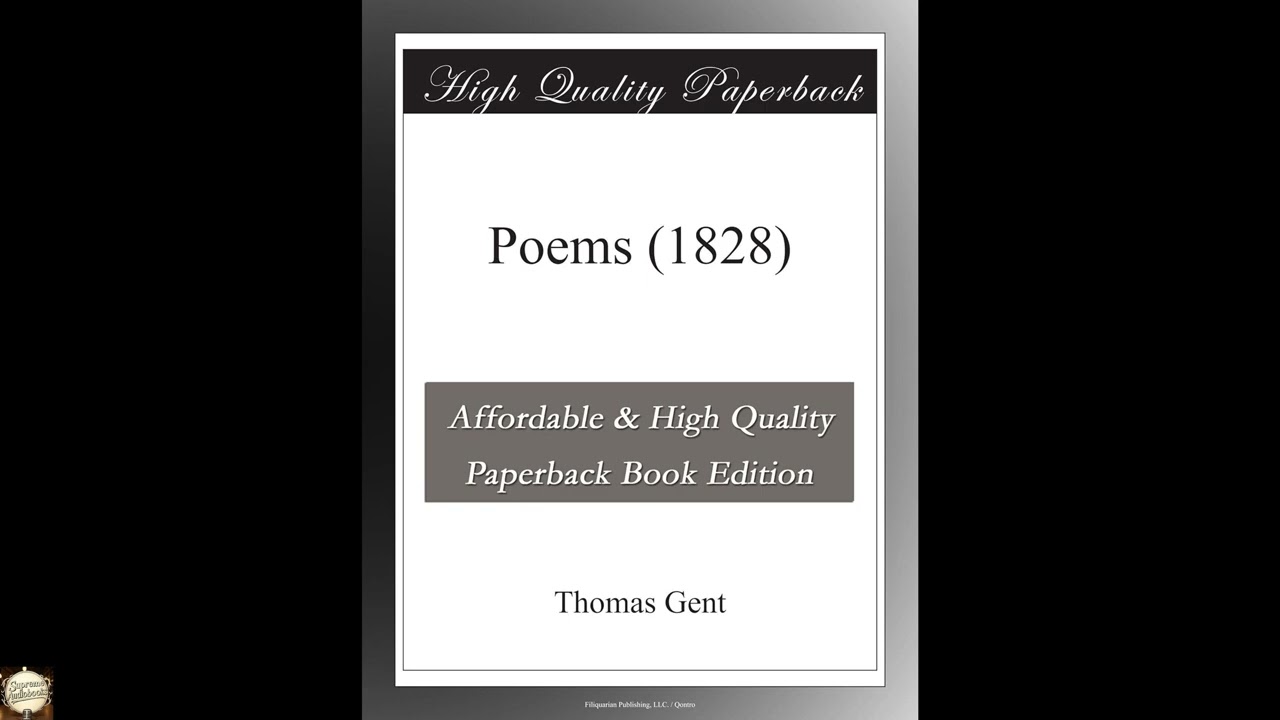
Poems (1828)
The early nineteenth century, a period of profound transformation in art, society, and individual consciousness, gave rise to countless poetic voices, some destined for canonical greatness, others offering more intimate glimpses into the spirit of their age. Among these latter, we find Thomas Gent's Poems (1828), a collection that, while perhaps not widely known today, opens a fascinating portal to a particular sensibility flourishing just as Romanticism reached its zenith. This is not a grand, revolutionary statement, but rather an earnest echo from a specific time and place – an opportunity for listeners to connect with the personal reflections, observations, and emotional landscapes that captivated a thinking person during a pivotal era in British history. To listen to these verses now is to experience the very cadence of an epoch, understanding how beauty, sorrow, nature, and human experience were articulated by a poet whose concerns, though rooted in his time, resonate with enduring human truths. Within these pages, or rather, across these hours of spoken verse, Gent guides us through a diverse landscape of poetic expression. The collection functions less as a single narrative and more as a series of vignettes, meditations, and lyrical observations, each poem a distinct window into the poet's mind and the world around him. We find ourselves transported to the tranquil English countryside, where the changing seasons provide ample material for reflection on transience and renewal. A spring morning might inspire verses on the delicate unfurling of blossoms and the songs of birds, while an autumnal evening could lead to somber thoughts on decay and the fading light. The "characters" are often the figures and forces that populate the poet’s inner and outer worlds: the solitary wanderer contemplating a ruin, the shepherd attending his flock, or the personified spirits of nature itself—winds, rivers, and ancient trees. The central "conflict," if one can be ascribed to a collection of poems, often plays out between the ephemeral nature of life and the human desire for lasting meaning, between the harsh realities of existence and the solace found in beauty or spiritual contemplation. Gent also turns his gaze towards more domestic or social scenes, offering glimpses of community life, quiet moments of friendship, or perhaps elegiac tributes to loved ones lost. The overall arc, therefore, is not a linear progression towards a climactic resolution, but rather a cyclical unfolding of themes, a gentle movement through different moods and subjects that collectively paint a portrait of the poet's engagement with the world. He offers no definitive answers, but rather shares his sincere ponderings, leaving the listener to share in his observations and draw their own conclusions about the world he so carefully depicts. Thomas Gent, the author of this collection, was not one of the celebrated literary figures whose names instantly spring to mind when we consider the early nineteenth century. Born in 1780 in Yorkshire, he followed in the venerable footsteps of his father, the renowned printer and antiquarian Thomas Gent (1693–1778). The younger Gent inherited not only the family name but also the printing business in York, continuing a tradition of craftsmanship and intellectual engagement within his community. While his father was famous for his historical works and topographical writings, the son, Thomas Gent of 1780-1849, appears to have found an outlet for his own creative impulses in verse. His life as a printer placed him at the heart of the publishing world, albeit from a practical rather than purely artistic vantage point. This background likely afforded him both access to a wide array of literature and the means to publish his own efforts, however modest his ambitions for widespread fame might have been. Gent’s poetic output, exemplified by this 1828 collection, places him outside the immediate orbit of literary giants like Wordsworth or Byron, yet firmly within the broader currents of the Romantic era. His work reflects a period when poetry was not exclusively the domain of professional authors, but also a cherished pursuit for educated individuals across various professions. He was a contemporary of poets who redefined the English literary landscape, and while his name may not appear in many standard anthologies, his verse provides valuable insight into the diffuse and democratic nature of poetic expression during a time of immense literary ferment. He represents a significant strand of creative activity: the local poet, the thoughtful amateur, whose work, though perhaps less ambitious in scope, nonetheless faithfully mirrored the prevailing sentiments and aesthetic tastes of his time, demonstrating the widespread appeal and influence of the Romantic modes of thought. At its core, Poems (1828) touches upon several enduring themes, rendered with a sensibility characteristic of the early nineteenth century. One prominent theme is the appreciation of nature and its ability to soothe, inspire, and provoke contemplation. Gent frequently turns to the natural world as a source of solace and metaphor, often describing a pastoral scene with careful attention to detail. For instance, one might find verses dedicated to the winding course of a river through a valley, not merely as a descriptive exercise, but as a reflection on the ceaseless flow of time and the quiet persistence of life. Another recurring theme is mortality and the passage of time. Many poems quietly confront the brevity of human existence and the inevitability of decay. A contemplation of an ancient oak or a weathered churchyard monument might prompt a melancholic yet accepting meditation on what remains and what fades. Gent also frequently engages with personal reflection and sentiment, often turning his gaze inward to ponder states of mind, memory, or emotional experiences. We encounter a speaker who is observant and introspective, sharing his feelings of hope, sorrow, or quiet contentment, such as in a poem that might recall a cherished childhood memory, imbued with a gentle sense of nostalgia for days gone by. These poems, though often understated, offer genuine emotional weight, providing a poignant glimpse into the poet's inner world. The publication of Poems (1828) occurred at a fascinating juncture in British history and literature. The Napoleonic Wars had ended a little over a decade prior, leaving a transformed Europe and a Britain grappling with economic adjustment and social change. The Industrial Revolution was rapidly reshaping the landscape, driving population shifts from rural areas to burgeoning industrial towns, though its full impact was still unfolding. Culturally, this was the heart of the Romantic Age. Lord Byron had died four years earlier, Percy Bysshe Shelley six years before that, and John Keats seven years earlier, yet their influence, alongside that of William Wordsworth and Samuel Taylor Coleridge, profoundly shaped poetic expression. The emphasis on individual emotion, the sublime in nature, the celebration of the common man, and a certain yearning for simpler, purer times characterized much of the era’s verse. Gent’s work, while not reaching the innovative heights of his more famous contemporaries, clearly operated within this established aesthetic. His focus on nature, personal sentiment, and the contemplation of mortality would have resonated deeply with the prevailing literary tastes, representing a regional or localized voice echoing the broader national poetic conversation. It was a time when the ability to compose verse was still seen as a mark of education and refined sensibility, and many individuals, like Gent, contributed their own observations and feelings to the great outpouring of poetry that defined the age. Listening to Poems (1828) as an audiobook offers a uniquely intimate and enriching experience, allowing the listener to engage with the verse in a way that reading silently cannot always replicate. The duration, spanning several hours, makes it an ideal companion for quiet evenings at home, contemplative walks, or even during routine tasks where one can allow the words to wash over them. A skilled narrator's interpretation breathes life into these early nineteenth-century verses, articulating the precise rhythms and meters that might otherwise be missed on the page. You can listen for the subtle shifts in pacing, reflecting the poet's changes in mood or subject matter—perhaps a quicker tempo for a description of a bustling market scene, or a more measured cadence for a philosophical rumination. The voice, with its careful enunciation and emotional shading, can illuminate the intended emphasis of Gent’s language, making the nuances of his sentiment more accessible. It transforms what might be seen as historical text into a living, breathing expression, allowing the atmosphere of the poems—whether it be the gentle melancholy of a sunset or the quiet joy of a pastoral vista—to envelop the listener, forging a direct connection to the poet's contemplative spirit.
Enjoyed Poems (1828)? A few ways to support us
Audible & Amazon links are affiliate; we may earn a small commission at no extra cost.
About this production
Human narration by a volunteer reader from LibriVox.org, the public-domain audiobook project. LibriVox volunteers record literary works whose copyright has expired in the United States, releasing the resulting recordings into the public domain.
Poems (1828) by Thomas Gent. The underlying text is in the U.S. public domain. We do not republish any modern copyrighted edition, translation, or commentary.
The 4K cinematic visuals accompanying this audiobook are generated by an AI image model from prompts derived from the source text. No copyrighted photos, paintings, or stock footage are used. AI generation is disclosed on every video on our YouTube channel as required by YouTube's altered/synthetic content policy.
English subtitles are transcribed from the LibriVox recording with OpenAI Whisper. Translations into the 11 other supported languages are produced by Meta's NLLB-200 neural translation model. No human translator's copyrighted translation is used.
Questions about sourcing or rights? See our DMCA & Sourcing policy or contact us.
Enjoyed this audiobook?
If you'd like to own a copy of Poems (1828) or hear a professionally produced edition, the links below help support free audiobook production at no extra cost to you.
As an Amazon Associate we earn from qualifying purchases. Audible / print links are affiliate.