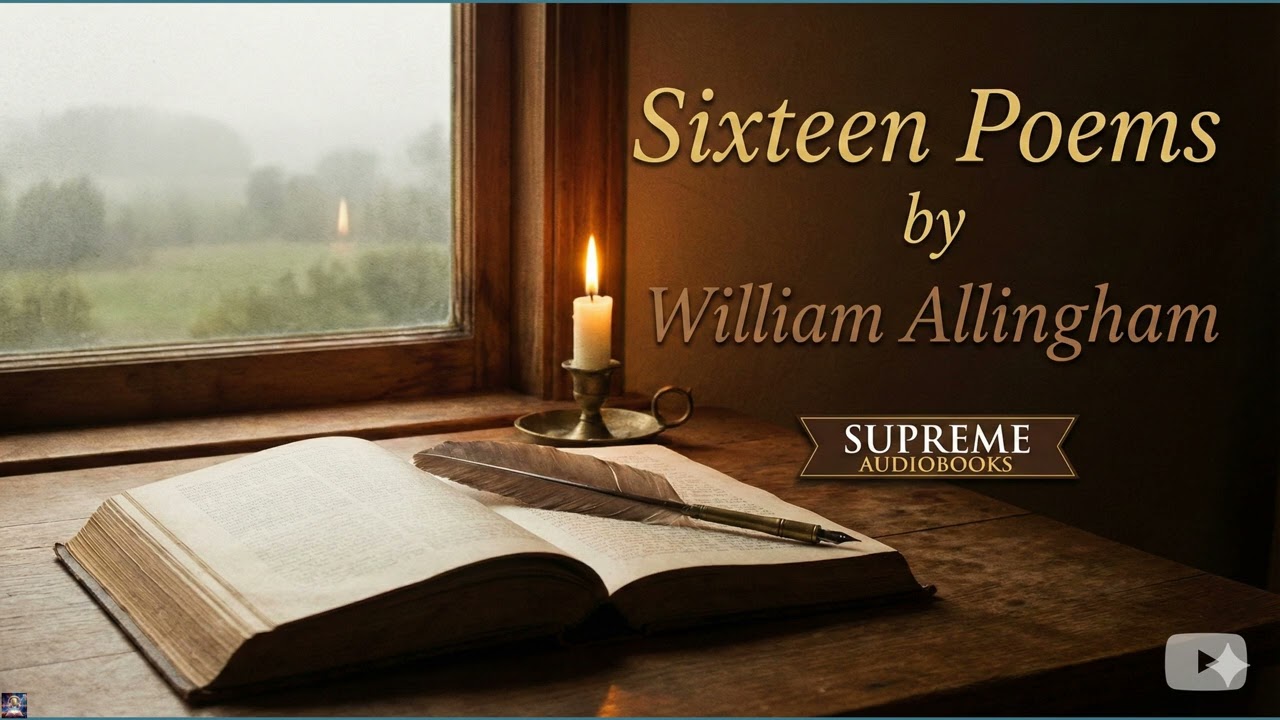
Sixteen Poems
Step into a quiet corner of the Victorian mind, a space where the rustle of leaves, the murmur of the sea, and the echoes of old tales still hold sway. Sixteen Poems by William Allingham offers more than just a collection of verses; it is an invitation to pause, to observe, and to feel the ebb and flow of a world caught between tradition and nascent modernity. This is poetry that speaks not in grand pronouncements, but in the precise beauty of an observed detail, the poignant clarity of a recalled emotion, and the enduring power of a story well told. For anyone seeking solace in language, connection to the natural world, or a deeper understanding of the human spirit as it navigated a changing era, these poems present a compelling argument for the enduring resonance of a gentle, yet profound, poetic voice. Across these sixteen selections, listeners will encounter a varied landscape, both geographical and emotional. While there isn't a single narrative in the conventional sense, a distinct sensibility guides us through each piece. We might find ourselves walking winding country lanes in rural Ireland, observing the simple lives of its inhabitants, or standing on a windswept coastline, watching ships disappear over the horizon. The "characters" that populate these verses are often archetypal: a lonely wanderer, a young lover, children at play, or the personified elements of nature itself—the sun, the moon, the whispering wind. The "conflict," where it arises, is rarely external and dramatic; instead, it tends to be an internal wrestling with time's passage, the bittersweet ache of memory, the yearning for beauty, or the subtle melancholy that often accompanies reflection. The collection, taken as a whole, creates a unique arc, not of a story, but of an experience. It moves through moments of lyrical beauty and stark realism, between the bright wonder of childhood and the resigned wisdom of age. Listeners will find themselves immersed in moods that shift from joyful simplicity to thoughtful contemplation, from an almost mystical engagement with nature to a clear-eyed observation of social realities. Each poem acts as a window onto a particular scene or feeling, contributing to a larger mosaic of human and natural existence, encouraging a meditative approach to the world's quiet dramas. William Allingham, born in Ballyshannon, County Donegal, Ireland, in 1824, was a significant, if often understated, figure in Victorian letters. His early life in a small Irish port town deeply shaped his poetic imagination, instilling a profound connection to the sea, the landscape, and the rich folklore of his homeland. His career as a customs officer—a role he held for several decades, stationed in various locations across England and Ireland—provided him with both financial stability and extensive opportunities for observation, allowing him to travel widely and engage with diverse communities, experiences that would later infuse his writing. Allingham's literary life was marked by remarkable friendships with some of the most prominent writers and artists of his time. He was a close confidant of Alfred, Lord Tennyson, and Thomas Carlyle, and became deeply associated with the Pre-Raphaelite Brotherhood, counting Dante Gabriel Rossetti and John Ruskin among his friends. This intellectual cross-pollination enriched his perspective, yet he retained a distinct voice, often more grounded and less ornate than some of his contemporaries. Beyond Sixteen Poems, his best-known work includes "The Fairies" (with its famous lines "Up the airy mountain, Down the rushy glen"), the long narrative poem Laurence Bloomfield in Ireland, which addressed social issues in his native land, and his extensive Diary, a invaluable record of Victorian literary and artistic life. Allingham passed away in 1889, leaving behind a body of work that gently but firmly asserted his place as a sensitive observer and a skilled lyricist. Among the central themes Allingham frequently engages is the profound connection between humanity and the natural world. He portrays nature not merely as a backdrop, but as a living, breathing entity, a source of spiritual sustenance and a mirror for human emotion. One might encounter a scene where a lone figure finds solace in the rhythmic crash of ocean waves against the shore, the vastness of the sea reflecting an internal state of yearning or peace. The turning of the seasons, the flight of birds, and the ancient wisdom held within trees frequently appear as potent symbols of life's cycles, reminding the reader of both enduring beauty and inevitable change. Another prominent thread running through Allingham's poetry is the theme of memory and the passage of time. His verses often evoke a sense of looking back, of cherishing moments lost and holding onto the echoes of the past. A common scenario might involve a speaker recalling childhood scenes with a bittersweet clarity—a forgotten game, a beloved face, the simple joy of a summer day—contrasting the vividness of recollection with the undeniable onward march of years. This allows Allingham to explore the bittersweet nature of nostalgia, the way the past continues to shape the present, and the comforting yet sometimes sorrowful realization that all things eventually fade or transform. He also touches upon themes of folk belief and the unseen world, drawing heavily from Irish mythology and superstitions, bringing a mystical dimension to everyday occurrences. Allingham's output emerged during a period of immense social and cultural upheaval in Victorian Britain. The mid-to-late nineteenth century was characterized by rapid industrialization, burgeoning urban centers, scientific advancements that challenged traditional beliefs, and significant social reform movements. Amidst this swirl of change, many poets wrestled with how to portray a world that felt increasingly modern and complex. Allingham, while certainly aware of these developments, often chose to look towards simpler, more enduring aspects of life. His focus on rural landscapes, traditional ways of living, and the enduring power of nature and folklore can be seen as a gentle counterpoint to the era's relentless march of progress, offering a space for reflection and a quiet assertion of the value of continuity and tradition. His poetry arose from a desire to capture beauty and truth in the everyday, to find the universal in the local, and to preserve a certain spiritual grace in a world that was becoming increasingly materialistic. Listening to Sixteen Poems as an audiobook offers a unique opportunity to immerse oneself in the pure sound of poetry. The subtle rhythms, the carefully chosen cadences, and the lyrical beauty of Allingham's language come alive through skilled narration. Over several hours of listening, the listener can allow the words to unfold, savoring the pacing of each line and stanza, appreciating the nuanced voice that brings each scene and sentiment to life. A good narrator will highlight the evocative atmosphere Allingham creates, whether it's the gentle melancholy of a sunset, the playful spirit of a mythical encounter, or the grounded realism of a human interaction. This extended listening format encourages a deeper, more meditative engagement with the verses, allowing their emotional resonance to settle and linger, offering a truly reflective and enriching experience.
Enjoyed Sixteen Poems? A few ways to support us
Audible & Amazon links are affiliate; we may earn a small commission at no extra cost.
About this production
Human narration by a volunteer reader from LibriVox.org, the public-domain audiobook project. LibriVox volunteers record literary works whose copyright has expired in the United States, releasing the resulting recordings into the public domain.
Sixteen Poems by William Allingham. The underlying text is in the U.S. public domain. We do not republish any modern copyrighted edition, translation, or commentary.
The 4K cinematic visuals accompanying this audiobook are generated by an AI image model from prompts derived from the source text. No copyrighted photos, paintings, or stock footage are used. AI generation is disclosed on every video on our YouTube channel as required by YouTube's altered/synthetic content policy.
English subtitles are transcribed from the LibriVox recording with OpenAI Whisper. Translations into the 11 other supported languages are produced by Meta's NLLB-200 neural translation model. No human translator's copyrighted translation is used.
Questions about sourcing or rights? See our DMCA & Sourcing policy or contact us.
Enjoyed this audiobook?
If you'd like to own a copy of Sixteen Poems or hear a professionally produced edition, the links below help support free audiobook production at no extra cost to you.
As an Amazon Associate we earn from qualifying purchases. Audible / print links are affiliate.