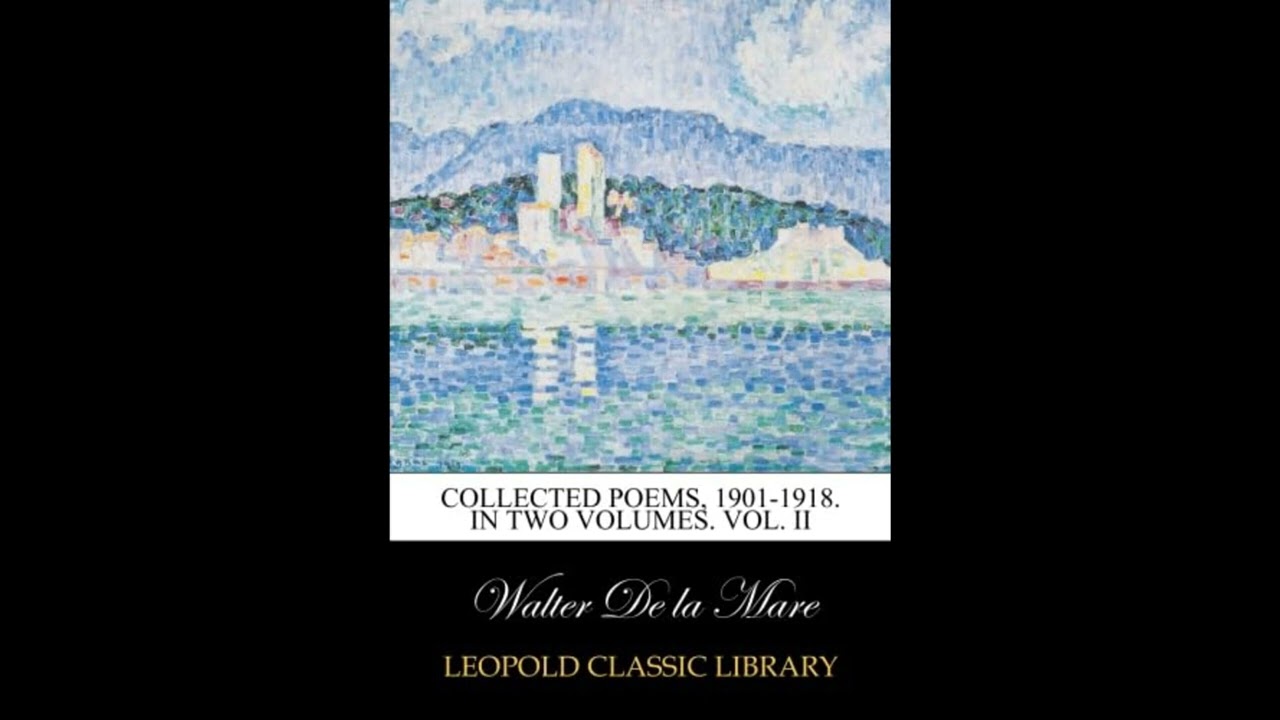
Collected poems, 1901-1918. In two volumes. Vol. II
Step into a world where the veil between waking life and dream seems impossibly thin, where the echoes of childhood wonder mingle with the quiet shadows of memory and the supernatural. Walter De la Mare's "Collected Poems, 1901-1918, Volume II" offers a rare glimpse into the formative years of one of English literature's most distinctive voices, presenting a body of work that continues to resonate with listeners seeking both beauty and a profound sense of the mysterious. This collection is not merely an assemblage of verses; it is an invitation to experience the world through the poet’s unique lens, one that finds magic in the mundane and deep emotion in the ethereal. In an age often overwhelmed by noise, De la Mare’s poetry provides a sanctuary—a space of quiet contemplation where the imagination is not just permitted but actively encouraged to take flight. His artistry promises not only aesthetic pleasure but also a connection to universal feelings of yearning, awe, and a gentle melancholy that speaks to the human condition across generations. This second volume of De la Mare's collected poems from the early 20th century carries us through a landscape defined as much by inner sensation as by external observation. The setting often hovers between the familiar English countryside—its ancient trees, winding lanes, and quiet cottages—and a more elusive, psychological terrain of twilight, dreams, and hidden presences. We encounter a varied cast of "characters" within these verses: mischievous children playing out their innocent dramas, lonely travelers pausing at forgotten inns, ancient figures burdened with memories, and even unseen spirits rustling through moonlit gardens. The central thread connecting these disparate elements is the poet's unwavering sensitivity to the subtle shifts of mood and the unspoken feelings that color human experience. Listeners will find themselves drawn into a gentle unfolding, where the arc of the "story" is less about sequential events and more about the progression of an internal world. The poems move from lighter, more overtly whimsical pieces, often focused on childhood and nature, towards verses imbued with a growing sense of the uncanny, the poignant, and even the somber. This collection allows us to witness a mind grappling with themes of transience and the elusive nature of beauty, often couched in imagery that is both precise and suggestive. The "conflict", if one can call it that, arises from the poet's quiet struggle to articulate the ineffable—the whisper of a forgotten name, the fleeting glimpse of a distant shore, the strange logic of a dream. He seeks to capture the liminal spaces of existence, the moments where reality seems to shimmer with other possibilities, creating an emotional landscape that is both comforting in its beauty and disquieting in its subtle hints of the unknown. Walter De la Mare (1873-1956) remains a celebrated figure in English letters, known for his unique blend of fantasy, lyrical verse, and psychological depth. Born in Charlton, Kent, De la Mare began his career working for Standard Oil, a position he held for nearly two decades while secretly cultivating his passion for writing. It was not until 1908, upon receiving a Civil List pension, that he was able to dedicate himself entirely to literature, a turning point that unleashed a prolific and distinguished career spanning over fifty years. His early life in rural England and his later literary associations profoundly shaped his distinct voice. De la Mare’s prolific output included not only poetry but also acclaimed short stories, novels, and children's books. He penned classic tales like "The Listeners," a poem instantly recognizable for its atmospheric suspense and enigmatic narrative, and "Peacock Pie," a much-loved collection of verses for younger readers that nonetheless appeals to adults for its sheer poetic inventiveness. His novel "Memoirs of a Midget" garnered the James Tait Black Memorial Prize in 1921, further cementing his reputation as a prose stylist. Though often associated with the Georgian poets of his era—a group who sought to return to a more traditional, lyrical style, focusing on English rural life—De la Mare stood apart. While sharing their love for nature and simpler forms, his work possessed a profound psychological dimension and an almost mystical quality that distinguished it, placing him as a unique bridge between late Victorian romanticism and the burgeoning modernism of the early 20th century. He was honored with the Companion of Honour and the Order of Merit, affirming his significant place in the literary canon. The poems gathered here enact several enduring themes, foremost among them the power of childhood imagination and memory. De la Mare frequently revisits the innocent perspective of a child, not merely for nostalgic effect, but as a lens through which to perceive a world still brimming with wonder and latent mystery. Consider, for example, verses that depict children playing simple games or contemplating everyday objects; through De la Mare's eyes, these scenes become imbued with a deep, almost sacred significance, suggesting that the purity of early vision holds a key to understanding deeper truths. Another prevalent theme is the spectral and the liminal. He masterfully evokes a sense of unseen presences and the thinness of the veil between worlds, often through descriptions of twilight, dreams, or isolated settings. A lonely traveler knocking at an empty house, a figure glimpsed in a fleeting shadow, or the quiet rustle of leaves in an abandoned garden—these elements consistently hint at something beyond immediate perception, creating an atmosphere that is at once eerie and profoundly beautiful, inviting contemplation of existence's hidden layers. Further, De la Mare frequently engages with themes of transience and quiet melancholy. Many poems reflect on the fleeting nature of beauty, the inevitability of loss, and the gentle ache of memory. He often achieves this not through overt statements of sadness, but through delicate imagery—a fading flower, a forgotten tune, the quiet passage of seasons—that carry an undertone of wistful contemplation. This particular collection also displays a persistent fascination with nature's inherent beauty and its capacity for mystery. Rather than merely describing landscapes, De la Mare animates the natural world, imbuing trees, birds, and stars with an almost sentient quality, as if they hold secrets waiting to be whispered. His literary significance lies in his sustained ability to fuse the plain spoken with the profound, creating verse that is accessible yet deeply resonant, often exploring subconscious anxieties and spiritual longings with a deceptively simple grace. This period, from 1901 to 1918, was a time of immense change in England and across the globe. It spanned the Edwardian era, characterized by a lingering sense of Victorian stability mixed with burgeoning social and technological shifts, and the vast majority of World War I. While De la Mare was broadly associated with the Georgian movement, which sought to distinguish itself from Victorian grandiloquence with a focus on lyrical beauty and English rural subjects, his work often transcended its perceived limitations. Many poets of the latter half of this period would come to articulate the horrors of the Great War with brutal realism. De la Mare, however, offered a different kind of response. Rather than direct depictions of the trenches, his poems written during and around the war years often provided an alternative space—a refuge of imagination, dream, and spiritual inquiry. The heightened sense of loss, the questioning of reality, and the yearning for simpler, more beautiful worlds found in his verse can be understood as a profound cultural counterpoint to the collective trauma of the era, a way of processing overwhelming events through metaphor and the enduring power of the human spirit. To listen to Walter De la Mare's "Collected Poems, 1901-1918, Volume II" as an audiobook is to grant these verses an added dimension of life. The very sound of his words, with their carefully chosen rhythms and melodies, truly flourishes when spoken aloud. A skilled narrator can bring out the nuanced pacing, the subtle shifts in emotional register, and the inherent musicality of De la Mare’s lines, allowing the listener to fully sink into the atmospheres he conjures. With several hours of content, this audiobook provides an extended period for quiet contemplation, perfect for long walks, moments of rest, or simply as an accompaniment to a peaceful evening. The narrative voice becomes a guide through the poet’s inner world, highlighting the delicate interplay of sound and sense that might be missed on the page, deepening the sense of wonder, mystery, and gentle melancholy that defines De la Mare's unique and lasting contribution to literature.
Enjoyed Collected poems, 1901-1918. In two volumes. Vol. II? A few ways to support us
Audible & Amazon links are affiliate; we may earn a small commission at no extra cost.
About this production
Human narration by a volunteer reader from LibriVox.org, the public-domain audiobook project. LibriVox volunteers record literary works whose copyright has expired in the United States, releasing the resulting recordings into the public domain.
Collected poems, 1901-1918. In two volumes. Vol. II by Walter De la Mare. The underlying text is in the U.S. public domain. We do not republish any modern copyrighted edition, translation, or commentary.
The 4K cinematic visuals accompanying this audiobook are generated by an AI image model from prompts derived from the source text. No copyrighted photos, paintings, or stock footage are used. AI generation is disclosed on every video on our YouTube channel as required by YouTube's altered/synthetic content policy.
English subtitles are transcribed from the LibriVox recording with OpenAI Whisper. Translations into the 11 other supported languages are produced by Meta's NLLB-200 neural translation model. No human translator's copyrighted translation is used.
Questions about sourcing or rights? See our DMCA & Sourcing policy or contact us.
Enjoyed this audiobook?
If you'd like to own a copy of Collected poems, 1901-1918. In two volumes. Vol. II or hear a professionally produced edition, the links below help support free audiobook production at no extra cost to you.
As an Amazon Associate we earn from qualifying purchases. Audible / print links are affiliate.