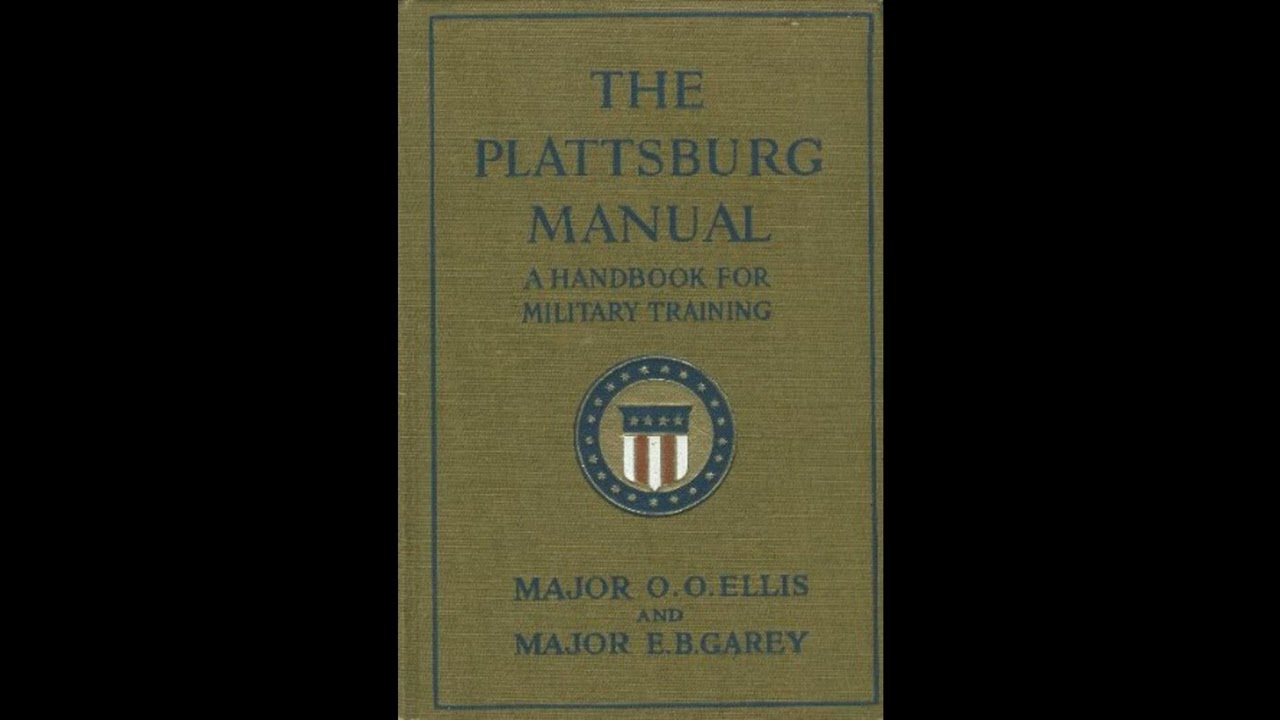
The Plattsburg Manual: A Handbook for Military Training
Step back into a pivotal moment in American history, when the nation wrestled with its role on the global stage and ordinary citizens answered an extraordinary call to arms. The Plattsburg Manual: A Handbook for Military Training is not a conventional narrative with fictional heroes, but an intensely practical and profoundly telling document from a bygone era, a direct window into the minds and methods that shaped a generation of citizen-soldiers. This manual, a cornerstone of the American Preparedness Movement, codified the knowledge and discipline deemed essential for civilians readying themselves for potential conflict. Listening to its precise instructions today allows us to grasp not just the tactical minutiae of early 20th-century warfare, but also the civic ideals, the earnest sense of duty, and the very spirit that animated a nation on the brink of a world war. It is a historical artifact that speaks volumes about national identity, military culture, and the transformation of a peacetime society into one prepared for battle. This unique handbook charts a systematic path for the aspiring soldier, commencing with the very fundamentals of military life and gradually advancing to the complexities of field maneuvers. The setting is less a geographical location and more a state of mind: the American civilian contemplating service, the drill field, the barracks, and the theoretical battlegrounds where courage and discipline would be tested. The central figures are, in essence, the nameless recruit and the authoritative instructor. The manual’s "story" unfolds as a meticulously structured curriculum. It begins with physical conditioning, the foundational elements of marching, standing, and basic personal hygiene necessary for the rigors of camp life. From there, it progresses to the handling of weapons, the intricacies of rifle drill, and the proper care of equipment, transforming a civilian into a disciplined, functional part of a larger military machine. The progression continues into more complex subjects, such as trench construction, the use of field artillery, and the principles of military sanitation, which was a critical concern in an era where disease could be as deadly as enemy fire. The implicit conflict woven throughout the manual is the stark reality of unpreparedness versus the urgent demand for military competence. It is about bridging the gap between civilian life and the exacting standards of the armed forces. The arc of this "story" traces the transformation from an individual civilian into a cohesive unit member, ready to understand and execute orders, to act decisively under pressure, and to contribute to the collective defense. The handbook culminates in an understanding of tactics, leadership, and the broader strategic thinking required on the battlefield, all without revealing a traditional narrative ending, as its purpose is to instruct, not to conclude a fictional tale. The authorship of The Plattsburg Manual is attributed to "Unknown," a designation that speaks volumes about its genesis and purpose. This was not the work of a single literary figure crafting a personal narrative, but rather a collaborative effort, a crystallization of military wisdom and educational methodology gathered during a specific historical moment. The manual emerged directly from the Plattsburg Movement, a series of civilian military training camps held in Plattsburgh, New York, and other locations across the United States between 1915 and 1917. These camps were designed for businessmen, professionals, and college students who volunteered their summers to receive intensive military instruction, driven by a growing national preparedness sentiment ahead of America's entry into World War I. It is highly probable that the manual was compiled by a committee of experienced military officers, educators, and strategists intimately involved with the Plattsburg camps themselves. Figures like Major General Leonard Wood, a key proponent and organizer of the movement, or other high-ranking officers and instructors, would have overseen its creation. Their goal was to produce a standardized, accessible text that could effectively transmit essential military knowledge to a civilian populace with no prior experience. Thus, the "author" of The Plattsburg Manual can be understood not as an individual, but as the collective expertise and urgent purpose of the American military establishment and its civilian allies during a critical period of national re-evaluation and preparation. It serves as a distillation of the era's military doctrine, civic expectations, and pedagogical approaches to creating a ready reserve force. Several powerful themes resonate throughout the pages of this handbook, transcending its purely instructional nature. First among them is Civic Duty and Patriotism. The manual inherently assumes a willingness on the part of the civilian to serve the nation, framing military training not merely as a skill acquisition, but as a fulfillment of a moral obligation. For instance, sections outlining the importance of respecting superiors and adhering to regulations implicitly underscore the idea that personal freedoms are temporarily subsumed by the greater good of national defense. Another core theme is Discipline and Order. Every instruction, from the precise measurements for a military step to the systematic procedure for cleaning a rifle, emphasizes the necessity of strict adherence to rules and the beauty of synchronized action. The detailed diagrams and step-by-step instructions for drill exemplify this, showing how individual movements coalesce into a formidable, coordinated unit. Furthermore, The Plattsburg Manual enacts the theme of Transformation and Self-Improvement. It posits that through rigorous training, an ordinary citizen can be forged into a capable, responsible, and effective soldier. The manual’s progressive structure—moving from basic physical exercises to complex tactical maneuvers—mirrors this developmental arc, suggesting that character, resilience, and leadership are cultivated through systematic effort. For example, the detailed guidance on physical training and endurance not only builds muscle but also instills mental fortitude. Lastly, the manual confronts the Demands of Modern Warfare. While appearing rudimentary by today's standards, its inclusion of topics like trench warfare, field sanitation, and specific weapon handling reflects the brutal realities and technological advancements of the early 20th century battlefield, moving beyond romanticized notions of cavalry charges to the gritty practicalities of industrialized conflict. This manual emerged from a very specific and anxious moment in American history. From 1914 to 1917, the United States maintained a policy of neutrality as World War I raged across Europe. However, beneath the surface of official non-intervention, a powerful "Preparedness Movement" gained momentum. Business leaders, former presidents like Theodore Roosevelt, and military strategists grew increasingly concerned about the nation's woefully inadequate defense capabilities should it be drawn into the conflict. Culturally, there was a strong debate between isolationists who wished to avoid entanglement in European affairs and interventionists who believed America had a moral and strategic imperative to act. The Plattsburg camps, and consequently this manual, were a direct response to this anxiety. They aimed to demonstrate that a civilian population, if properly trained, could form a vital national reserve force, a citizen army capable of defending the nation without resorting to a large, expensive standing army, which many Americans viewed with suspicion. Politically, President Woodrow Wilson initially resisted calls for increased military spending, but public opinion, fueled by submarine warfare and propaganda, gradually shifted. The Preparedness Movement, exemplified by Plattsburg, played a significant role in this shift, advocating for universal military training and a stronger defense posture. The manual, therefore, wasn't just a guide; it was a political statement, a practical manifestation of a societal belief that citizens had a responsibility to be ready for national service. It represented an earnest, almost idealistic effort to democratize military knowledge, ensuring that if the call came, Americans from all walks of life would have the basic skills to contribute effectively to the war effort, embodying a spirit of collective responsibility in the face of global upheaval. Listening to The Plattsburg Manual as an audiobook offers a uniquely immersive and illuminating experience. The inherent didactic nature of the text lends itself beautifully to an authoritative, clear narration that guides you through its instructions as if you yourself are the recruit on the drill field. The several-hour run length allows for a deliberate pace, giving you ample time to absorb the detailed explanations and reflect on their historical implications without feeling rushed. A skilled narrator's voice, perhaps with a certain gravitas, can effectively evoke the seriousness of the content, the discipline it demanded, and the profound historical weight of the era it represents. While there is no "dialogue" in the traditional sense, the precise, instructional language acts as a direct communication from the past, inviting you to listen for the subtle rhythms of military command and the prevailing attitudes towards duty and order. It is an auditory gateway, transporting you to an era when the sound of a drill sergeant's bark and the rustle of a manual's pages were the sounds of a nation bracing for its moment on the world stage.
Enjoyed The Plattsburg Manual: A Handbook for Military Training? A few ways to support us
Audible & Amazon links are affiliate; we may earn a small commission at no extra cost.
About this production
Human narration by a volunteer reader from LibriVox.org, the public-domain audiobook project. LibriVox volunteers record literary works whose copyright has expired in the United States, releasing the resulting recordings into the public domain.
The Plattsburg Manual: A Handbook for Military Training. The underlying text is in the U.S. public domain. We do not republish any modern copyrighted edition, translation, or commentary.
The 4K cinematic visuals accompanying this audiobook are generated by an AI image model from prompts derived from the source text. No copyrighted photos, paintings, or stock footage are used. AI generation is disclosed on every video on our YouTube channel as required by YouTube's altered/synthetic content policy.
English subtitles are transcribed from the LibriVox recording with OpenAI Whisper. Translations into the 11 other supported languages are produced by Meta's NLLB-200 neural translation model. No human translator's copyrighted translation is used.
Questions about sourcing or rights? See our DMCA & Sourcing policy or contact us.
Enjoyed this audiobook?
If you'd like to own a copy of The Plattsburg Manual: A Handbook for Military Training or hear a professionally produced edition, the links below help support free audiobook production at no extra cost to you.
As an Amazon Associate we earn from qualifying purchases. Audible / print links are affiliate.
More by Unknown



More Audiobooks
Lectures on Land Warfare: A Tactical Manual for the Use of Infantry Officers: An Ex
Cavalry In Future Wars
Fighting Instructions, 1530-1816 - Publications Of The Navy Records Society Vol. XX

A Soldier's Life: Being the Personal Reminiscences of Edwin G. Rundle