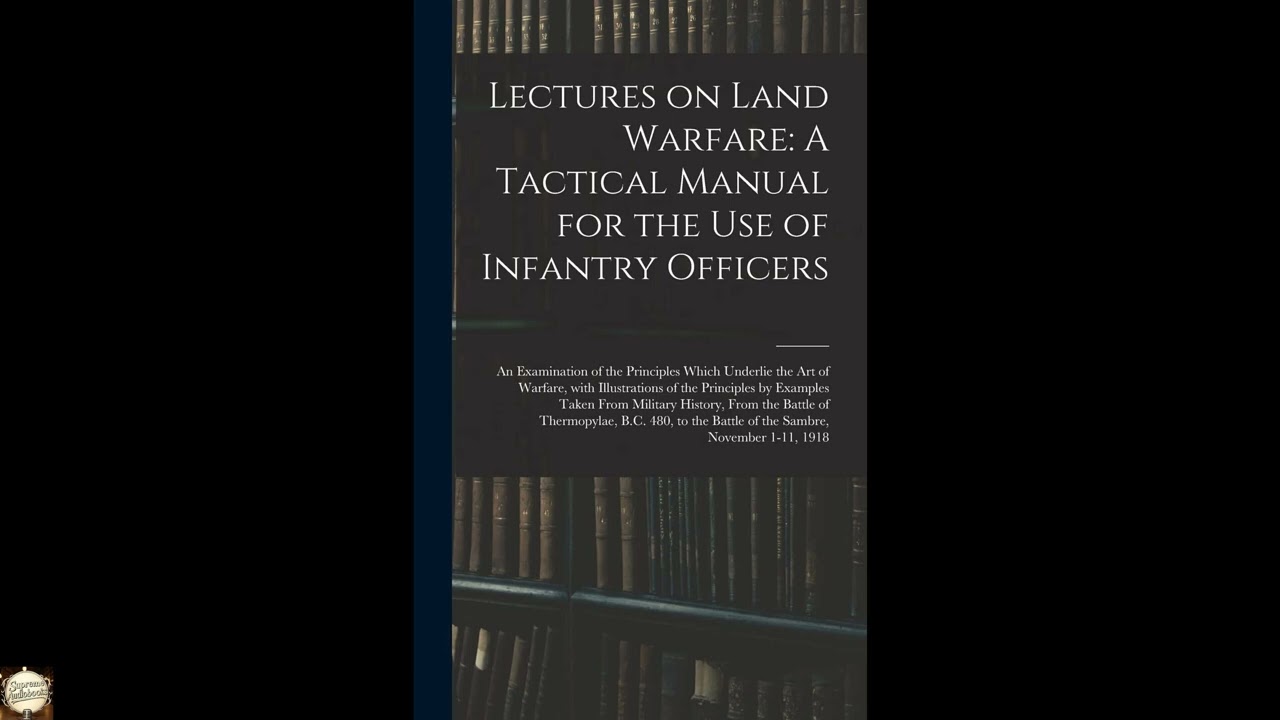
Lectures on Land Warfare: A Tactical Manual for the Use of Infantry Officers: An Ex
The clamor of battle might seem a world away from the quiet contemplation of a book, yet throughout history, the most critical conflicts have often been decided long before a single shot was fired—they were won or lost in the minds of those who studied, strategized, and trained. Lectures on Land Warfare: A Tactical Manual for the Use of Infantry Officers: An Ex offers a fascinating portal into this realm of strategic thought, presenting a detailed framework for understanding the relentless, high-stakes art of infantry combat. This is not merely a dusty relic; it is a profound articulation of enduring principles concerning leadership, logistics, and the human element in conflict, offering insights that resonate far beyond the battlefield, speaking to the challenges of decision-making under pressure and the organization of collective effort that remain vital in any demanding field. It allows us to grasp the intellectual scaffolding upon which the modern military mind was built, revealing how structured thought was applied to the most chaotic of human endeavors. The content of Lectures on Land Warfare unfolds as a systematic curriculum designed to forge effective military leaders. The "setting," if one can call it that, is the crucible of the hypothetical battlefield and the rigorous intellectual environment of a staff college or training academy. The primary "characters" are, implicitly, the seasoned instructor delivering these lectures and the aspiring infantry officer absorbing every detail—a young man or woman (though historically, predominantly men) burdened with immense future responsibilities. The central "conflict" is the eternal struggle between the unpredictable, devastating reality of war and the human desire to impose order, strategy, and decisive action upon it. The instruction begins with foundational principles: the structure of units, the fundamentals of drill, and the importance of discipline, laying the groundwork for organized movement and coordinated action. As the lectures progress, the scope broadens dramatically, mirroring the increasing complexity an officer would face in the field. Listeners are guided through the intricacies of reconnaissance, scouting, and intelligence gathering—the eyes and ears of an advancing force. The manual then dissects the mechanics of both offensive and defensive operations, detailing everything from effective deployment strategies and the utilization of terrain to the art of holding a position against superior numbers. Logistics, the often-overlooked backbone of any campaign, receive extensive attention, covering supply lines, communications, and the management of personnel. Each lecture builds upon the last, culminating in a holistic understanding of how individual tactical decisions contribute to broader strategic objectives, all while emphasizing the profound weight of an officer's command and the lives entrusted to their judgment. The narrative arc, therefore, is not one of a hero's personal struggle, but of an intellectual ascent, leading the listener from basic concepts to the sophisticated demands of battlefield command. Though the precise identity of the author of Lectures on Land Warfare remains a mystery, relegated to the anonymity of "Unknown," this circumstance itself provides a compelling insight into the work's historical context and significance. This is not the singular vision of an individual literary figure, but rather a distillation of accumulated institutional wisdom, likely compiled from the pedagogical materials of a military academy or the collected experiences of multiple seasoned officers. Such texts emerged during a pivotal era in military history, generally considered to be the late 19th or early 20th centuries, a time when armies across the globe were undergoing a profound transformation. They were transitioning from personalized commands and ad-hoc arrangements to highly professional, standardized forces, complete with formalized training, staff colleges, and a concerted effort to codify effective doctrine. This manual, therefore, represents the collective intellectual effort to professionalize the officer corps, standardizing best practices and ensuring a baseline of tactical competence across diverse units. It speaks to a period when the lessons of past conflicts—such as the American Civil War or the various colonial campaigns—were being meticulously analyzed, and new technologies like machine guns and improved artillery were forcing a re-evaluation of traditional battlefield tactics. The absence of a specific author's name lends the text a certain gravitas, suggesting that its contents are not merely opinion but rather a synthesis of established, proven methods, honed through experience and deliberation, intended to serve as a bedrock of military education for generations of officers. It stands as a testament to the ongoing need for rigorous thought and systematic preparation in the face of inevitable future conflicts. Lectures on Land Warfare enacts several profound themes that resonate far beyond its specific military context. First and foremost is the undeniable power of Discipline and Order. The manual meticulously breaks down complex maneuvers and organizational structures, illustrating how adherence to established protocols, precise drill, and hierarchical command can transform a disparate group of individuals into a formidable, cohesive fighting force. For example, the sections detailing the precise spacing of marching columns or the specific commands for changing formation underscore the absolute necessity of systematic execution to maintain unit integrity and operational efficiency in chaotic situations. This principle extends to the intellectual discipline required to plan and execute operations, emphasizing clear thinking over impulsive action. A second compelling theme is Leadership and Responsibility. While the manual is a tactical guide, it implicitly positions the officer as a figure of immense moral and practical burden. Every lesson, from managing supplies to deploying skirmishers, is presented as a task that falls under the officer's direct purview, requiring not just technical knowledge but also foresight, courage, and the ability to inspire confidence. The discussions of maintaining morale or assessing enemy intentions subtly highlight the psychological demands of command, where the well-being and performance of an entire unit hinge on one individual's decisions. A third theme is Adaptation and Contingency, subtly woven into the fabric of tactical discussions. While the lectures offer prescriptive advice, they also anticipate the inherent unpredictability of combat. Instructions on deploying flank guards or establishing reserve units illustrate the constant need to plan for the unexpected, to react swiftly to evolving threats, and to adjust strategies on the fly when initial plans inevitably encounter friction. This teaches a valuable lesson about the limits of control and the necessity of flexible thinking in any high-stakes environment. Culturally and politically, the era from which Lectures on Land Warfare likely emerged—the period roughly spanning the late 19th and early 20th centuries—was marked by immense change and often, intense geopolitical rivalry. It was an age of industrialization, scientific advancement, and the rise of nation-states with increasingly powerful and professionalized standing armies. The lessons of wars like the Franco-Prussian War (1870-1871) had profoundly influenced military thinkers, demonstrating the effectiveness of meticulous planning, rapid mobilization, and superior staff work. Empires were expanding or vying for global influence, leading to a constant need for trained officers capable of commanding complex expeditions and defending vast territories. This manual, therefore, emerged from a crucible of both technological innovation (e.g., repeating rifles, smokeless powder, early machine guns) and strategic re-evaluation, as military leaders grappled with how to integrate these new capabilities into existing doctrines while still maintaining the fundamental principles of maneuver and command. It reflects a moment when military theory was being rigorously formalized and standardized across the Western world, moving away from individual battlefield genius toward a more systematic, institutional approach to warfare. Listening to Lectures on Land Warfare as an audiobook offers a singular experience, transforming what could be a dry academic text into an immersive educational encounter. The several hours of content allow for a measured, deliberate pace, akin to attending a series of formal talks or a semester-long course. A skilled narrator can imbue the detailed tactical instructions with a clarity and gravitas that elevates the material, guiding the listener through complex concepts without overwhelming them. The methodical unfolding of information, from basic formations to intricate battle plans, lends itself well to auditory reception, allowing the listener to absorb the structure of military thought without the distraction of flipping pages or deciphering dense diagrams. One can absorb the rhythm of military instruction, the precise language used to describe movements, and the underlying philosophy that seeks to bring order to chaos. This format encourages a contemplative mode of engagement, inviting deep thought on strategy, leadership, and the enduring challenges of human conflict, all delivered with the cadence of a seasoned instructor sharing vital, hard-won knowledge.
Enjoyed Lectures on Land Warfare: A Tactical Manual for the Use of Infantry Officers: An Ex? A few ways to support us
Audible & Amazon links are affiliate; we may earn a small commission at no extra cost.
About this production
Human narration by a volunteer reader from LibriVox.org, the public-domain audiobook project. LibriVox volunteers record literary works whose copyright has expired in the United States, releasing the resulting recordings into the public domain.
Lectures on Land Warfare: A Tactical Manual for the Use of Infantry Officers: An Ex by John Bigelow. The underlying text is in the U.S. public domain. We do not republish any modern copyrighted edition, translation, or commentary.
The 4K cinematic visuals accompanying this audiobook are generated by an AI image model from prompts derived from the source text. No copyrighted photos, paintings, or stock footage are used. AI generation is disclosed on every video on our YouTube channel as required by YouTube's altered/synthetic content policy.
English subtitles are transcribed from the LibriVox recording with OpenAI Whisper. Translations into the 11 other supported languages are produced by Meta's NLLB-200 neural translation model. No human translator's copyrighted translation is used.
Questions about sourcing or rights? See our DMCA & Sourcing policy or contact us.
View 10 famous quotes from this book →
Enjoyed this audiobook?
If you'd like to own a copy of Lectures on Land Warfare: A Tactical Manual for the Use of Infantry Officers: An Ex or hear a professionally produced edition, the links below help support free audiobook production at no extra cost to you.
As an Amazon Associate we earn from qualifying purchases. Audible / print links are affiliate.