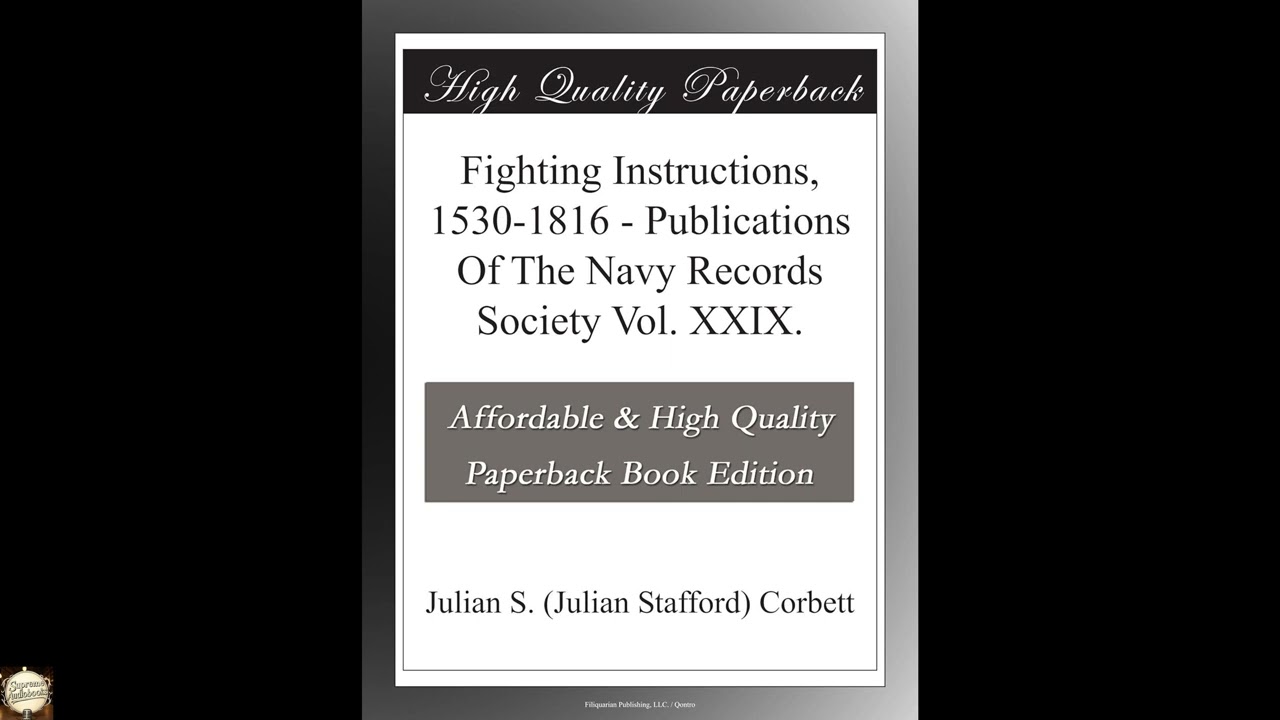
Fighting Instructions, 1530-1816 - Publications Of The Navy Records Society Vol. XX
Step into the command rooms and onto the quarterdecks of history as you uncover the very blueprints of naval power from the dawn of England's maritime might to the zenith of the Age of Sail. "Fighting Instructions, 1530-1816," presented as Volume XX of the esteemed Publications Of The Navy Records Society, is not a story told about events, but the events themselves, captured in the directives that shaped centuries of naval warfare. This vital collection presents the actual orders, signals, and tactical doctrines issued by admirals and the Admiralty that defined how fleets engaged, maneuvered, and fought across three hundred years. For anyone who has ever wondered how complex naval engagements were choreographed, how commanders imposed their will across miles of ocean, or how the tactics of the greatest seafaring nations evolved, this extraordinary resource provides a direct, unvarnished insight, offering a profound understanding of the strategic minds that forged empires and defended nations. The narrative arc of these instructions begins in an era where naval warfare was still finding its footing. The early directives, dating from the reign of Henry VIII, reveal a relatively nascent organization, with commands often focusing on basic formations and the necessity of individual ship captains staying close to their flagship. As the years progress, the instructions become increasingly sophisticated, reflecting both technological advancements—such as improved gunnery and ship design—and a growing understanding of fleet-level tactics. Listeners will observe the gradual formalization of the line of battle, a revolutionary concept that sought to maximize broadside fire and bring order to the chaos of combat. This section of the collection illustrates the continuous problem-solving inherent in naval strategy, as commanders grappled with issues of communication, discipline, and the sheer logistical challenge of coordinating dozens of massive warships. As the centuries unfold, particularly through the Dutch Wars and the great Anglo-French contests, the instructions detail the refinement of signal systems, moving beyond simple flag hoisting to complex code books that allowed for nuanced communication across a sprawling fleet. The "plot" here is the constant striving for tactical advantage, adapting to the enemy's innovations, and the relentless pursuit of decisive victory. The "characters" are the aggregate of naval leadership, from anonymous committee members to legendary figures whose tactical philosophies are enshrined in these very words. The central "conflict" is the eternal struggle for command of the sea, played out not just in cannon fire but in the careful, precise language of official orders. The story culminates in the sophisticated doctrines of the late 18th and early 19th centuries, reflecting the strategic brilliance of figures like Horatio Nelson, whose aggressive pursuit of enemy fleets and emphasis on close-quarters fighting were both products of and contributors to the evolving instructions of the era, pushing the boundaries of what was considered possible at sea. Given that the authorship of "Fighting Instructions, 1530-1816" is listed as Unknown, this section instead illuminates the genesis and nature of the work itself and the tradition it represents. These are not the musings of a single historian or theorist, but the cumulative wisdom, experience, and authority of the British Admiralty and its most prominent commanders over nearly three centuries. The Navy Records Society, founded in the late nineteenth century, undertook the crucial task of systematically collecting, editing, and publishing these invaluable primary sources. Their mission was, and remains, to foster a deeper appreciation and understanding of British naval history by making original documents accessible to scholars and the public. This particular volume stands as a testament to the meticulous dedication of the Society's editors, who painstakingly compiled these directives from various archival repositories. Each instruction, each signal, each general order represents a snapshot in time, a direct echo of the strategic thinking and practical considerations that governed naval operations. The "authors" are therefore the collective institution of the Royal Navy itself, from its earliest Tudor form to its Napoleonic War peak—a continuous body of professional expertise shaping the world's most powerful maritime force through written decree. Several profound themes emerge from a careful consideration of these historical documents. One prominent theme is the evolution of command and control. Early instructions often leave much to the individual captain's discretion once battle was joined, simply urging them to engage the enemy. Over time, however, we witness a clear movement towards more centralized and sophisticated control, with detailed instructions on formations, signaling, and even post-engagement procedures. For example, early instructions might simply mandate "fight bravely," while later examples feature complex signal tables with hundreds of distinct messages, allowing an admiral to direct individual ships' movements, target specific enemy vessels, or adjust tactics mid-battle. This shift vividly illustrates the increasing professionalization and systematization of naval warfare. Another significant theme is the interplay between technology and tactics. As gunnery improved and ships became larger and more robust, the instructions adapted. The emphasis on the "line of battle," for instance, directly correlates with the development of ships capable of delivering devastating broadsides, requiring a formation that maximized this firepower while minimizing vulnerability. A specific scene enacted throughout the text, though not a narrative scene, is the constant revision of diagrams showing fleet formations, demonstrating how a new type of cannon or a faster ship design could necessitate an entirely new set of fighting instructions to capitalize on or mitigate the change. This collection reveals how practical innovation on the battlefield translated directly into official doctrine, shaping the very way wars were fought at sea. The period covered by "Fighting Instructions, 1530-1816" was one of monumental global transformation. It spans the age of European expansion, intense colonial rivalries, and the establishment of vast seaborne empires. Politically, nations like England, France, Spain, and the Netherlands were vying for global dominance, and naval supremacy was often the decisive factor. Culturally, the professionalization of the military, particularly the navy, was a significant development, moving away from ad-hoc forces to highly trained, disciplined organizations. These instructions did not just emerge during this period; they were an intrinsic, active component of it. They were the very means by which nations projected power, protected trade routes, and waged war across continents, reflecting the strategic imperatives and operational realities of a world rapidly becoming interconnected through maritime travel. The publication of this collection in the late nineteenth century reflects a subsequent desire to consolidate and understand Britain's past maritime glory, providing the raw material for historians to analyze how an island nation came to rule the waves. Listening to "Fighting Instructions, 1530-1816" as an audiobook offers a unique and intimate engagement with these historical documents. The clarity of the narration allows listeners to absorb the often precise and formal language of the directives without the visual distractions of a printed page. With a runtime of several hours, this allows for a substantial, unhurried immersion into the shifting doctrines and strategic philosophies. As you listen, pay close attention to the evolution of the language itself—how commands become more standardized, more technical, and less reliant on generalized exhortations. The pacing of the narration ensures that even complex tactical descriptions are digestible, allowing the listener to visualize the fleets maneuvering and the orders being conveyed across wind and waves. This format brings the stark, functional beauty of these operational manuals to life, providing a tangible sense of the atmosphere of command and the immense responsibility carried by naval leaders throughout history.
Enjoyed Fighting Instructions, 1530-1816 - Publications Of The Navy Records Society Vol. XX? A few ways to support us
Audible & Amazon links are affiliate; we may earn a small commission at no extra cost.
About this production
Human narration by a volunteer reader from LibriVox.org, the public-domain audiobook project. LibriVox volunteers record literary works whose copyright has expired in the United States, releasing the resulting recordings into the public domain.
Fighting Instructions, 1530-1816 - Publications Of The Navy Records Society Vol. XX by Publications Of The Navy Records Society Vol. XX. The underlying text is in the U.S. public domain. We do not republish any modern copyrighted edition, translation, or commentary.
The 4K cinematic visuals accompanying this audiobook are generated by an AI image model from prompts derived from the source text. No copyrighted photos, paintings, or stock footage are used. AI generation is disclosed on every video on our YouTube channel as required by YouTube's altered/synthetic content policy.
English subtitles are transcribed from the LibriVox recording with OpenAI Whisper. Translations into the 11 other supported languages are produced by Meta's NLLB-200 neural translation model. No human translator's copyrighted translation is used.
Questions about sourcing or rights? See our DMCA & Sourcing policy or contact us.
Enjoyed this audiobook?
If you'd like to own a copy of Fighting Instructions, 1530-1816 - Publications Of The Navy Records Society Vol. XX or hear a professionally produced edition, the links below help support free audiobook production at no extra cost to you.
As an Amazon Associate we earn from qualifying purchases. Audible / print links are affiliate.