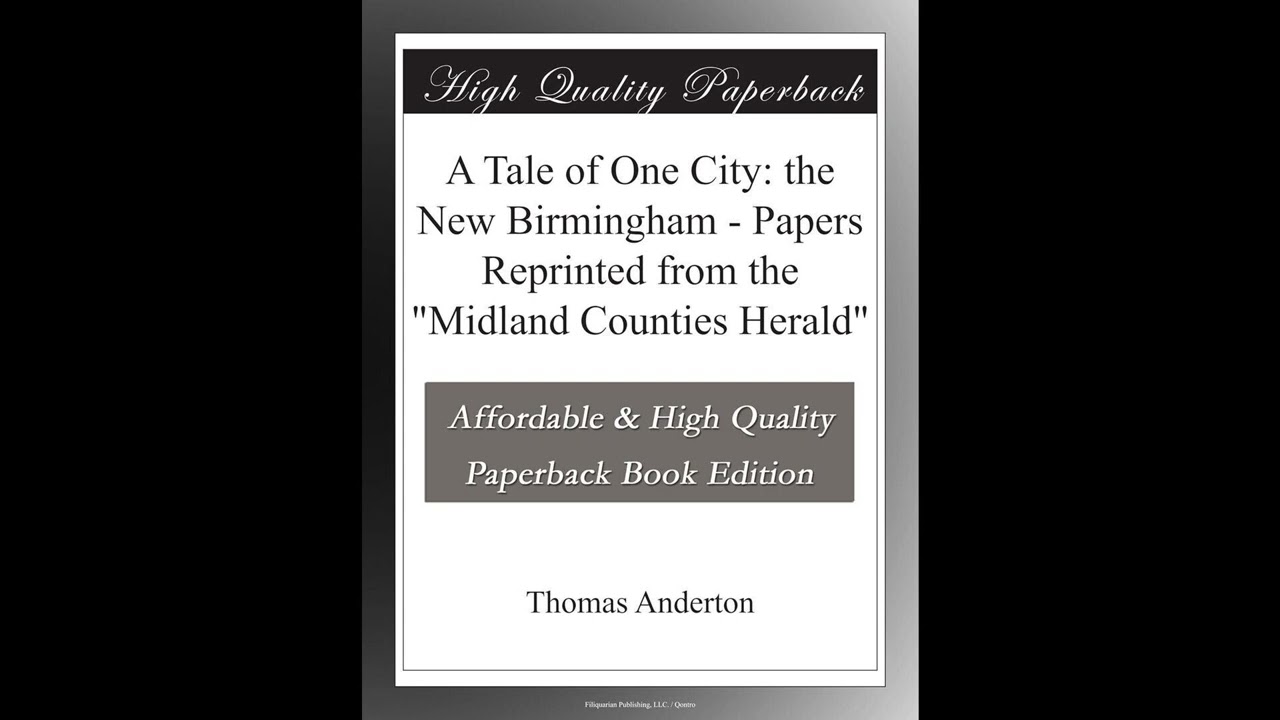
A Tale of One City: the New Birmingham - Papers Reprinted from the "Midland Counties- Full Audiobook
Cities are living entities, constantly reshaping themselves, their identities forged in the fires of industry, innovation, and human endeavor. "A Tale of One City: the New Birmingham," a collection of papers reprinted from the "Midland Counties," offers an extraordinary opportunity to witness this metamorphosis firsthand. This audiobook is not merely a historical document; it is a resonant echo from a pivotal era, capturing the spirit and challenges of a burgeoning metropolis as it grappled with rapid change. For anyone fascinated by urban development, the social fabric of industrial society, or the enduring legacy of Victorian ambition, this collection provides an unparalleled, intimate look at the making of a modern city, allowing listeners today to understand the very foundations upon which contemporary urban life is built. This collection provides a panoramic view of Birmingham at a critical juncture in its development, likely spanning the late nineteenth and early twentieth centuries. Rather than following individual characters, the narrative protagonist here is Birmingham itself—its streets, its factories, its people, and its evolving civic consciousness. The "papers" are vignettes and observations, each contributing a brushstroke to a larger portrait of a city in flux. Listeners will encounter detailed descriptions of burgeoning industries, from the roar of the metalworks to the precision of the jewelry quarter, illustrating how Birmingham earned its moniker as "the workshop of the world." The arc of the collection charts a progression from detailed reportage on new infrastructure projects—like expanded tram networks or improved sanitation systems—to thoughtful commentary on the social implications of such rapid growth. The central dynamic that unfolds is the constant tension between the forces of progress and the human experience within it. The papers highlight the immense energy and optimism that drove Birmingham's expansion, showcasing the entrepreneurial spirit and the vision of its civic leaders. Yet, they also subtly introduce the complexities and costs of this progress: the changing nature of work, the challenges of public health in densely populated areas, and the ongoing efforts to create a sense of community amidst demographic shifts. The collective voice of these papers draws a compelling picture of a city striving to balance its industrial might with the welfare of its inhabitants, painting an expansive picture of a city continually reinventing itself without revealing the ultimate outcomes of these transformative efforts. The "author" of this collection, while unknown as a single individual, represents a collective voice deeply embedded in the civic life of the Midlands. These papers, originally published in the "Midland Counties" publication, likely emerged from a tradition of local journalism and public discourse that flourished during a period of immense regional growth. Such publications served as vital forums for reporting on local events, critiquing municipal policies, and celebrating community achievements. The decision to reprint these specific papers under the title "A Tale of One City" suggests a deliberate effort to curate a definitive historical record, preserving snapshots of a specific historical moment for posterity. The anonymous nature of the authorship allows the focus to remain squarely on the city itself and the observable changes taking place. This tradition of collaborative observation, where multiple perspectives converge to create a comprehensive picture, was a hallmark of civic engagement in the era. It reflects an understanding that a city's story is too vast and too complex for any single individual to fully capture. Instead, it is the accumulation of many voices—journalists, social reformers, local historians, and thoughtful citizens—that truly reveals the spirit and struggles of a community striving to define its future amidst rapid transformation. A primary theme running through "A Tale of One City" is urbanization and its relentless pace. The papers vividly recount the expansion of Birmingham's physical footprint, detailing how fields became factories and quiet lanes transformed into bustling thoroughfares. For instance, one paper might describe the engineering marvel of a new canal system bringing goods into the city, while another focuses on the rapid construction of workers' housing, illustrating the sheer scale of the city's outward spread. This growth was inextricably linked to the theme of industrial transformation. Descriptions of new manufacturing techniques, the establishment of diverse industries—from button making to gun production—and the subsequent influx of labor demonstrate how Birmingham became a powerhouse of innovation and production. The text shows the city's industries not just as economic engines but as shapers of landscape and social structure. Another significant theme is social welfare and municipal reform. While the collection celebrates progress, it does not shy away from the social challenges inherent in rapid industrialization. Papers might discuss early efforts to improve public sanitation, establish parks for recreation, or address issues of poverty through philanthropic initiatives. These accounts highlight the burgeoning civic responsibility of the era, where local governments and private citizens alike grappled with the implications of housing vast populations and maintaining public health. The overarching literary significance of these papers lies in their direct, unvarnished portrayal of a specific time and place. They offer a unique window into the daily realities of urban life, the aspirations of its leaders, and the ground-level impact of historical forces, providing primary source material for understanding a pivotal period in British history. This collection emerged during a profound era of change in Britain, broadly encompassing the Victorian and Edwardian periods. Politically, it was a time of expanding local governance, with city councils gaining greater autonomy and responsibility for infrastructure, public health, and education. This spurred a robust discourse around civic improvement and municipal socialism. Culturally, there was an intense fascination with progress and innovation, tempered by a growing awareness of the social costs of industrialization—poverty, pollution, and crowded living conditions. This dual perspective often manifested in public commentary, leading to papers that both lauded advancements and called for reform. In the literary world, the late nineteenth century saw a rise in realism and naturalism, movements that prioritized depicting life as it truly was, often focusing on the struggles of the working classes and the impact of industrial society. While these papers are factual accounts rather than fiction, they share a similar spirit of detailed observation and social commentary prevalent in the literature of the time. The focus on a single city, its people, and its industries reflects a broader cultural interest in regional identity and the unique stories of Britain's diverse communities, making this collection a direct product of the intellectual and social currents of its day. Listening to "A Tale of One City" as an audiobook offers a uniquely immersive way to engage with this historical record. The narration brings these reprinted papers to life, transforming what might otherwise be purely academic texts into a vivid auditory experience. Over several hours, a skilled reader can imbue the descriptions of industrial landscapes and social conditions with a compelling resonance, allowing the listener to truly "hear" the city's past. Pay attention to the pacing, which can emphasize the careful, considered nature of the original reports, or the more urgent tone of calls for reform. The voice performing the text helps to convey the underlying sentiment of each paper, whether it is one of civic pride, cautious concern, or visionary ambition. This audio format creates an atmospheric portal, enabling a direct connection with the voices and concerns that shaped "the New Birmingham" and, by extension, much of modern urban society.
Enjoyed A Tale of One City: the New Birmingham - Papers Reprinted from the "Midland Counties- Full Audiobook? A few ways to support us
Audible & Amazon links are affiliate; we may earn a small commission at no extra cost.
About this production
Human narration by a volunteer reader from LibriVox.org, the public-domain audiobook project. LibriVox volunteers record literary works whose copyright has expired in the United States, releasing the resulting recordings into the public domain.
A Tale of One City: the New Birmingham - Papers Reprinted from the "Midland Counties- Full Audiobook. The underlying text is in the U.S. public domain. We do not republish any modern copyrighted edition, translation, or commentary.
The 4K cinematic visuals accompanying this audiobook are generated by an AI image model from prompts derived from the source text. No copyrighted photos, paintings, or stock footage are used. AI generation is disclosed on every video on our YouTube channel as required by YouTube's altered/synthetic content policy.
English subtitles are transcribed from the LibriVox recording with OpenAI Whisper. Translations into the 11 other supported languages are produced by Meta's NLLB-200 neural translation model. No human translator's copyrighted translation is used.
Questions about sourcing or rights? See our DMCA & Sourcing policy or contact us.
Enjoyed this audiobook?
If you'd like to own a copy of A Tale of One City: the New Birmingham - Papers Reprinted from the "Midland Counties- Full Audiobook or hear a professionally produced edition, the links below help support free audiobook production at no extra cost to you.
As an Amazon Associate we earn from qualifying purchases. Audible / print links are affiliate.