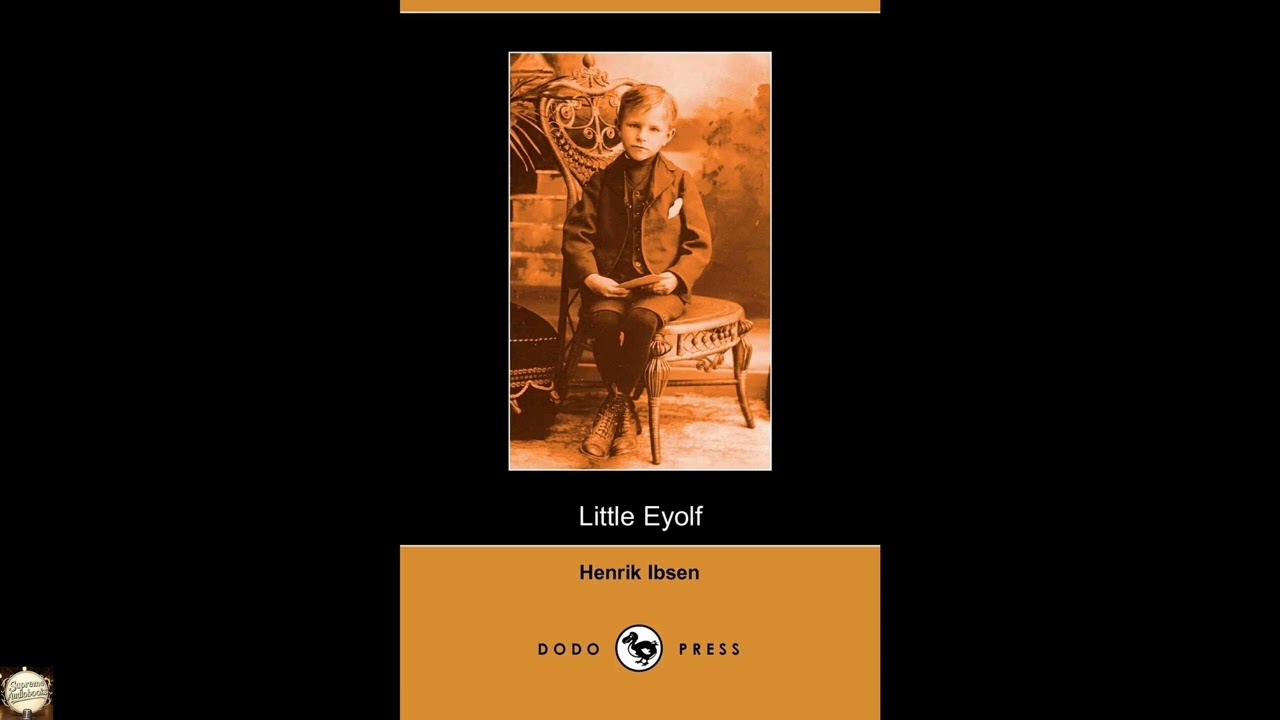
Little Eyolf
Henrik Ibsen’s Little Eyolf arrives as a profoundly moving and often unsettling examination of marriage, parenthood, and the relentless human search for purpose. Written in the twilight of Ibsen's celebrated career, this play cuts to the core of personal responsibility and the often-destructive power of love and neglect. It stands as a stark and beautiful testament to the idea that our most intimate relationships can either be our salvation or our undoing, offering a mirror to universal struggles that feel as immediate and vital today as they did over a century ago. The story invites us to question what we truly owe to ourselves, to our partners, and most poignantly, to our children, making it a compelling listen for anyone grappling with the complexities of human connection. The play unfolds within the seemingly tranquil confines of the Allmers' estate, nestled beside a majestic Norwegian fjord during the endless light of a northern summer. Here, we meet Alfred Allmers, a scholar recently returned from a transformative mountain retreat, abandoning his grand intellectual project—a treatise on human responsibility—with a sudden, fervent desire to dedicate himself solely to his young son, Eyolf. This radical shift in priorities sends ripples of unease through the household. His wife, Rita, a woman of intense passions and possessive love, finds her world upended. Her desire for Alfred’s undivided attention, both physical and emotional, clashes violently with his newfound, almost obsessive, devotion to their child. Eyolf himself, a frail boy with a crippled leg, becomes the focal point of their fractured lives. He is a constant, living reminder of an accident in infancy, a moment of parental neglect that forever altered his life and cast a long shadow over the Allmers’ marriage. Completing this uneasy triangle is Asta, Alfred’s half-sister, a woman of quiet strength and deep affection, who has largely served as Eyolf’s primary caregiver and confidante. As the summer days lengthen, and the characters are confined together, the pressure cooker of their unresolved emotions begins to build, exacerbated by the unsettling appearance of the Rat-Wife, a mysterious local woman who claims she can rid homes of unwanted "gnawing things." This encounter, steeped in folk superstition, precipitates a crisis that forces Alfred and Rita to confront their deepest fears, their mutual resentments, and the very foundations of their life together, without revealing the ultimate, heart-wrenching outcome that shapes their future. Henrik Ibsen, born in Skien, Norway in 1828, remains one of the most towering figures in the history of world drama. Often hailed as the "father of modern prose drama," Ibsen revolutionized the stage by moving away from romantic idealism and well-made plots toward a searingly honest portrayal of contemporary life and psychological realism. His early life was marked by his family's financial decline, a period of hardship that perhaps honed his keen eye for societal pressures and individual struggle. After an apprenticeship as an apothecary, he pursued a career in theatre management, first in Bergen and later in Christiania (now Oslo), gaining invaluable insight into stagecraft and dramatic structure. However, it was during his nearly three-decade self-imposed exile, spent mostly in Italy and Germany, that Ibsen truly found his voice, producing the major works that cemented his legacy. Plays like Brand and Peer Gynt established his poetic and philosophical range, but it was his social realism dramas such as A Doll's House, Ghosts, and An Enemy of the People that propelled him to international fame, challenging the prevailing social norms and hypocrisies of the late 19th century. Later works, including The Wild Duck, Hedda Gabler, and The Master Builder, saw him delve even deeper into the internal lives of his characters, exploring the complexities of human motivation with unprecedented psychological insight. Ibsen’s dramatic style—characterized by penetrating dialogue, carefully constructed symbolism, and profound emotional depth—continues to influence playwrights and resonate with audiences worldwide, long after his death in 1906. Little Eyolf enacts several profound themes that reveal the precarious balance of human existence. One central theme is the nature of love and its various, often destructive, forms. Rita’s passionate, almost animalistic love for Alfred is intensely possessive, manifested in her fiery jealousy and her desperate need for his physical presence and affection. This stands in stark contrast to Alfred’s more intellectualized, duty-bound love, and his sudden, fervent redirection of affection towards Eyolf. Scenes where Rita openly pleads with Alfred, her words burning with unmet desire, vividly expose the chasm between their emotional needs and the suffocating dynamic of their marriage. Another powerful theme is guilt and the burden of past actions. Eyolf’s crippled leg serves as a constant, harrowing symbol of the moment of parental neglect that caused his injury, a shared guilt that festers beneath the surface of Alfred and Rita’s interactions. Alfred’s aspiration to write a book on human responsibility feels ironically hollow given his own perceived failure. The characters are haunted by this past, and the play shows how such unaddressed guilt can poison relationships and prevent genuine connection, forcing a raw reckoning with moral accountability that Ibsen often staged so brilliantly. Little Eyolf was written and published in 1894, placing it firmly in Ibsen’s late period, a time when European society was undergoing profound shifts. The late 19th century was an era marked by increasing industrialization, scientific advancements, and a growing questioning of traditional morality and social structures. Psychology was emerging as a new field, and Ibsen’s plays, with their deep dives into character motivation and subconscious drives, resonated strongly with this new intellectual curiosity. Culturally, there was a growing appetite for drama that reflected real life, that challenged audiences rather than merely entertaining them. Ibsen, by this point, was a celebrated figure, yet he continued to innovate. His later plays, including Little Eyolf, often moved beyond the direct social critique of his middle period toward a more symbolic and introspective examination of individual consciousness and the human spirit. This work emerged as a reflection of its time’s anxieties concerning domestic life, the changing roles within marriage, and the psychological costs of unfulfilled desires and societal expectations. It represents Ibsen’s ongoing commitment to dissecting the human condition with unflinching honesty, even as the theatrical world around him was transitioning into new forms of dramatic expression. Listening to Little Eyolf as an audiobook offers a unique and compelling immersion into Ibsen’s world of psychological tension. A skilled narrator can bring the subtle nuances of Ibsen's dialogue to life, revealing the unspoken currents of emotion and the profound subtext simmering beneath the surface of every exchange. The several hours of listening time allow for a deep, contemplative engagement with the characters’ inner turmoil and the gradual unraveling of their lives. Listen closely for the shifts in pacing – the slow, deliberate build-up of domestic pressure, punctuated by moments of searing emotional intensity. The voice acting can expertly differentiate the characters, giving distinct life to Rita’s passionate outbursts, Alfred’s intellectualizing evasion, and Asta’s quiet strength. Through careful vocal delivery, the oppressive atmosphere of the remote Norwegian summer, the claustrophobic intimacy of the household, and the tragic inevitability of the unfolding drama are all conveyed, creating an experience that resonates long after the final words.
Enjoyed Little Eyolf? A few ways to support us
Audible & Amazon links are affiliate; we may earn a small commission at no extra cost.
About this production
Human narration by a volunteer reader from LibriVox.org, the public-domain audiobook project. LibriVox volunteers record literary works whose copyright has expired in the United States, releasing the resulting recordings into the public domain.
Little Eyolf by Henrik Ibsen. The underlying text is in the U.S. public domain. We do not republish any modern copyrighted edition, translation, or commentary.
The 4K cinematic visuals accompanying this audiobook are generated by an AI image model from prompts derived from the source text. No copyrighted photos, paintings, or stock footage are used. AI generation is disclosed on every video on our YouTube channel as required by YouTube's altered/synthetic content policy.
English subtitles are transcribed from the LibriVox recording with OpenAI Whisper. Translations into the 11 other supported languages are produced by Meta's NLLB-200 neural translation model. No human translator's copyrighted translation is used.
Questions about sourcing or rights? See our DMCA & Sourcing policy or contact us.
Enjoyed this audiobook?
If you'd like to own a copy of Little Eyolf or hear a professionally produced edition, the links below help support free audiobook production at no extra cost to you.
As an Amazon Associate we earn from qualifying purchases. Audible / print links are affiliate.