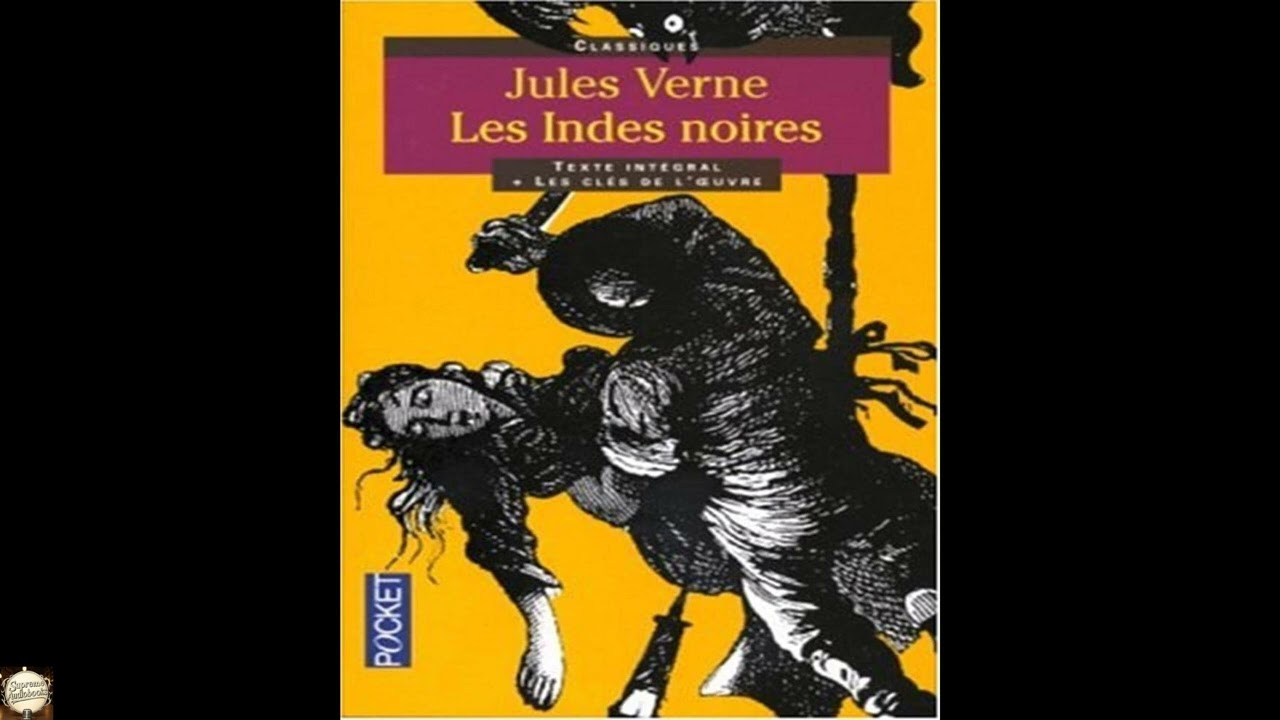
Les Indes noires
Step into a world where the sun never shines, where an entire community breathes, toils, and loves in the perpetual twilight of Earth's depths. Jules Verne's Les Indes noires, known in English as The Child of the Cavern or The Black Indies, stands as a singular entry in his celebrated collection of "Extraordinary Voyages." Far from the globe-trotting airships and submarines that populate many of his more famous tales, this novel grounds its wonder in the claustrophobic grandeur of an abandoned Scottish coal mine. It asks us to consider what humanity might build, and what we might become, when pushed to the absolute limits of known existence. Why does this subterranean saga resonate today? Perhaps because its vision of an old industry’s revival, its examination of human resilience against daunting odds, and its subtle blend of scientific curiosity with ancient superstition speak to our own contemporary anxieties about resources, community, and the persistent allure of the unknown. It’s a story of isolation and connection, of progress and peril, all unfolding in a setting as beautiful as it is terrifying. The story begins in the dramatic landscapes of the Scottish Highlands, specifically near Loch Katrine, where engineer James Starr receives a peculiar letter from his old foreman, Simon Ford. The letter invites Starr back to the long-defunct Aberfoyle coal mine, a place everyone believes has been utterly exhausted for a decade. But Ford’s letter hints at a startling discovery: a new, immense vein of coal, promising a second life for the forgotten pit. Intrigued, Starr returns, accompanied by Harry, Simon’s son, and they descend into the eerie silence of the old workings. What they find is far more than just coal; it’s an entire subterranean world. Deep within the mine, illuminated by a permanent methane flame and warmed by a geothermal spring, a new cavern has formed, complete with a lake, a forest of fungi, and an atmosphere perfectly suited for human habitation. Here, Simon Ford, his wife Madge, and their son Harry have established a unique, isolated existence. Their tranquil, if unusual, life is disrupted by a sequence of increasingly strange occurrences. Amidst the darkness and echoing passages, they discover a mysterious young woman named Nell, a true "child of the cavern," who has never seen the light of day. Her wild grace and uncanny connection to the mine’s secrets add an element of enchantment and danger to the budding community around the "New Aberfoyle" pit. As Starr and the Fords work to expand their operations, strange noises, unsettling apparitions, and acts of sabotage begin to plague them, hinting at a hidden presence, an intelligence that resents their intrusion into its dark domain. The conflict pits scientific endeavor against superstition, progress against a primordial force, and the fragile light of human ingenuity against the profound, ancient darkness that threatens to swallow them whole. The struggle intensifies as the small community faces an unseen adversary determined to drive them out of their miraculous underground sanctuary. The author behind this imaginative escape into the Earth's core was Jules Verne, a foundational figure in the development of science fiction. Born in Nantes, France, in 1828, Verne initially pursued a legal career, following his father's wishes. However, his true passion lay in literature and theater. His early efforts in playwriting and opera librettos introduced him to influential Parisian literary circles. A pivotal moment came with his meeting of publisher Pierre-Jules Hetzel, who saw the potential in Verne's unique blend of scientific fact and adventurous fiction. This partnership led to the creation of the "Voyages Extraordinaires" series, a collection of fifty-four novels that would define Verne's career and shape the future of popular literature. Verne's output was prodigious, and his creations captured the imaginations of millions, predicting technological advancements that were decades or even centuries away. His most famous works, such as Twenty Thousand Leagues Under the Seas (1870), which introduced the iconic Captain Nemo and his submarine Nautilus, and Around the World in Eighty Days (1873), a thrilling race against time, became instant classics. He also penned Journey to the Center of the Earth (1864), which shares a thematic link with Les Indes noires in its exploration of subterranean worlds, and From the Earth to the Moon (1865), anticipating space travel. Verne’s genius lay in his ability to blend meticulously researched scientific details with grand, fantastical adventures, creating narratives that were both educational and exhilarating. He is widely considered, alongside H.G. Wells, to be one of the "fathers of science fiction," influencing countless writers, scientists, and inventors with his optimistic yet often cautionary visions of humanity’s future. He passed away in Amiens in 1905, leaving behind a literary legacy that continues to inspire. Les Indes noires foregrounds several compelling themes. One central idea is the resilience of industry and the human spirit in the face of decline. The Aberfoyle mine, declared barren, represents a dying way of life. Starr’s return and Simon Ford’s unwavering belief in its potential symbolize the human capacity to innovate and find new purpose even in what appears to be exhausted. The novel portrays the sheer dedication of miners, who build not just an industry but an entire functioning society in the heart of the Earth. Another potent theme is human adaptation to extreme environments. The Fords and Nell, along with the burgeoning community, demonstrate remarkable ingenuity in carving out a habitable space far from the surface. They learn to navigate perpetual darkness, utilize unique resources, and forge social bonds under extraordinary conditions, illustrating how profoundly adaptable human beings are. The novel also grapples with the interplay between rational science and ancient superstition. James Starr represents the enlightened scientific mind, always seeking logical explanations for the bizarre occurrences in the mine. However, the deep, echoing caverns and the presence of Silfax, an enigmatic, almost spectral old miner, repeatedly challenge this rationality. The strange noises, the mysterious disappearances, and the pervasive sense of being watched evoke ancient Scottish legends of gnomes and kobolds, forces that defy simple scientific categorization. Finally, the story touches upon the tension between raw nature and burgeoning civilization. Nell, the child of the cavern, embodies the untamed, instinctive spirit of the subterranean world, initially uncomfortable with the trappings of surface life. Her gradual integration into the human community, while retaining her wildness, reflects the ongoing negotiation between humanity’s desire for order and the powerful, elemental forces that surround us. When Les Indes noires was published in 1877, the world was deeply immersed in the Victorian era, a period defined by rapid industrialization, scientific discovery, and a fascination with both progress and the unknown. Coal was the lifeblood of this era, powering factories, trains, and homes, and the fortunes of nations often rose and fell with the output of their mines. However, concerns about resource depletion were also emerging, alongside a growing awareness of the harsh realities and dangers of mining itself. Verne’s novel taps into these anxieties, proposing a miraculous discovery of a "new" source of energy even as it illustrates the arduous conditions of subterranean labor. Culturally, the late nineteenth century saw an increasing interest in geology, speleology (cave exploration), and the romanticized wildness of places like the Scottish Highlands. Tales of fantastic scientific discoveries and lost worlds captivated the public imagination, often fueled by genuine archaeological and scientific expeditions. Verne, with his acute awareness of contemporary scientific thought and popular interests, skillfully wove together these threads. The novel reflects the Victorian age’s blend of scientific optimism — the belief that human ingenuity could conquer any challenge — with a lingering romanticism and a fascination with the darker, more mysterious aspects of nature and folklore. It presented a thought experiment: what if humanity’s future lay not outward, but inward, into the hidden depths of our own planet? Listening to Les Indes noires as an audiobook transforms the experience of this unusual tale. The very nature of its setting—the echoing tunnels, the drip of water in the darkness, the distant rumble of mining machinery—lends itself perfectly to auditory immersion. A skilled narrator can make the claustrophobic atmosphere palpable, drawing the listener into the unique sensory deprivation of the underground world. Listen for the subtle shifts in pacing, from the descriptive passages detailing the strange beauty of the cavern to the sudden, heart-pounding moments of mystery and peril. The narrator’s voice can delineate the distinct personalities: James Starr’s determined rationality, Simon Ford’s unwavering loyalty, and the almost ethereal quality of Nell, the child who has never seen the sky. The dialogue, rich with the concerns of both scientific endeavor and human emotion, gains a new dimension when spoken aloud, allowing the listener to fully appreciate the complex relationships and the building suspense. This several-hour listen offers a unique opportunity to truly inhabit Verne’s extraordinary subterranean vision.
Enjoyed Les Indes noires? A few ways to support us
Audible & Amazon links are affiliate; we may earn a small commission at no extra cost.
About this production
Human narration by a volunteer reader from LibriVox.org, the public-domain audiobook project. LibriVox volunteers record literary works whose copyright has expired in the United States, releasing the resulting recordings into the public domain.
Les Indes noires by Jules Verne. The underlying text is in the U.S. public domain. We do not republish any modern copyrighted edition, translation, or commentary.
The 4K cinematic visuals accompanying this audiobook are generated by an AI image model from prompts derived from the source text. No copyrighted photos, paintings, or stock footage are used. AI generation is disclosed on every video on our YouTube channel as required by YouTube's altered/synthetic content policy.
English subtitles are transcribed from the LibriVox recording with OpenAI Whisper. Translations into the 11 other supported languages are produced by Meta's NLLB-200 neural translation model. No human translator's copyrighted translation is used.
Questions about sourcing or rights? See our DMCA & Sourcing policy or contact us.
View 10 famous quotes from this book →
Enjoyed this audiobook?
If you'd like to own a copy of Les Indes noires or hear a professionally produced edition, the links below help support free audiobook production at no extra cost to you.
As an Amazon Associate we earn from qualifying purchases. Audible / print links are affiliate.