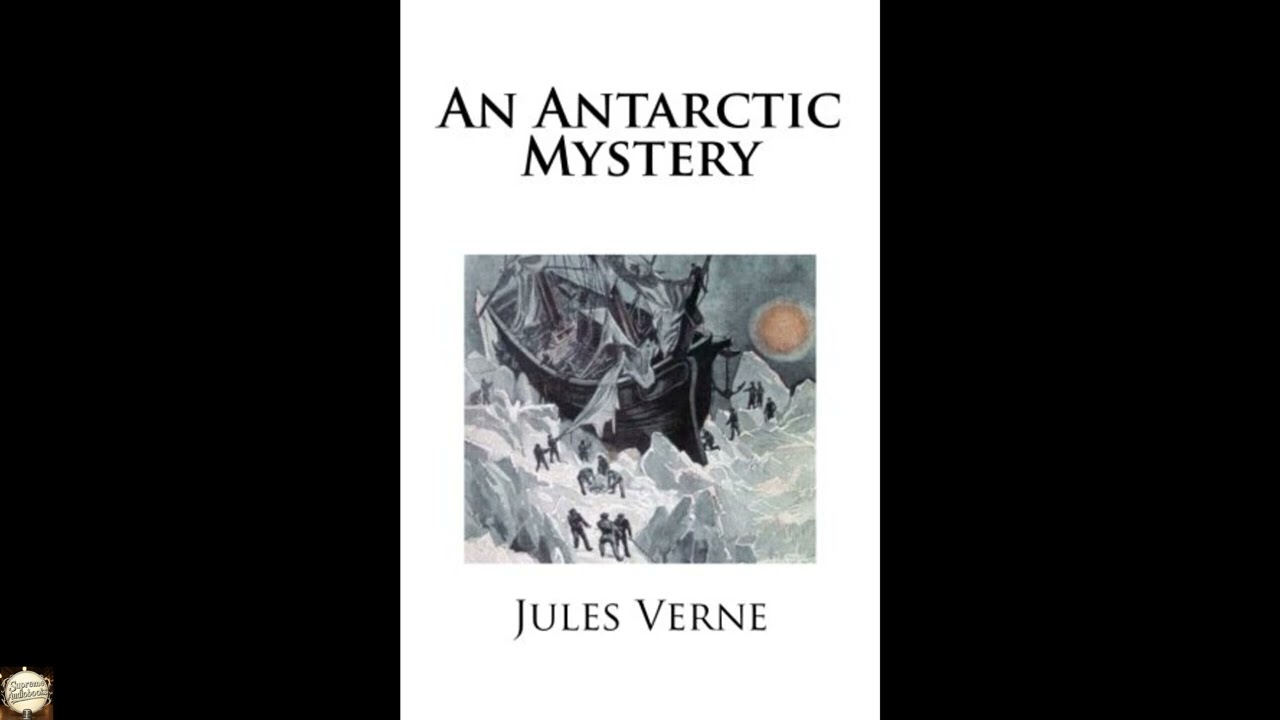
An Antarctic Mystery
Step into a world where the chilling unknown beckons, where the lines between scientific fact and chilling legend blur in the frozen wastes of the South Pole. Jules Verne's An Antarctic Mystery is more than just an adventure story; it is a profound literary dialogue, a daring sequel to Edgar Allan Poe's unfinished, enigmatic novel, The Narrative of Arthur Gordon Pym of Nantucket. For listeners today, this tale offers a unique opportunity to witness one literary giant attempting to complete the work of another, crafting a thrilling narrative that confronts the enduring human desire to comprehend the inexplicable, all while pushing the boundaries of geographical and imaginative discovery. This book resonates with anyone fascinated by the last wild frontiers of our planet and the mysteries they guard. Our story begins in the bleak, remote Kerguelen Islands, a desolate outpost in the southern Indian Ocean, where the American naturalist Halbrand finds himself waiting for passage. There, he meets the eccentric and learned Jeorling, a man utterly obsessed with the fate of Arthur Gordon Pym, Poe's infamous protagonist who vanished into the Antarctic mists. Jeorling has convinced himself that Pym’s cryptic final words, and the very structure of Poe’s incomplete narrative, conceal a profound, unrevealed truth. The two men soon secure berths aboard the Halbrane, a hardy sealing vessel commanded by Captain Len Guy, whose brother had been one of Pym's companions. As the Halbrane sets sail southward, intent on a sealing expedition, destiny intervenes. The crew soon stumbles upon a derelict ship, its timbers rotting and its sails tattered, carrying a lone, emaciated survivor: the powerful Native American chieftain Dirk Peters, Pym's loyal friend and formidable ally from Poe's original account. Peters, having survived the unimaginable horrors of the ice, confirms Jeorling's deepest suspicions: Pym and his companions did indeed push further south than any human before, encountering a landscape and phenomena that defied all known science and reason. Inspired by Peters’s fragmented, terrifying testimony, and driven by a shared, consuming curiosity, Captain Guy abandons the sealing hunt. The Halbrane turns its bow definitively toward the pole, following the trail of a twenty-year-old mystery, plunging deeper into the increasingly strange and dangerous domain of the Antarctic, chasing spectral clues left by Poe's characters into the heart of an icy, primordial enigma. The further they go, the more the world around them warps, presenting them with geographical oddities and atmospheric wonders that challenge their very understanding of existence. Jules Verne, born in Nantes, France, in 1828, grew up captivated by the sea and tales of far-off lands. Though initially pursuing a legal career at the insistence of his father, Verne’s true passion lay in literature and theater. His collaboration with publisher Pierre-Jules Hetzel proved pivotal, leading to the creation of the Voyages Extraordinaires series, a collection of novels that masterfully blended adventure, scientific speculation, and meticulous research. Verne became a prolific writer, dedicating his life to crafting stories that transported readers to the furthest reaches of the Earth and beyond. His life, largely spent in Amiens, was marked by a steady stream of literary output, punctuated by a deep interest in geography, technology, and oceanography. He foresaw many future technological advancements, from submarines in Twenty Thousand Leagues Under the Seas to space travel in From the Earth to the Moon. Other enduring works include Journey to the Center of the Earth, Around the World in Eighty Days, and The Mysterious Island. Verne passed away in 1905, leaving behind a monumental legacy as one of the foundational figures of science fiction and a revered storyteller whose influence continues to shape imaginative literature across the globe. He carved out a unique place in the literary canon, making scientific concepts accessible and thrilling to a wide audience. An Antarctic Mystery skillfully enacts several compelling themes. First, it vividly portrays the lure of the unknown and the human drive for exploration. The relentless southward push of the Halbrane, long after the practical purpose of their voyage has been abandoned, embodies this insatiable curiosity. Characters like Jeorling, driven by a desire to complete Poe's narrative, symbolize humanity's impulse to fill geographical and intellectual gaps, to stand at the edge of the map and peer beyond. Even Captain Guy, initially pragmatic, falls under the spell of the deep south's secrets, risking his ship and crew for the sake of discovery. Another significant theme is the clash between scientific explanation and the supernatural. Verne, a staunch rationalist, endeavors to provide plausible, albeit highly speculative, scientific explanations for Poe's more fantastic elements – the strange writings, the warm polar sea, the colossal human-like figure encountered by Pym. For example, Halbrand meticulously records observations, often attempting to deduce natural causes for the unsettling phenomena they witness. This intellectual struggle permeates the narrative, as characters grapple with phenomena that push the very limits of their understanding, forcing them to reconsider their preconceived notions about the world and its natural laws, yet still searching for a logical underpinning. Culturally and scientifically, An Antarctic Mystery emerged at a fascinating juncture in the late nineteenth century, published in 1897. This era marked the tail end of the great age of geographical discovery, with vast swathes of the Earth still unmapped, particularly the polar regions. Antarctica remained a formidable, largely unconquered continent, a place of profound mystery and danger, making it an ideal canvas for tales of extreme adventure and the unknown. Verne himself was already a titan of popular literature, and his choice to engage directly with Poe's Pym, published decades earlier, speaks to the enduring power of Poe's ambiguous ending and the persistent human desire to resolve lingering literary questions. The period also saw rapid advancements in science and technology, fueling a widespread belief in human ingenuity and the potential for rational explanation. Verne’s novel reflects this optimism, even as it acknowledges the sheer, overwhelming power of nature. It stands as a testament to the era's spirit of scientific inquiry combined with a romantic fascination for the world's last unpenetrated frontiers, offering a unique synthesis of scientific rigor and boundless imagination that typified Verne's entire literary output. Listening to An Antarctic Mystery as an audiobook transforms the experience of this ambitious narrative. A skilled narrator breathes life into Halbrand’s detailed observations and Jeorling’s fervent theories, allowing the listener to truly inhabit the isolated, often terrifying world of the Halbrane. The several hours of running time offer a substantial, engrossing experience, perfect for long stretches of focused listening or for sustained immersion over several days. Pay attention to the gradual shifts in the narrator's pacing, which will mirror the increasing tension and strangeness of the Antarctic environment, from the meticulous descriptions of nautical life to the unsettling encounters with the unknown. The vocal performances of the distinct characters, from the resolute Captain Guy to the enigmatic Dirk Peters, give depth to their debates and their desperate search, truly conveying the chilling atmosphere of the frozen South and the profound mystery at its heart.
Enjoyed An Antarctic Mystery? A few ways to support us
Audible & Amazon links are affiliate; we may earn a small commission at no extra cost.
About this production
Human narration by a volunteer reader from LibriVox.org, the public-domain audiobook project. LibriVox volunteers record literary works whose copyright has expired in the United States, releasing the resulting recordings into the public domain.
An Antarctic Mystery by Jules Verne. The underlying text is in the U.S. public domain. We do not republish any modern copyrighted edition, translation, or commentary.
The 4K cinematic visuals accompanying this audiobook are generated by an AI image model from prompts derived from the source text. No copyrighted photos, paintings, or stock footage are used. AI generation is disclosed on every video on our YouTube channel as required by YouTube's altered/synthetic content policy.
English subtitles are transcribed from the LibriVox recording with OpenAI Whisper. Translations into the 11 other supported languages are produced by Meta's NLLB-200 neural translation model. No human translator's copyrighted translation is used.
Questions about sourcing or rights? See our DMCA & Sourcing policy or contact us.
Enjoyed this audiobook?
If you'd like to own a copy of An Antarctic Mystery or hear a professionally produced edition, the links below help support free audiobook production at no extra cost to you.
As an Amazon Associate we earn from qualifying purchases. Audible / print links are affiliate.