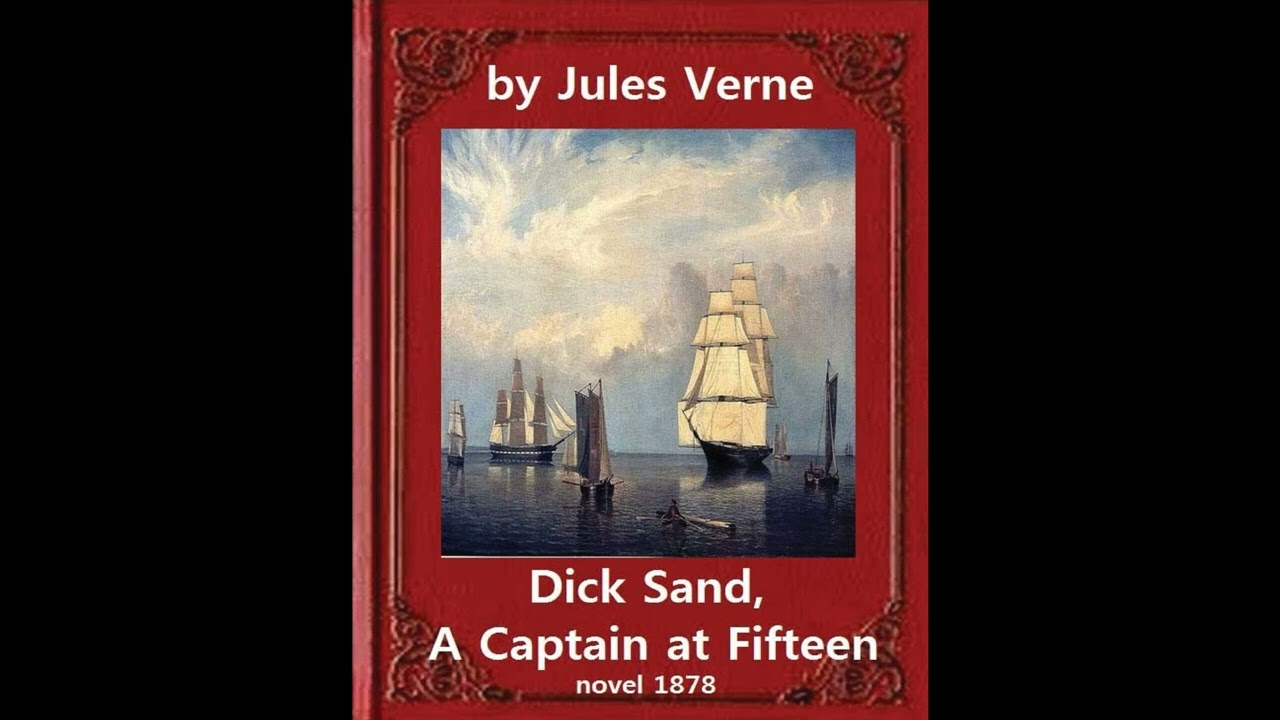
Dick Sand, A Captain at Fifteen (1878) NOVEL By Jules Verne
Imagine a world where the vast, unforgiving ocean demands an impossible transformation: a boy, barely a man, must suddenly command a ship and safeguard a handful of lives against the most savage forces of nature and human malevolence. Such is the premise of Jules Verne's Dick Sand, A Captain at Fifteen, a novel that pulls listeners into a relentless saga of survival and moral awakening. Far more than a simple adventure story, this gripping tale challenges notions of capability and prejudice, testing the limits of courage when a young person is thrust into an adult’s world, confronting a brutal reality shaped by greed and betrayal. It’s a powerful narrative, offering a stark look at the perils of the unknown and the resilience of the human spirit, a message as potent now as it was when first penned. The story opens aboard the Pilgrim, a whaling vessel returning from a successful season in the South Pacific. Among its diverse crew is Dick Sand, a fifteen-year-old orphan who serves as an apprentice sailor, possessing an uncommon sense of duty and a budding skill for navigation. His companions include Mrs. Weldon, wife of the ship's owner, her young son Jack, and her eccentric cousin, Bénédict, an entomologist more interested in insects than ocean currents. Their routine voyage takes a catastrophic turn when the entire experienced whaling crew, including Captain Hull, perishes while attempting to harpoon a wounded whale. Suddenly, the fate of the ship and its remaining passengers rests squarely on Dick’s young shoulders. With only a handful of African-American former slaves—the loyal Tom, Actéon, and Hercules, along with the intuitive dog Dingo—to assist him, Dick Sand assumes command. His gravest challenge, however, comes not from the elements, but from a sinister cook named Negoro, whose true intentions are shrouded in mystery and malice. Manipulating the ship's compass, Negoro deliberately steers the Pilgrim off its intended course towards Valparaíso, diverting it across thousands of miles of ocean to the treacherous coast of Angola. After enduring ferocious storms and near-starvation, the ship is wrecked, forcing the survivors onto a desolate shore, believing they have landed somewhere in South America. The reality, however, is far more terrifying, as they quickly discover the continent they are on is Africa, a land rife with danger, including slave traders and hostile environments, a stark and brutal contrast to the safety they sought. The author behind this riveting narrative, Jules Verne, was born in Nantes, France, in 1828. Initially pursuing a career in law at his father's insistence, Verne's true passion lay in literature and the theater. He soon abandoned legal practice to dedicate himself entirely to writing, drawn to the burgeoning fields of science and technology that characterized the nineteenth century. His early life in the bustling port city of Nantes, with its constant flow of ships and tales of distant lands, undoubtedly fueled his imagination and instilled in him a lifelong fascination with travel and adventure. Verne’s career truly took flight with his collaboration with publisher Pierre-Jules Hetzel, who encouraged him to write "scientific adventure novels." This partnership led to the creation of the Voyages extraordinaires series, through which Verne aimed to summarize all geographical, geological, physical, and astronomical knowledge in an entertaining and accessible format. Works like Twenty Thousand Leagues Under the Seas, which introduced the iconic Captain Nemo and his submarine, the Nautilus, and Around the World in Eighty Days, featuring the intrepid Phileas Fogg, became global sensations, establishing Verne as a foundational figure in science fiction and adventure literature. His ability to blend meticulously researched scientific detail with thrilling narratives secured his place as one of the most widely translated authors in history, influencing generations of writers and scientists. Dick Sand, A Captain at Fifteen enacts several powerful themes. One prominent idea is the profound nature of responsibility and the coming-of-age under duress. Dick, forced into leadership, must make life-or-death decisions that test his nascent skills and moral fortitude. For instance, when the captain and crew are lost, Dick’s immediate focus shifts from his own youth to the safety of Mrs. Weldon and Jack, demonstrating a selfless commitment to his charges. He meticulously consults navigation charts and directs the ship, even as fear gnaws at him, embodying the idea that true maturity is often forged in adversity. Another compelling theme centers on the insidious nature of prejudice and the moral imperative of justice. Verne starkly contrasts the inherent goodness and loyalty of the African-American characters, particularly Tom and Hercules, with the calculating evil of Negoro, who represents the brutality of the slave trade. When the survivors land in Africa, they confront the horrors of this trade firsthand, exposing the exploitation and suffering inflicted upon innocent people. This situation forces the listener to confront uncomfortable truths about human cruelty and the fight against injustice, providing a powerful social commentary woven into the fabric of the adventure. The book emerged during a period of immense global change and fervent public interest in exploration. The late nineteenth century saw European powers aggressively expanding their colonial empires, particularly into Africa, often under the guise of scientific discovery or civilizing missions. This era was characterized by a surge in geographical societies, popular travel accounts, and a general public hunger for news and stories from distant, "unmapped" regions. Verne's narrative tapped directly into this widespread fascination with the unknown corners of the world, offering vicarious experiences of adventure and discovery to his readers, all while subtly critiquing some of the darker aspects of colonial expansion, such as the slave trade, which continued to persist despite international efforts to abolish it. Listening to Dick Sand, A Captain at Fifteen as an audiobook transforms the experience into something deeply immersive. The novel's dramatic pacing, shifting from the relatively calm routine of a whaling ship to the heart-pounding suspense of a storm-battered vessel and the terrifying reality of an unknown jungle, gains considerable power through skilled narration. A talented reader can bring to life the distinctive voices of young Dick, the nurturing Mrs. Weldon, the sinister Negoro, and the steadfast African-American crew members, creating a vivid soundscape that enhances the story's emotional impact. The several hours of its duration allow for sustained attention to the escalating tension and character development, inviting listeners to truly inhabit the world Verne created, feeling the vastness of the ocean, the oppressive heat of the African interior, and the constant threat lurking just beyond the campfire. The descriptive passages truly come alive when spoken, allowing the listener to visualize the grand and terrifying landscapes, making every moment of this grand adventure resonate deeply.
Enjoyed Dick Sand, A Captain at Fifteen (1878) NOVEL By Jules Verne? A few ways to support us
Audible & Amazon links are affiliate; we may earn a small commission at no extra cost.
About this production
Human narration by a volunteer reader from LibriVox.org, the public-domain audiobook project. LibriVox volunteers record literary works whose copyright has expired in the United States, releasing the resulting recordings into the public domain.
Dick Sand, A Captain at Fifteen (1878) NOVEL By Jules Verne by Jules Verne. The underlying text is in the U.S. public domain. We do not republish any modern copyrighted edition, translation, or commentary.
The 4K cinematic visuals accompanying this audiobook are generated by an AI image model from prompts derived from the source text. No copyrighted photos, paintings, or stock footage are used. AI generation is disclosed on every video on our YouTube channel as required by YouTube's altered/synthetic content policy.
English subtitles are transcribed from the LibriVox recording with OpenAI Whisper. Translations into the 11 other supported languages are produced by Meta's NLLB-200 neural translation model. No human translator's copyrighted translation is used.
Questions about sourcing or rights? See our DMCA & Sourcing policy or contact us.
Enjoyed this audiobook?
If you'd like to own a copy of Dick Sand, A Captain at Fifteen (1878) NOVEL By Jules Verne or hear a professionally produced edition, the links below help support free audiobook production at no extra cost to you.
As an Amazon Associate we earn from qualifying purchases. Audible / print links are affiliate.