A Columbus of Space
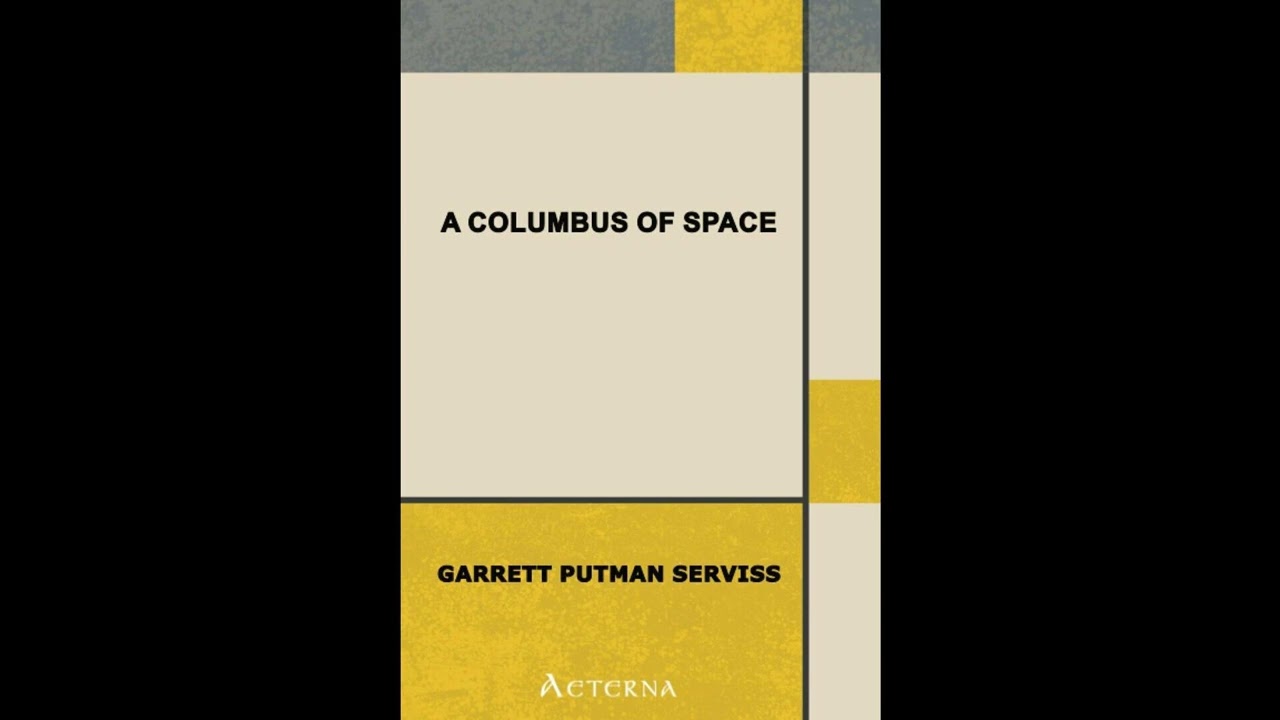
Step into a scientific romance from an earlier age, a thrilling vision of interplanetary adventure that predates humanity's actual forays into space by half a century. Garrett Putman Serviss's A Columbus of Space stands as a testament to human ingenuity and the enduring fascination with what lies beyond our terrestrial sphere. Published at a time when powered flight was still a marvel and the cosmos remained largely a mystery, this novel invites listeners to share in the wonder, the peril, and the profound questions of humanity's destiny among the stars. It is a foundational work of science fiction, offering not only a gripping narrative but a mirror to the scientific optimism and boundless imagination of the early twentieth century, echoing concerns and curiosities that resonate even today as we gaze at Mars and Venus. The story introduces us to Frank R. Chester, an ambitious American inventor whose genius finds its ultimate expression in the creation of the "Flying Dreadnaught," a revolutionary vessel powered by a unique anti-gravitational force. With this incredible machine, Chester intends to achieve what no human has before: travel to other planets. He gathers a select crew, including a seasoned astronomer and a brave companion, and sets out on a daring voyage. Their initial destination is Venus, depicted as a world shrouded in perpetual clouds, teeming with primordial life, vast oceans, and strange, ancient flora. Here, they encounter not advanced civilizations, but rather relics of a long-lost past, alongside formidable natural challenges and creatures that test their scientific understanding and survival skills. The atmospheric conditions, the unique ecology, and the sheer alienness of Venus become a major character in themselves, forcing the crew to adapt and observe with keen eyes. After their incredible experiences on Venus, Chester and his team decide to push further into the solar system, setting their sights on Mars. What they discover there is vastly different from the lush, if dangerous, world of Venus. Mars reveals itself as a starker, more arid planet, bearing the scars of aeons and perhaps the remnants of another kind of existence. The intrepid crew faces new obstacles, from the environmental extremes of the red planet to unexpected revelations about its geological history. Through their encounters and meticulous observations, Serviss blends adventure with a surprising amount of speculative scientific detail, painting vivid pictures of extraterrestrial landscapes and the profound isolation of being a true pioneer. The crew’s determination to understand these new worlds and their place in the larger cosmos drives the narrative forward, leading them through moments of breathtaking discovery and intense suspense without revealing the ultimate outcome of their audacious mission. The author, Garrett Putman Serviss, was born in 1851 in upstate New York and passed away in 1929 in New Jersey. A highly respected astronomer, popular science writer, and journalist, Serviss distinguished himself as one of the great popularizers of science in his era. He graduated from Cornell University and later studied law at Columbia, but his passion for the stars ultimately defined his career. For many years, he served as the science editor for the New York Sun, writing compelling articles that brought the wonders of astronomy to a wide public audience. His ability to explain complex scientific concepts in an engaging and accessible manner made him a sought-after lecturer, drawing large crowds eager to hear about the latest astronomical discoveries and theories. He often presented his lectures with vivid lantern slide illustrations, enhancing the public’s appreciation for the cosmos. Beyond his journalistic endeavors, Serviss penned several works of fiction that cemented his legacy as a significant figure in early science fiction. His most famous novel prior to A Columbus of Space was "Edison's Conquest of Mars," published in 1898 as an unauthorized sequel to H.G. Wells's War of the Worlds, where he reimagined Earth's counterattack against the Martian invaders. Other notable titles include "The Moon Metal" and "The Second Deluge," each showcasing his unique blend of scientific plausibility and imaginative storytelling. Serviss belonged to a generation of writers who viewed science fiction, or "scientific romance" as it was often called, as a vehicle for exploring technological possibilities and societal implications, building upon the foundations laid by Jules Verne while pushing into new speculative territory. His contributions helped bridge the gap between the adventure tales of the late nineteenth century and the more technologically focused science fiction that would gain prominence in the pulp magazines of the 1920s and beyond, securing his place as an important, if sometimes overlooked, voice in the genre's formative years. Serviss skillfully weaves several compelling themes throughout A Columbus of Space. One central theme is scientific ambition and the pursuit of knowledge. This comes to life vividly through Chester's relentless dedication to inventing the Flying Dreadnaught and the detailed scientific observations the crew conducts on Venus and Mars. For instance, the painstaking efforts to analyze atmospheric composition or catalogue new species illustrate the profound human desire to understand the universe through empirical investigation. Another potent theme is humanity's encounter with the unknown and the expansion of its perceived place in the cosmos. The isolation of space travel and the breathtaking, alien landscapes the crew witnesses — such as the vast, steaming jungles of Venus, or the desolate, wind-swept plains of Mars — consistently remind them of Earth's smallness and the universe's immense scale. This confrontation with the truly alien forces them to reconsider conventional notions of life and civilization. Furthermore, the book engages with the theme of survival against overwhelming odds. The crew faces constant dangers, from mechanical failures and the perils of landing on uncharted planets to navigating hazardous environments and potentially hostile life forms. A scene describing their desperate struggle to repair a critical component while exposed to the harsh Venusian atmosphere, or their efforts to find water on arid Mars, underscores the fragility of their existence and their resourcefulness. Finally, a subtle yet present theme is the spirit of terrestrial exploration extended to the celestial realm. The very title, "A Columbus of Space," evokes the Age of Discovery, framing the astronauts not just as scientists, but as intrepid explorers charting new frontiers. Their mission, in essence, mirrors the historical voyages across oceans, driven by curiosity, the promise of discovery, and the courage to venture beyond the known maps. When A Columbus of Space appeared in 1909, the world was on the cusp of dramatic technological and societal shifts. Aviation was still in its infancy, yet the concept of human flight had seized the public imagination. Radio communication was an emerging marvel, and advances in astronomy were constantly redefining our understanding of the universe. Culturally, there was a profound sense of optimism about scientific progress and what it might achieve, though this was tempered by anxieties about industrialization and global power struggles that would soon lead to a world war. In literature, the foundational works of Verne and Wells had already created a significant appetite for "scientific romances," tales that blended adventure with speculative science. Serviss, with his background as a noted astronomer and science popularizer, was uniquely positioned to capitalize on this public hunger. His stories resonated with a readership eager for visions of humanity's future, especially those grounded in plausible scientific principles, reflecting both the awe and the nascent apprehension about the power of technology to reshape the human experience. The book emerged from an era that believed science could solve almost anything, yet also recognized the profound challenges of venturing beyond the familiar. Listening to A Columbus of Space as an audiobook offers a unique and immersive experience, transforming the text from a century-old relic into a vibrant, unfolding drama. A skilled narrator brings Frank Chester's observations and the awe of discovery to life, letting the listener hear the very cadences of turn-of-the-century scientific speculation. The several hours of runtime allow for sustained absorption in the narrative, perfect for long drives, quiet evenings, or moments when you wish to truly escape into another world. Pay attention to the shifts in pacing – the careful, detailed descriptions of scientific preparations give way to rapid-fire action sequences during moments of peril, and then to the contemplative pauses as the crew reflects on their place in the vastness of space. The narrator's voice can convey the excitement of invention, the stark silence of the void, and the vibrant atmosphere of alien landscapes, allowing the listener to fully appreciate the blend of scientific rigor and sheer adventure that defines this classic work.
Enjoyed A Columbus of Space? A few ways to support us
Audible & Amazon links are affiliate; we may earn a small commission at no extra cost.
About this production
Human narration by a volunteer reader from LibriVox.org, the public-domain audiobook project. LibriVox volunteers record literary works whose copyright has expired in the United States, releasing the resulting recordings into the public domain.
A Columbus of Space by Garrett Putman Serviss. The underlying text is in the U.S. public domain. We do not republish any modern copyrighted edition, translation, or commentary.
The 4K cinematic visuals accompanying this audiobook are generated by an AI image model from prompts derived from the source text. No copyrighted photos, paintings, or stock footage are used. AI generation is disclosed on every video on our YouTube channel as required by YouTube's altered/synthetic content policy.
English subtitles are transcribed from the LibriVox recording with OpenAI Whisper. Translations into the 11 other supported languages are produced by Meta's NLLB-200 neural translation model. No human translator's copyrighted translation is used.
Questions about sourcing or rights? See our DMCA & Sourcing policy or contact us.
View 10 famous quotes from this book →
Enjoyed this audiobook?
If you'd like to own a copy of A Columbus of Space or hear a professionally produced edition, the links below help support free audiobook production at no extra cost to you.
As an Amazon Associate we earn from qualifying purchases. Audible / print links are affiliate.