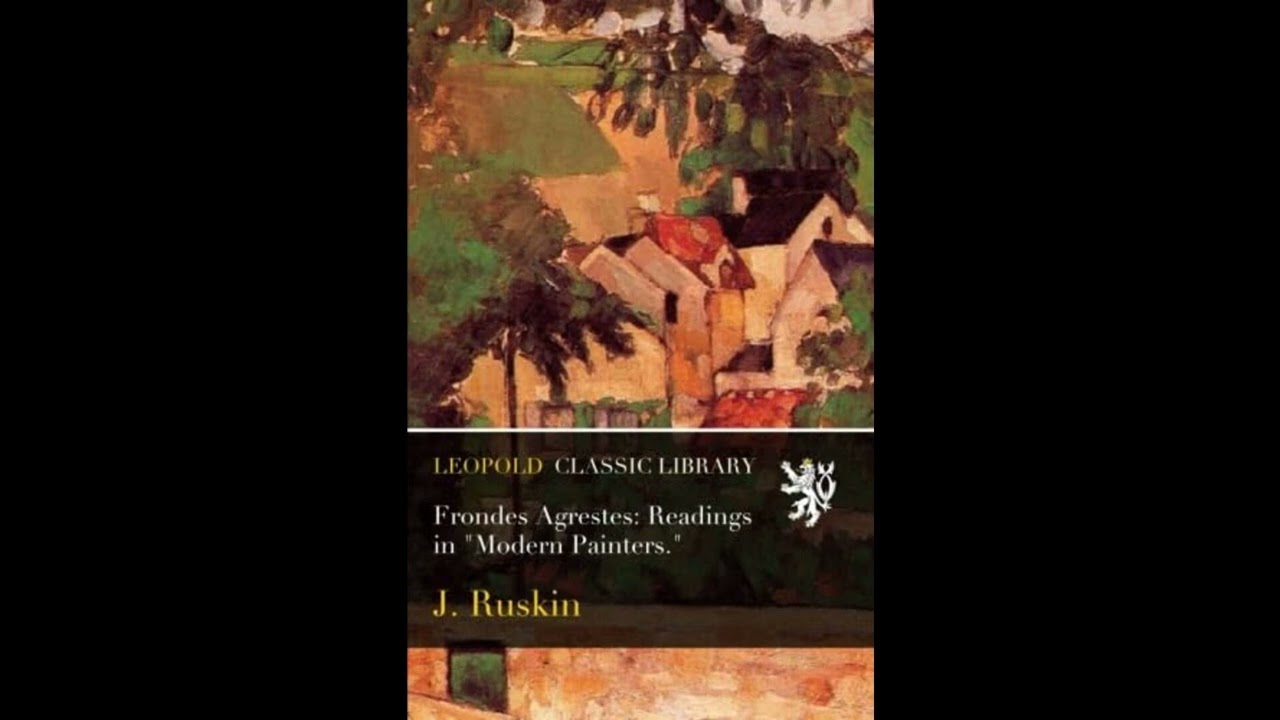
Frondes Agrestes: Readings in "Modern Painters"
"Frondes Agrestes: Readings in 'Modern Painters'" offers a concentrated encounter with the visionary mind of John Ruskin, one of the Victorian era's most formidable critics and thinkers. Far more than a collection of art criticism, this distillation of his monumental five-volume "Modern Painters" presents a profound meditation on beauty, truth, nature, and the moral responsibilities of the artist and observer alike. Listeners encountering Ruskin's work today will find themselves challenged to re-evaluate not only how they perceive art, but how they engage with the natural world and the very concept of authenticity in a rapidly changing world. It is a vital gateway to understanding a writer whose ideas shaped his century and continue to resonate with urgent relevance. The core argument of "Modern Painters," which "Frondes Agrestes" skillfully collects, establishes a grand intellectual quest. Ruskin sets the scene by presenting a passionate, often indignant, challenge to the prevailing art criticism of his day, which he viewed as stagnant and blind to genuine artistic merit. His primary "protagonist" in these early sections is the painter J.M.W. Turner, whose innovative landscapes Ruskin defends with fierce conviction, arguing that Turner’s radical depictions of light, atmosphere, and natural phenomena captured a truth previously unappreciated or misunderstood. Ruskin positions himself as the guide, leading the reader through galleries and out into the wild landscapes of Europe, teaching them how to truly see. The central intellectual conflict pits the unvarnished truth of nature, as revealed by diligent observation and artistic integrity, against the artificiality and idealization that often characterized academic painting. Ruskin critiques artists who merely copy established conventions or impose human sentimentality upon natural scenes, rather than striving to render what is actually there. He takes us through detailed examinations of skies, mountains, clouds, water, and trees, dissecting their forms and colors with a geologist’s precision and a poet’s sensitivity. The "arc" of these collected readings traces Ruskin's developing philosophy, moving from the specific defense of a single artist to the articulation of a comprehensive aesthetic and moral system, demonstrating how the act of seeing truthfully is intrinsically linked to ethical understanding. John Ruskin, born in London in 1819, grew up in a wealthy family that fostered his early passion for art, nature, and literature. His father, a successful sherry merchant, encouraged his intellectual pursuits, providing him with extensive travel opportunities across Europe, particularly to the Alps, which deeply influenced his aesthetic sensibilities and geological studies. A student at Christ Church, Oxford, Ruskin displayed precocious talent for writing and drawing. His first volume of "Modern Painters" appeared in 1843, initially as a defense of Turner against his critics, but it rapidly expanded into a multi-volume treatise that eventually covered the entire scope of art, nature, and society. Ruskin's influence grew throughout the Victorian age. He became an ardent supporter of the Pre-Raphaelite Brotherhood, advocating for their commitment to detailed observation and moral earnestness in painting. His subsequent works, such as "The Stones of Venice," shifted his focus from art criticism to architecture and then to broader social and economic critiques, notably in "Unto This Last," which challenged the tenets of industrial capitalism. He also authored "Sesame and Lilies," a work discussing women's education. A complex figure whose later life was marked by personal struggles and declining mental health, Ruskin died in 1900, leaving behind a prodigious body of work that profoundly shaped thought in aesthetics, social justice, and environmentalism. "Frondes Agrestes," published in 1875, represents Ruskin's own effort to make the essence of his early and perhaps most celebrated work, "Modern Painters," more accessible to a wider audience, selecting its most powerful and representative passages. One of the prominent themes woven through these readings is the absolute necessity of truth to nature. Ruskin argues that art’s highest calling is not to invent or idealize, but to faithfully represent the world as God created it, down to the smallest detail of a leaf or the fleeting shadow on a mountain slope. For instance, he meticulously compares the rendering of clouds by classical landscape painters, which he finds generalized and formulaic, with Turner’s dynamic, scientifically accurate depictions of atmospheric conditions, proving Turner's superior understanding and respect for natural phenomena. Ruskin’s rhetorical power lies in his ability to make these visual distinctions clear and morally significant. Another significant theme is the moral authority of art. For Ruskin, art is never merely decorative or entertaining; it functions as a powerful instrument for moral instruction and spiritual uplift. He suggests that the genuine artist, through diligent observation and honest rendering, acts as a conduit for divine truth, allowing others to see the beauty and order inherent in creation. Conversely, art that relies on falsehoods, sentimentality, or conventional imitation is morally bankrupt, failing both nature and humanity. His detailed examinations of specific artistic choices – how a tree is branched, how light falls upon water – become object lessons in integrity and vision. The mid-Victorian period in which "Modern Painters" was written and "Frondes Agrestes" was compiled was a time of immense social and intellectual upheaval. England was in the throes of the Industrial Revolution, leading to rapid urbanization, environmental degradation, and stark social inequalities. The scientific revolution, particularly in geology and botany, was rapidly expanding understanding of the natural world, often challenging traditional religious beliefs. In the art world, academic traditions still held sway, but new movements, like the nascent Realism and the Pre-Raphaelites, were beginning to question established norms. Turner, as a radical figure, often faced scorn for his departures from classical landscape conventions. Ruskin’s work emerged as a direct response to this context. He saw the industrial age's detachment from nature and its focus on material gain as morally corrosive. Through his passionate advocacy for truth in art, he sought to re-establish a spiritual connection to the natural world and to underscore the moral responsibilities of individuals and society. "Frondes Agrestes," appearing later in his career, served to consolidate his earlier, foundational arguments about beauty and art, perhaps intending to remind a society increasingly focused on his social critiques of the aesthetic principles that underpinned his entire moral framework. It offered a streamlined path back to his initial, powerful call for an honest and reverent engagement with creation. Listening to Ruskin's prose as an audiobook offers a singular experience. His language, renowned for its elaborate structure, rhythmic cadences, and compelling rhetorical force, truly comes alive when read aloud by a skilled narrator. The run length, several hours in duration, allows ample time to absorb his ideas without feeling overwhelmed by the sheer volume of his complete works. A good narration clarifies his complex arguments, guiding the listener through his meticulous observations of natural forms and artistic techniques. Listen for the narrator's pacing, which can emphasize Ruskin's moments of lyrical beauty or his bursts of indignant critique, and how the voice conveys his deep reverence for nature and his unwavering conviction in the moral power of art. It’s an opportunity to immerse oneself in the elegant, persuasive, and often fierce voice of a defining Victorian mind.
Enjoyed Frondes Agrestes: Readings in "Modern Painters"? A few ways to support us
Audible & Amazon links are affiliate; we may earn a small commission at no extra cost.
About this production
Human narration by a volunteer reader from LibriVox.org, the public-domain audiobook project. LibriVox volunteers record literary works whose copyright has expired in the United States, releasing the resulting recordings into the public domain.
Frondes Agrestes: Readings in "Modern Painters" by John Ruskin. The underlying text is in the U.S. public domain. We do not republish any modern copyrighted edition, translation, or commentary.
The 4K cinematic visuals accompanying this audiobook are generated by an AI image model from prompts derived from the source text. No copyrighted photos, paintings, or stock footage are used. AI generation is disclosed on every video on our YouTube channel as required by YouTube's altered/synthetic content policy.
English subtitles are transcribed from the LibriVox recording with OpenAI Whisper. Translations into the 11 other supported languages are produced by Meta's NLLB-200 neural translation model. No human translator's copyrighted translation is used.
Questions about sourcing or rights? See our DMCA & Sourcing policy or contact us.
Enjoyed this audiobook?
If you'd like to own a copy of Frondes Agrestes: Readings in "Modern Painters" or hear a professionally produced edition, the links below help support free audiobook production at no extra cost to you.
As an Amazon Associate we earn from qualifying purchases. Audible / print links are affiliate.