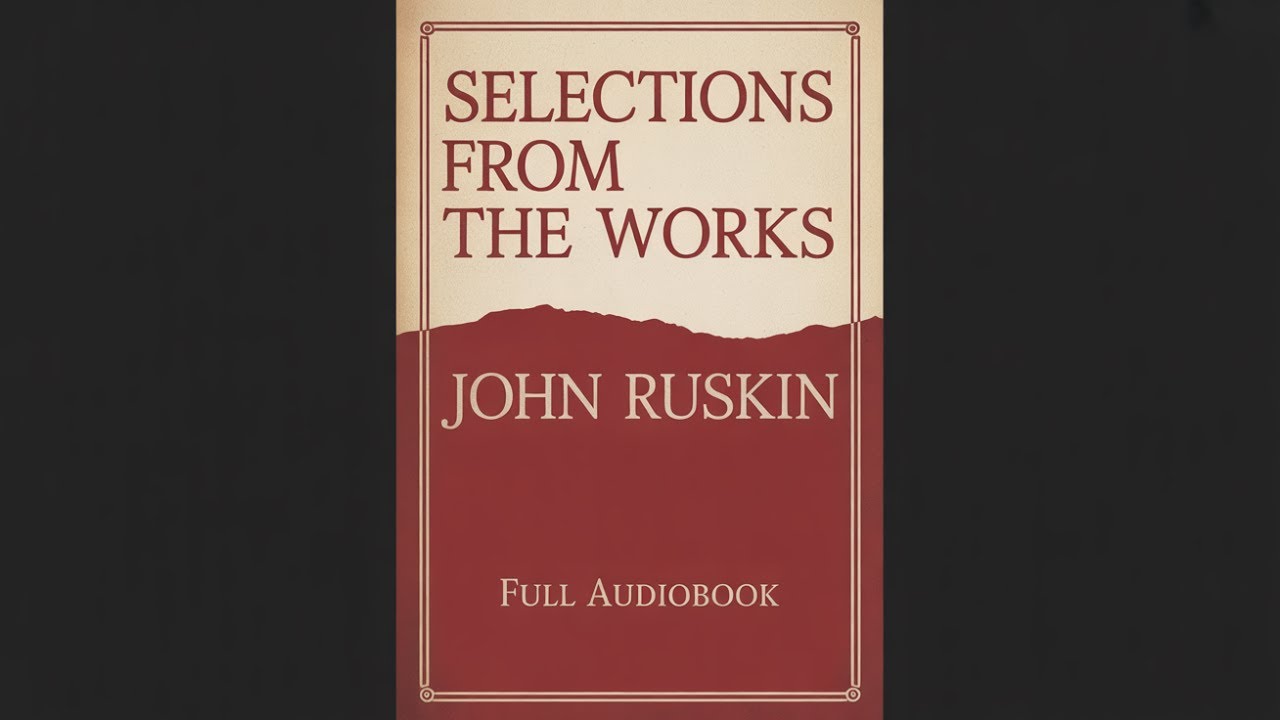
Selections From the Works of John Ruskin
The world is a complex place, often seeming to divide into myriad specialized fields: art, economics, ethics, ecology, social justice. Yet, the great Victorian thinker John Ruskin challenged this fragmentation, insisting that these domains are deeply intertwined, each reflecting and influencing the others. Selections From the Works of John Ruskin offers a carefully chosen portal into the mind of this towering intellectual, bringing together his most compelling insights on aesthetics, society, and the human condition. More than a historical curiosity, Ruskin’s ideas resonate with startling immediacy today. His urgent critiques of industrialism’s impact on human dignity and natural beauty, his passionate advocacy for the environment, and his profound belief in the moral responsibilities that underpin all economic and artistic endeavors confront us with questions that remain central to our own anxieties about technology, inequality, and the future of our planet. This collection presents an opportunity to engage with a thinker whose vision, far from being confined to his era, provides a foundational lens through which to examine many of our contemporary dilemmas. This collection traces the intellectual evolution of a profound critic grappling with a rapidly changing world. The narrative arc, if we consider Ruskin’s own unfolding thought as the central drama, begins with his passionate defense of art – particularly painting – as a moral force, rooted in truth and observation of nature. We witness him establish a setting in the art galleries and studios of mid-19th century Europe, where he meticulously dissects the techniques and spiritual intentions of artists like J.M.W. Turner, whom he championed against conventional critics. His early writings, selections from which likely appear here, frame art not as mere decoration but as a vital expression of a society’s ethical health. The conflict he introduces is often between genuine artistic vision, which he sees as inherently tied to moral perception, and the shallow, often corrupting influences of academic convention or popular taste. As the selections progress, we observe Ruskin broadening his focus from the brushstroke to the broader fabric of society. The setting expands to encompass the industrial cities of England, the bustling markets, and the architectural wonders of Venice. Here, the "characters" are no longer just artists and critics, but also the laborer, the merchant, the politician, and the very structures of society itself. The central conflict intensifies as Ruskin confronts the dehumanizing forces of industrialization and the prevailing economic theories of his day. He argues vehemently against a system that prioritizes profit over human well-being, that separates the worker from the joy of creation, and that pollutes both the physical and spiritual landscape. The arc of his thought moves from an aesthetic critique to a full-fledged social and economic manifesto, driven by an unwavering conviction that beauty, justice, and spiritual integrity are inseparable pillars of a truly humane civilization. This collection invites the listener to follow the development of his arguments, encountering his powerful prose as he critiques the perceived progress of his age, always seeking to define what constitutes a truly "wealthy" and "good" life for individuals and nations alike. The works themselves are by John Ruskin, born in London in 1819 to a wealthy, cultured family. His formative years were marked by an intense, often suffocating, Calvinist upbringing and extensive European tours that instilled in him a deep love for art, architecture, and the natural world, particularly the Alps. These experiences laid the groundwork for his prolific career as a writer, critic, and social reformer. His earliest major work, the multi-volume Modern Painters (published between 1843 and 1860), began as a spirited defense of the landscape painter J.M.W. Turner but evolved into a sweeping theory of art, truth, and the divine in nature. This established him as a leading voice in Victorian aesthetic criticism. Ruskin's intellectual trajectory shifted significantly in the 1850s, a period that saw him wrestle with the stark realities of industrial England and the social injustices he observed. His influential work, The Stones of Venice (1851–1853), initially an architectural history, became a profound meditation on the moral and social conditions necessary for the creation of great art, famously connecting the decay of Venetian architecture to the degradation of its society. This led him inexorably to social criticism and economics. His essays collected as Unto This Last (1860) launched a searing attack on classical economic theories, advocating for a more ethical and compassionate approach to labor and wealth. Throughout his long life, which ended in 1900 at his beloved Brantwood home in England’s Lake District, Ruskin remained a tireless, though often embattled, public intellectual. He exerted enormous influence on the Arts and Crafts movement, figures like William Morris and Mahatma Gandhi, and later social democratic thought, solidifying his place as a pivotal figure in the Victorian literary canon. At the heart of Ruskin’s writings lies the theme of the inextricable link between art, nature, and morality. He believed deeply that true beauty in art and nature was a reflection of divine truth, and that the appreciation of this beauty was essential for human spiritual health. For instance, in his discussions of Gothic architecture, which might be excerpted here, he extols the imperfections and individuality found in the work of medieval craftsmen. These qualities, he argues, are not flaws but expressions of human freedom and moral integrity, standing in stark contrast to the soulless uniformity produced by industrial machinery. When he champions Turner’s landscape paintings, he does so because he perceives in them an unvarnished truth to nature that transcends mere technical skill, demanding a moral engagement from both artist and viewer. This moral imperative extends into his profound critique of industrial capitalism and its dehumanizing effects. Ruskin was among the earliest and most eloquent voices to challenge the utilitarian economic doctrines prevalent in his time. In what could be a selected passage, he might argue that "wealth" should be understood as "life" — not merely an accumulation of material goods or money, but the cultivation of human potential and well-being. He condemned the division of labor that reduced workers to cogs in a machine, stripping them of the joy and dignity of creative work. His distress over the degradation of nature due to unchecked industrial expansion, vividly described in his later works, provides an early, forceful argument for environmental stewardship, positioning him as a prescient voice long before such concerns became widespread. He saw the defilement of the landscape as a direct consequence of a society that prioritized profit over reverence for life and beauty. Ruskin’s most productive years unfolded during the zenith of the Victorian era, a period defined by immense social and technological upheaval. The Industrial Revolution had transformed Britain into an economic powerhouse, but at a profound human and environmental cost: burgeoning cities teemed with poverty and squalor, factories belched smoke, and traditional craftsmanship yielded to mass production. Intellectually, the age was grappling with Darwin’s theories and the rise of scientific rationalism, which often challenged traditional religious beliefs and moral frameworks. Utilitarian philosophers like Jeremy Bentham and John Stuart Mill championed an economic system focused on maximizing utility and profit, a worldview Ruskin found deeply morally problematic. He emerged as a formidable critic against this backdrop, offering a unique, aesthetically and ethically driven counter-narrative. His fierce advocacy for the dignity of labor, the preservation of nature, and the moral responsibilities of wealth directly confronted the prevailing ethos of progress and material accumulation, making his work a vital commentary on the conscience of an empire at its height. Listening to Selections From the Works of John Ruskin as an audiobook transforms the experience of engaging with this formidable thinker. Ruskin's prose is often grand, rhetorical, and deeply passionate, sometimes characterized by complex sentence structures and sweeping arguments. The spoken word allows a skilled narrator to guide the listener through these intricacies, revealing the nuances of his arguments and the lyrical quality of his descriptions with clarity and emphasis. The "several hours" run length is ideal for such substantive material, permitting a sustained engagement with his ideas that might be more challenging in print. The pacing of the narration can highlight Ruskin's powerful condemnations of injustice, slow down for profound philosophical insights, and draw out the beauty of his observations on art and nature. A thoughtful and authoritative voice can bridge the temporal gap, making the Victorian sage's urgent pleas and profound observations resonate directly with a contemporary audience, creating an immersive atmosphere that brings his challenging, transformative vision vividly to life.
Enjoyed Selections From the Works of John Ruskin? A few ways to support us
Audible & Amazon links are affiliate; we may earn a small commission at no extra cost.
About this production
Human narration by a volunteer reader from LibriVox.org, the public-domain audiobook project. LibriVox volunteers record literary works whose copyright has expired in the United States, releasing the resulting recordings into the public domain.
Selections From the Works of John Ruskin by John Ruskin. The underlying text is in the U.S. public domain. We do not republish any modern copyrighted edition, translation, or commentary.
The 4K cinematic visuals accompanying this audiobook are generated by an AI image model from prompts derived from the source text. No copyrighted photos, paintings, or stock footage are used. AI generation is disclosed on every video on our YouTube channel as required by YouTube's altered/synthetic content policy.
English subtitles are transcribed from the LibriVox recording with OpenAI Whisper. Translations into the 11 other supported languages are produced by Meta's NLLB-200 neural translation model. No human translator's copyrighted translation is used.
Questions about sourcing or rights? See our DMCA & Sourcing policy or contact us.
View 10 famous quotes from this book →
Enjoyed this audiobook?
If you'd like to own a copy of Selections From the Works of John Ruskin or hear a professionally produced edition, the links below help support free audiobook production at no extra cost to you.
As an Amazon Associate we earn from qualifying purchases. Audible / print links are affiliate.