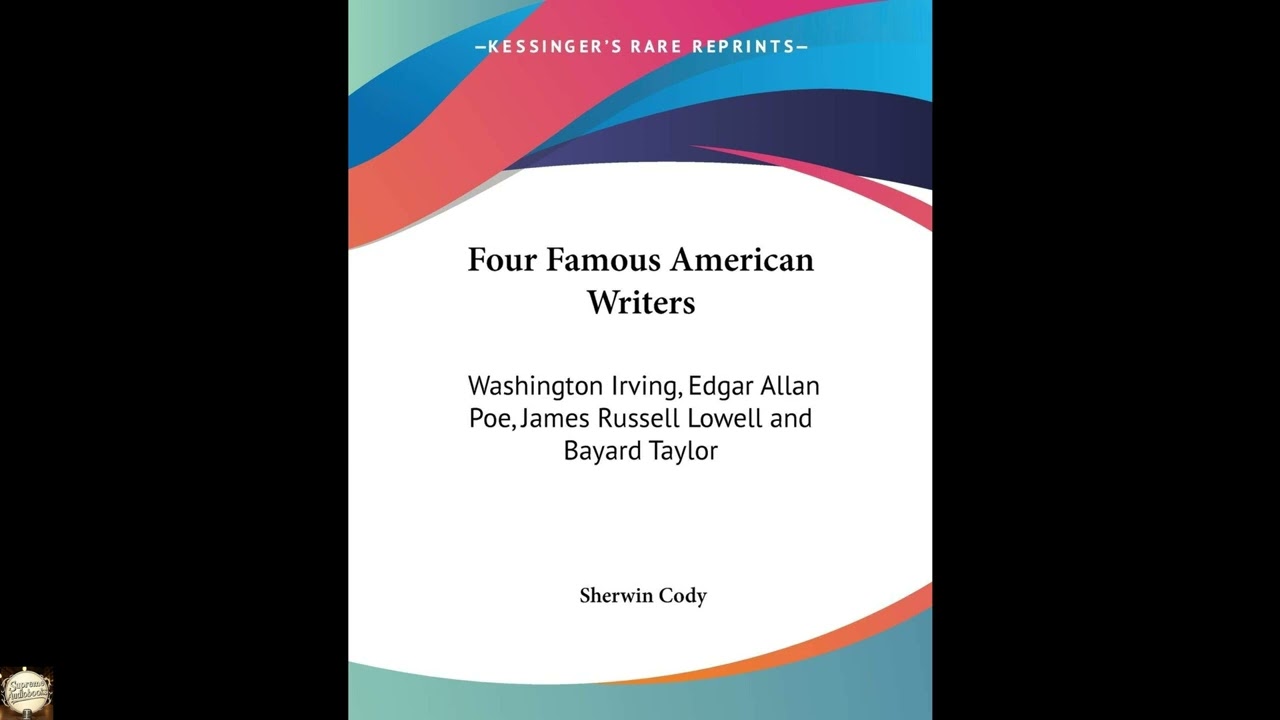
Four Famous American Writers: Washington Irving, Edgar Allan Poe, James Russell Low
Imagine a moment when a nascent nation found its voice, stretching its literary muscles and daring to tell its own stories. This collection, "Four Famous American Writers: Washington Irving, Edgar Allan Poe, James Russell Low," offers a rare opportunity to step back into that foundational era, to experience the genesis of American literature through its most formative figures. It is a portal to understanding the ideas, anxieties, and aspirations that shaped the American spirit in its earliest literary manifestations, demonstrating how these pioneering authors laid groundwork for everything that followed, from enduring myths to profound psychological dramas and passionate social critiques. Listeners will first encounter Washington Irving's often whimsical world, where his genius lay in transplanting European folklore onto the American landscape. He gave us indelible figures like Rip Van Winkle, who awakens from a lengthy slumber to a changed world, and the nervous schoolmaster Ichabod Crane, pursued by the spectral Headless Horseman through the mysterious hollows of New York's Hudson Valley. Irving’s narratives blend history, legend, and romanticized scenery, establishing a distinct American idiom rooted in local color and a wry observation of human nature. From Irving’s sun-dappled glens, the collection then plunges into the shadows with Edgar Allan Poe, a writer whose psychological intensity and mastery of the macabre remain unmatched. Poe transports the audience into unsettling realms of human obsession and dread, where sanity often hangs by a thread. Prepare for chilling confessions of narrators driven to horrific acts, inexorable descents into madness, and logic-defying mysteries that test reason's limits. Whether it's the mournful lamentations in his poetry or the meticulous deconstruction of a crime, Poe’s works disturb, provoke, and reveal terrifying undercurrents beneath everyday reality. Finally, the voice of James Russell Low emerges, representing a different, yet vital, strain of American letters. Low was a polymath: a poet, a trenchant literary critic, and a steadfast advocate for social justice. His contributions often reflected the moral and intellectual concerns of his era, blending lyrical beauty with pointed commentary. Listeners will find his ability to blend the personal with the political, whether in verse that champions freedom or in critical essays that dissect the literary landscape. His works provide not just aesthetic pleasure but also a window into the conscience of a nation grappling with its ideals and imperfections. This particular anthology, drawing from the canon of American letters, stands as a testament to the enduring appeal and educational value of compiling diverse voices under a single cover. Such collections are curated experiences, designed to offer a cohesive yet varied introduction to a nation's literary heritage. This grouping of Irving, Poe, and Low (and the implied fourth figure) likely originates from a tradition of presenting foundational authors whose collective works represent significant shifts in American thought and artistic expression. The creation of an anthology like this reflects a conscious effort to preserve and disseminate texts that shaped our cultural identity, highlighting the intellectual currents and stylistic innovations of a pivotal era. It allows listeners to discern connections and contrasts between writers who, though contemporaries, pursued radically different artistic agendas. A prominent theme running through these selections is the formation of a distinct American identity and voice. Washington Irving, for instance, actively sought to create folklore and mythology for a young nation, providing tales like "Rip Van Winkle" that rooted universal human experiences in specific American landscapes and nascent social structures. His work helped establish a sense of shared national story, moving beyond colonial dependence on European narratives. Even Edgar Allan Poe, while often perceived as detached from overt nationalism, contributed to this identity by articulating a unique American aesthetic—a dark, psychological Romanticism distinct from its European counterparts, asserting a powerful, individualistic voice. Another compelling theme is the interplay between reality and the supernatural, or the rational and the irrational. Irving’s tales frequently employ ghosts, sprites, and magical transformations, blurring lines between the mundane and the fantastic. Poe, however, elevates this theme to a disturbing art form, meticulously detailing characters’ descents into madness or their encounters with forces beyond conventional understanding, as seen in the calculated madness of the narrator in "The Tell-Tale Heart" or the haunting visitation in "The Raven." This exploration of the uncanny questions the nature of perception and sanity. Furthermore, James Russell Low often engaged with the moral complexities of his time, using his literary platform to comment on issues such as abolition, subtly intertwining the ideal and the real in his poetry and critical prose, showing how literature could serve as a mirror and guide for a developing society. These authors flourished during a dynamic period in American history—the early to mid-19th century—a time of immense national growth, expansion, and ideological ferment. Following the War of 1812, America was consolidating its identity, moving westward, and grappling with the implications of its republican ideals. This era saw the rise of Jacksonian democracy, burgeoning industrialization, and the profound moral crisis of slavery, which would ultimately lead to the Civil War. Culturally, American Romanticism was in full bloom, drawing inspiration from European counterparts but increasingly distinguishing itself with unique American themes and landscapes. Washington Irving, writing in the earlier part of this period, capitalized on a hunger for distinctly American stories, helping to forge a literary identity for a country still defining itself. Edgar Allan Poe’s darker Romanticism, emerging a generation later, reflected a growing national introspection, a recognition of the shadows beneath the surface of progress, and a fascination with psychological depth that paralleled societal anxieties about urban life, crime, and the human condition. James Russell Low, active through the mid-century, became a prominent voice in intellectual and reform movements, using his literary acumen to address the pressing social and political questions of his day, particularly concerning abolitionism and national unity. Their works, individually and collectively, are invaluable documents of a nation coming into its own, confronting its demons, and articulating its dreams. To truly appreciate the artistry of these foundational American writers, listening to their works aloud provides an unparalleled experience. An audiobook allows the listener to become immersed in the rhythm and cadence of Irving’s flowing descriptive prose, to feel the creeping tension and psychological horror in Poe's meticulously crafted sentences, and to absorb the moral urgency and lyrical beauty of Low's verse and essays. The narration breathes life into these classic texts, making the evocative settings and distinct character voices palpably real. The extended run time of "several hours" makes this an ideal companion for long commutes, focused listening, or extended relaxation, offering deep engagement with the literary voices that continue to define American storytelling.
Enjoyed Four Famous American Writers: Washington Irving, Edgar Allan Poe, James Russell Low? A few ways to support us
Audible & Amazon links are affiliate; we may earn a small commission at no extra cost.
About this production
Human narration by a volunteer reader from LibriVox.org, the public-domain audiobook project. LibriVox volunteers record literary works whose copyright has expired in the United States, releasing the resulting recordings into the public domain.
Four Famous American Writers: Washington Irving, Edgar Allan Poe, James Russell Low. The underlying text is in the U.S. public domain. We do not republish any modern copyrighted edition, translation, or commentary.
The 4K cinematic visuals accompanying this audiobook are generated by an AI image model from prompts derived from the source text. No copyrighted photos, paintings, or stock footage are used. AI generation is disclosed on every video on our YouTube channel as required by YouTube's altered/synthetic content policy.
English subtitles are transcribed from the LibriVox recording with OpenAI Whisper. Translations into the 11 other supported languages are produced by Meta's NLLB-200 neural translation model. No human translator's copyrighted translation is used.
Questions about sourcing or rights? See our DMCA & Sourcing policy or contact us.
Enjoyed this audiobook?
If you'd like to own a copy of Four Famous American Writers: Washington Irving, Edgar Allan Poe, James Russell Low or hear a professionally produced edition, the links below help support free audiobook production at no extra cost to you.
As an Amazon Associate we earn from qualifying purchases. Audible / print links are affiliate.