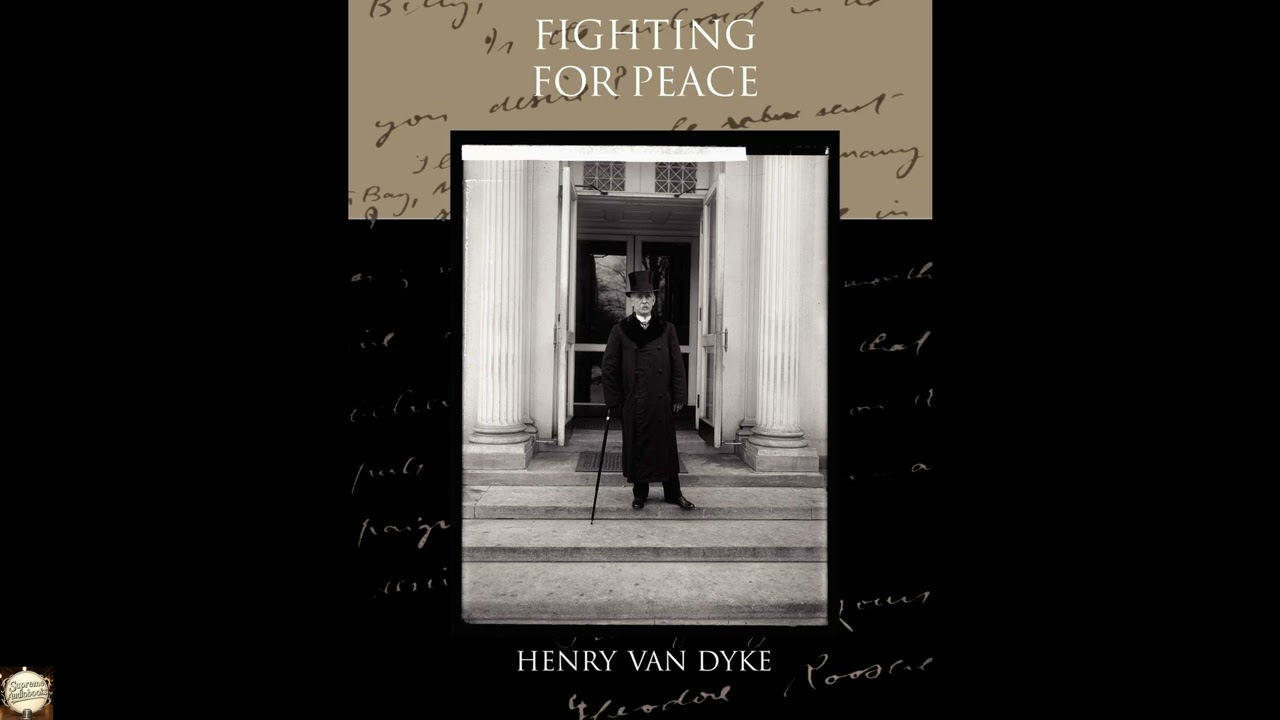
Fighting for Peace
In a world constantly grappling with the paradoxes of conflict and calm, where the pursuit of an elusive global harmony often clashes with the harsh realities of aggression, Henry Van Dyke's Fighting for Peace offers a remarkably resonant voice from a century past. Published amidst the churning anxieties of the First World War, this collection of essays and addresses stands not merely as a historical document, but as a stirring call to conscience that speaks directly to our own complex times. It challenges the simplistic notions of peace, arguing instead for a peace built on justice, morality, and the courageous defense of fundamental human dignities. Listeners today will find themselves drawn into a profound meditation on national duty, individual responsibility, and the true cost of moral neutrality when the world demands a stand. This collection of essays and addresses takes listeners into the heart of a moral and political struggle unfolding on a global stage. The setting is primarily Europe, specifically the neutral Netherlands, where Van Dyke served as U.S. Minister, juxtaposed against the backdrop of an America slowly awakening to the European catastrophe. The central figure is Van Dyke himself, not as a character in a fictional narrative, but as the authorial voice grappling with the unprecedented upheaval of World War I. His "story" is one of an idealist confronted by brutal pragmatism, a man of faith observing widespread destruction, and a diplomat navigating the treacherous waters of international policy while clinging to principles of justice. The book's arc follows Van Dyke's evolution from a hopeful observer of European peace to a staunch advocate for American intervention and a clear moral stance against German aggression. Initially, the conflict is the intellectual and spiritual challenge of maintaining a detached neutrality in the face of widespread atrocity. As the war progresses and the true nature of the conflict—particularly Germany's invasion of Belgium and unrestricted submarine warfare—becomes clearer, Van Dyke's arguments sharpen. He articulates the idea that true peace is not merely the absence of war, but the triumph of righteousness, making a compelling case for why a nation might, and indeed must, fight to preserve that higher form of peace. The narrative tension derives from his passionate appeals and logical dismantling of purely isolationist or pragmatic arguments, urging his countrymen toward a principled engagement with the world's sorrows. Henry Van Dyke was a prominent American literary and religious figure of the late nineteenth and early twentieth centuries, born in Germantown, Pennsylvania, in 1852. His life was one of varied and distinguished service, encompassing roles as a Presbyterian clergyman, an acclaimed author, an educator, and a diplomat. After graduating from Princeton University and Princeton Theological Seminary, Van Dyke served as pastor of the Brick Presbyterian Church in New York City for two decades, a period during which he gained renown for his eloquent sermons and published several popular books. In 1900, he returned to his alma mater, Princeton, as a professor of English literature, influencing a generation of students with his conservative yet eloquent literary insights. Perhaps his most recognized fictional work remains The Story of the Other Wise Man, a short novel published in 1896, which offered a fresh perspective on the biblical Magi. Beyond his literary endeavors, his diplomatic career marked a significant chapter. In 1913, President Woodrow Wilson appointed him as the U.S. Minister to the Netherlands and Luxembourg, a position he held with dedication until 1917. This crucial posting placed him at the very heart of Europe's escalating crisis during the initial years of World War I, profoundly shaping his perspective and leading directly to the reflections found in Fighting for Peace. He remained a prolific writer and public speaker until his death in 1933, leaving behind a legacy that bridges Victorian idealism with the dawning complexities of the modern era. One of the central themes Van Dyke addresses is the fundamental nature of peace itself. He carefully distinguishes between a superficial quietude—the mere cessation of hostilities—and a profound, justice-based peace. For instance, he argues that to allow injustice and tyranny to reign unopposed for the sake of avoiding conflict is not peace, but moral cowardice, describing how a "peace purchased at the cost of honor" ultimately proves fleeting and corrosive. This perspective, born from his observations of Germany's actions in Belgium, forces a re-evaluation of what constitutes true stability and human flourishing, emphasizing that certain principles are worth defending, even with force. Another significant theme is the moral responsibility of nations and individuals. Van Dyke contends that neutrality in the face of clear evil is not an act of wisdom, but a failure of conscience. He points to specific instances of atrocities, such as the sinking of the Lusitania and the systematic destruction in Belgium, as concrete examples demanding a moral response beyond diplomatic protest. He frames America's potential involvement not as an act of aggression, but as a necessary defense of civilization and international law, urging his fellow citizens to consider their ethical obligations on a global scale. The book also implicitly tackles the complex interplay of patriotism and internationalism, suggesting that true love for one's country can sometimes necessitate a broader vision of human solidarity. Fighting for Peace emerged during a period of immense global upheaval and American introspection. The book was published in 1917, a pivotal year during World War I, just as the United States was transitioning from a declared neutrality to active participation in the conflict. Culturally and politically, America was grappling with its identity as a rising world power, torn between a long-standing tradition of isolationism and the undeniable pull of European events. Van Dyke's unique position as a diplomat serving in a neutral country bordering warring nations gave him a first-hand view of the war's human cost and its profound moral implications. His experiences and the arguments within this book directly reflect the national debate surrounding intervention, the nature of German militarism, and the moral imperatives that ultimately led America to abandon its neutrality and join the Allied cause. The work stands as an articulate response to the era's great question: when is it morally necessary to fight for peace? Listening to Fighting for Peace as an audiobook offers a particularly potent experience, allowing the listener to absorb Van Dyke's powerful arguments and moral appeals in their original, persuasive cadence. The length of several hours allows for a sustained engagement with his evolving thought, moving from initial observations to his impassioned calls for action. A skilled narrator can bring to life the measured, yet deeply felt, tone of Van Dyke's prose, highlighting the subtle shifts in his conviction and the unwavering strength of his principles. Pay attention to the pacing, which often builds toward stirring conclusions, and the direct, often rhetorical, nature of his address. The absence of traditional narrative dialogue allows the listener to focus entirely on the author's voice, immersing themselves in the atmosphere of urgent moral debate that characterized America on the brink of war.
Enjoyed Fighting for Peace? A few ways to support us
Audible & Amazon links are affiliate; we may earn a small commission at no extra cost.
About this production
Human narration by a volunteer reader from LibriVox.org, the public-domain audiobook project. LibriVox volunteers record literary works whose copyright has expired in the United States, releasing the resulting recordings into the public domain.
Fighting for Peace by Henry Van Dyke. The underlying text is in the U.S. public domain. We do not republish any modern copyrighted edition, translation, or commentary.
The 4K cinematic visuals accompanying this audiobook are generated by an AI image model from prompts derived from the source text. No copyrighted photos, paintings, or stock footage are used. AI generation is disclosed on every video on our YouTube channel as required by YouTube's altered/synthetic content policy.
English subtitles are transcribed from the LibriVox recording with OpenAI Whisper. Translations into the 11 other supported languages are produced by Meta's NLLB-200 neural translation model. No human translator's copyrighted translation is used.
Questions about sourcing or rights? See our DMCA & Sourcing policy or contact us.
Enjoyed this audiobook?
If you'd like to own a copy of Fighting for Peace or hear a professionally produced edition, the links below help support free audiobook production at no extra cost to you.
As an Amazon Associate we earn from qualifying purchases. Audible / print links are affiliate.