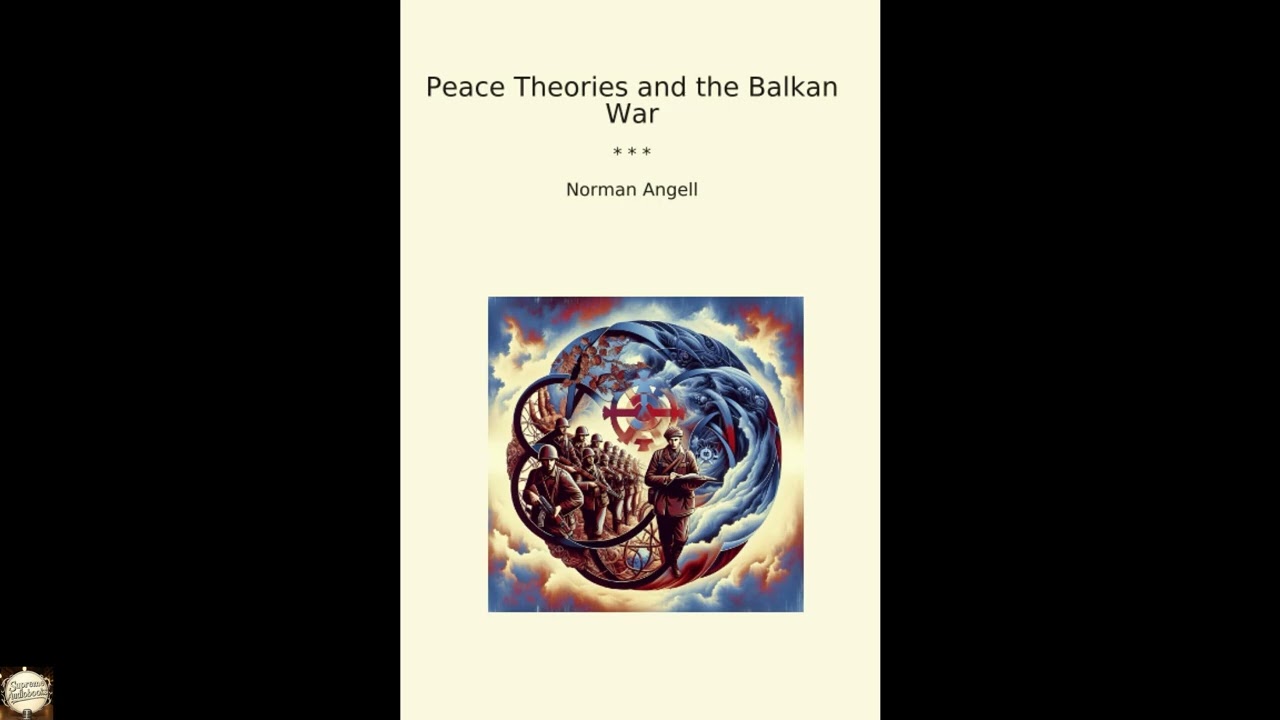
Peace Theories and the Balkan War (Classic Books)
Before the world plunged into the cataclysm of the First World War, a singular voice of reason emerged, challenging the very bedrock of conventional geopolitical thought. Norman Angell’s Peace Theories and the Balkan War is more than a historical document; it is a profound and urgent analysis of international relations that resonates with startling clarity even today. This book unpacks the fundamental misconceptions driving nations toward conflict, particularly the idea that military victory necessarily translates to national prosperity or political advantage. Angell’s arguments about economic interdependence and the futility of war were considered radical at the time, yet they offer a framework for understanding global conflicts that feels prescient in our own era of complex interconnectedness, regional instability, and the persistent illusion of conquest as a profitable endeavor. It is a work that compels us to re-evaluate deeply ingrained assumptions about power, profit, and peace. Angell’s central contention, a principle often referred to as "The Great Illusion," posits that in the modern industrial and financial age, successful military conquest is economically futile. The narrative thread of the book follows Angell as he systematically dissects and refutes the prevailing notion that a nation benefits by subjugating another or seizing its resources through force. He establishes a setting of early 20th-century Europe, a continent bristling with arms and rivalries, where the "characters" are less individuals and more the dominant ideologies of nationalism, militarism, and colonial expansion. Angell's "protagonist" is rational economic analysis, confronting the "antagonist" of deeply emotional, historically rooted beliefs about national honor and the perceived necessity of military strength for economic survival. The arc of Angell's argument begins by demonstrating how global finance, trade, and communication have woven nations into a web of mutual reliance. A war, even if "victorious" for one side, inevitably disrupts this delicate system, causing widespread economic damage that affects the conqueror as much as the conquered. He provides concrete examples, showing how a nation cannot simply seize another's wealth without destroying the very mechanisms that create that wealth. The book then pivots to the contemporary example of the Balkan Wars (1912-1913), applying his theories to a real-world conflict. He argues that the immediate struggles and subsequent instability in the Balkans, far from proving the necessity or profitability of war, actually underscored his points about its inherent economic destructiveness, regardless of who claims victory. He meticulously breaks down how credit collapses, trade routes are disrupted, and human capital is lost, making any territorial gains or indemnities hollow victories at best. His careful construction leaves the listener with a stark understanding of why modern warfare, unlike earlier forms, becomes a shared catastrophe. Sir Ralph Norman Angell Lane, born in Holbeach, Lincolnshire, England, in 1872, led a remarkably varied and influential life before becoming one of the most significant public intellectuals of his time. At the age of seventeen, he left England for the United States, where he spent several years working as a ranch hand, prospector, and eventually a journalist for various American newspapers. This period of diverse experiences undoubtedly shaped his pragmatic worldview and his ability to see beyond conventional wisdom. He later returned to Europe, settling in Paris, where he became the editor of the Daily Mail's continental edition and a foreign correspondent, positions that gave him an intimate understanding of European politics and public opinion. Angell’s most famous work, The Great Illusion, published in 1910, preceded Peace Theories and the Balkan War and laid the groundwork for his arguments against the economic profitability of war. His relentless advocacy for international cooperation and rational approaches to foreign policy earned him widespread recognition, culminating in the Nobel Peace Prize in 1933. He served as a Labour Member of Parliament for Bradford North from 1929 to 1931 and continued to write and lecture extensively throughout the interwar period, passionately warning against the dangers of nationalism and isolationism. Angell was a prominent figure in the liberal internationalist movement, a pragmatic pacifist who based his arguments on economic realities rather than purely moral grounds, securing his place as a pivotal voice in the political philosophy of the 20th century. He passed away in 1967, having lived long enough to witness many of his dire predictions about the consequences of unresolved international tensions tragically come to pass. The book powerfully enacts several critical themes. Foremost among them is economic interdependence, a concept Angell articulates with groundbreaking clarity. He demonstrates how the modern global economy functions as a highly integrated system, where actions in one part of the world inevitably ripple across all others. For instance, he illustrates how a financial crisis in one major European capital, triggered by conflict, would quickly lead to credit contractions and trade disruptions felt everywhere, proving that military conquest cannot isolate a nation from the economic fallout it creates. This interconnectedness means that victory in battle does not translate to economic gain, but rather to shared losses. Another central theme is the folly of conquest as a means to national wealth or security. Angell meticulously debunks the deeply ingrained belief that military power directly confers economic advantage. He argues that even if a nation were to conquer a territory, the act of war itself would devastate the very infrastructure and markets it sought to acquire, making the prize worthless. For example, seizing another country's natural resources might seem appealing, but the destruction of its productive capacity, the loss of skilled labor, and the disruption of its financial ties make any supposed gain illusory. He also highlights the "Great Illusion" itself – the pervasive and dangerous myth that military might is the ultimate guarantor of national prosperity and a necessary tool for maintaining a nation's position in the world. Angell directly challenges the romanticized view of warfare prevalent in his era, contrasting it with the stark, verifiable facts of modern economics. Peace Theories and the Balkan War emerged from a Europe teetering on the precipice of its bloodiest century. Published in 1912, it arrived at a moment of intense geopolitical flux, precisely as the First and Second Balkan Wars unfolded, reshaping the map of Southeast Europe and inflaming nationalist passions. This was a period characterized by an accelerating arms race among the Great Powers, fervent imperial rivalries, and the widespread intellectual acceptance of Social Darwinist ideas applied to international relations – the notion that nations were in a constant struggle for survival, where only the fittest, meaning the most militarily powerful, would endure. Angell's work was a direct, reasoned counter-argument to this prevailing mood. He wrote it not as an abstract academic exercise, but as an urgent intervention, seeking to impress upon public opinion and political leaders the profound economic irrationality of the path they were collectively choosing, offering a radically different perspective on how national interests could truly be secured, not through military might, but through peaceful cooperation and economic integration. Listening to Angell’s arguments as an audiobook offers a uniquely immersive and contemplative experience. The extended runtime allows for a sustained engagement with his carefully constructed logical propositions, giving the listener the space to fully absorb and reflect upon ideas that challenged the established wisdom of his day and continue to provoke thought today. A clear, articulate narration is crucial for conveying the precise nature of Angell’s economic and political analysis, allowing his arguments to unfold with the measured gravity they deserve. The pacing can highlight the deliberate way Angell builds his case, moving from general principles to specific contemporary examples. The listener can focus on the clarity of his reasoning, the lack of rhetorical flourish, and the sheer intellectual force of a voice attempting to cut through nationalistic fervor with facts and figures. It’s an opportunity to hear history speaking not just about the past, but offering vital lessons for the present and future.
Enjoyed Peace Theories and the Balkan War (Classic Books)? A few ways to support us
Audible & Amazon links are affiliate; we may earn a small commission at no extra cost.
About this production
Human narration by a volunteer reader from LibriVox.org, the public-domain audiobook project. LibriVox volunteers record literary works whose copyright has expired in the United States, releasing the resulting recordings into the public domain.
Peace Theories and the Balkan War (Classic Books) by Norman Angell. The underlying text is in the U.S. public domain. We do not republish any modern copyrighted edition, translation, or commentary.
The 4K cinematic visuals accompanying this audiobook are generated by an AI image model from prompts derived from the source text. No copyrighted photos, paintings, or stock footage are used. AI generation is disclosed on every video on our YouTube channel as required by YouTube's altered/synthetic content policy.
English subtitles are transcribed from the LibriVox recording with OpenAI Whisper. Translations into the 11 other supported languages are produced by Meta's NLLB-200 neural translation model. No human translator's copyrighted translation is used.
Questions about sourcing or rights? See our DMCA & Sourcing policy or contact us.
Enjoyed this audiobook?
If you'd like to own a copy of Peace Theories and the Balkan War (Classic Books) or hear a professionally produced edition, the links below help support free audiobook production at no extra cost to you.
As an Amazon Associate we earn from qualifying purchases. Audible / print links are affiliate.