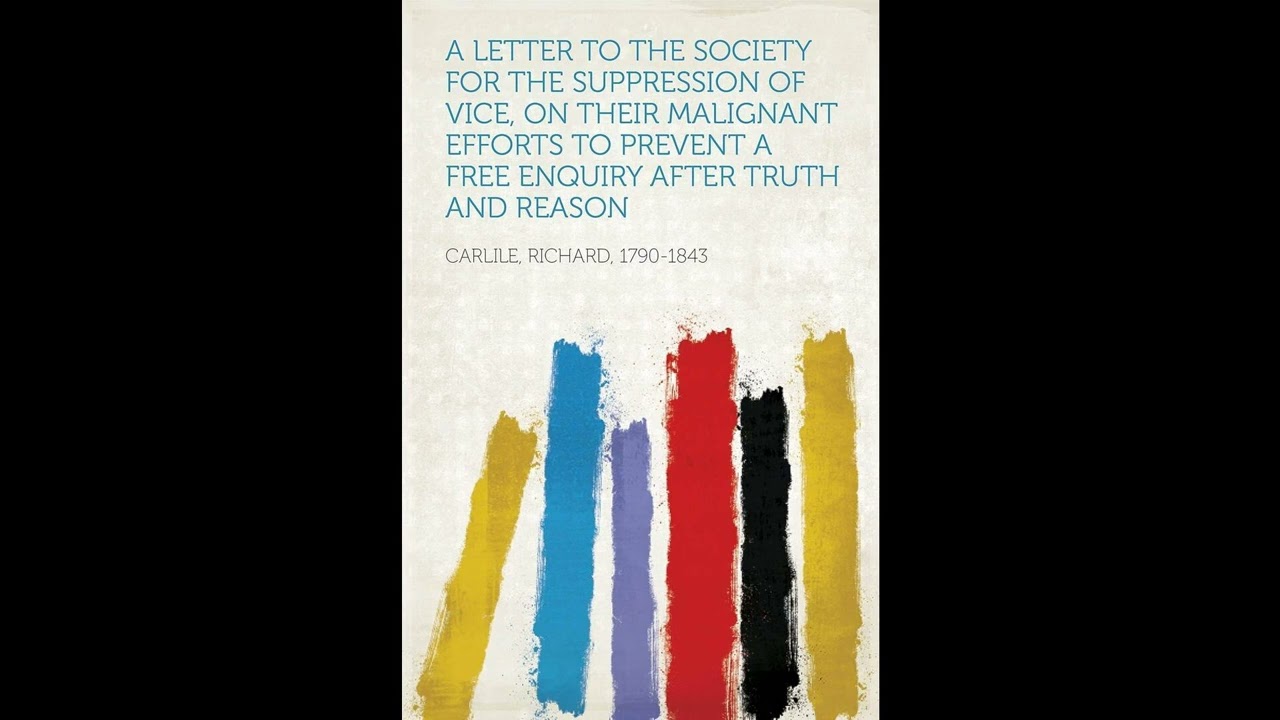
A Letter to the Society for the Suppression of Vice, on Their Malignant Efforts to P- Full Audiobook
The urgent, often furious debate over who dictates morality and how society ought to govern itself pulses through "A Letter to the Society for the Suppression of Vice, on Their Malignant Efforts to P-". This striking piece of classic literature plunges listeners into a historic clash of ideals, forcing us to consider the enduring tension between individual liberty and collective moral policing. Even centuries after its original composition, the raw intelligence and impassioned arguments within this polemic resonate with surprising force, offering vital perspective on contemporary discussions about censorship, personal freedom, and the very definition of what constitutes "vice." It is a testament to the power of a single, articulate voice rising in defiant opposition to established authority. The core of this work is a direct and unsparing challenge to a powerful societal organization — the titular Society for the Suppression of Vice. Our unnamed writer positions themselves as a passionate defender of intellectual and personal freedom, confronting the Society's attempts to impose its narrow definition of morality upon the wider public. The setting is less a physical place than an ideological battleground, with the writer dissecting the Society's stated aims and methods with surgical precision. Through a series of carefully constructed arguments, the letter systematically dismantles the Society's claims to moral authority, questioning their motives, highlighting their perceived hypocrisy, and exposing the potential dangers inherent in their zeal for suppression. The narrative arc, if one can call it that in an argumentative text, follows the relentless escalation of the writer's case. It begins with an assertion of the Society's "malignant efforts," then moves through a detailed critique of their practical actions, and culminates in a broader philosophical questioning of their entire enterprise. The main conflict is thus purely intellectual: the right of individuals to think, read, and live according to their own consciences, pitted against the organized, institutionalized attempt to control public morals and tastes. The letter presents its arguments with a fervor that borders on outrage, yet it is grounded in a deep respect for rational discourse, even as it excoriates its opponents. When a work is attributed to "Unknown," it takes on a unique kind of power, stripping away the personality of the creator to let the ideas stand on their own. The author, in this instance, becomes an everyman or everywoman, a collective voice speaking for a segment of society that felt unheard or oppressed by the moral dictates of the time. This anonymity was often a shield, protecting the writer from the very societies they critiqued, allowing for a freedom of expression that might have been impossible under a named byline. Such an approach echoes a long tradition of powerful, anonymous pamphlets and satires that shaped public discourse, from the early modern broadsides of the English Civil War to the Federalist Papers in America, initially published under the pseudonym "Publius." The lack of a named author also allows "A Letter to the Society for the Suppression of Vice" to transcend the specific historical moment of its creation, positioning its arguments as universal rather than merely personal. It invites listeners to project themselves into the writer's position, to feel the urgency and indignation that fuels such a potent response to perceived injustice. This tradition of the unnamed voice, speaking truth to power from the shadows, imbues the text with a profound sense of authority and universality, making it not just a historical document, but a continuing call to intellectual vigilance against overreaching moral authority. At its heart, "A Letter to the Society for the Suppression of Vice" grapples with the fundamental theme of freedom of expression. The writer champions the right to articulate dissenting views and to engage with a diversity of ideas, even those deemed unconventional or "immoral" by certain segments of society. The very act of writing and circulating such a letter, despite the Society's efforts, stands as an example of this freedom. Another prominent theme is hypocrisy. The author frequently turns the Society's own moral lens back upon them, suggesting that their zealous pursuit of "vice" may itself stem from questionable motives or blind spots, perhaps even hinting at a self-righteousness that is itself a moral failing. For example, the letter might imply that those who are quick to condemn others often overlook their own imperfections, or that the focus on superficial morality distracts from more substantial societal injustices. The letter also interrogates the concept of individual liberty versus societal control. It argues passionately for the right of individuals to make their own choices, to engage with literature, art, and personal conduct as they see fit, free from the heavy hand of organized moral censorship. This is contrasted with the Society's attempts to impose a singular, rigid moral code on everyone, illustrating the tension between the autonomy of the individual and the desire for social order. Finally, the work touches on the nature of vice itself — questioning whether morality can truly be legislated or policed, or if such attempts are ultimately futile and even counterproductive, perhaps even driving certain behaviors underground where they become more harmful. The text suggests that genuine moral improvement comes from within, not from external suppression. The early 19th century, the period in which such a society would have been most active, was a time of significant social and political upheaval. Following the French Revolution and the Napoleonic Wars, Britain experienced a conservative backlash, coupled with the evangelical revival that swept through segments of Protestantism. This confluence created a fertile ground for moral reform movements, driven by a desire to "purify" society and restore what was perceived as traditional order. Organizations like the Society for the Suppression of Vice (founded in London in 1802) emerged from this climate, dedicated to combating perceived moral decay — which often included everything from blasphemy and profanity to gambling, sabbath-breaking, and the circulation of what they deemed "obscene" literature. This was also an era grappling with the consequences of industrialization, urbanization, and a widening chasm between social classes, leading to anxieties about public order and the moral character of the working poor. The Society's efforts were, in part, a response to these deep-seated fears, an attempt to use moral policing as a means of social control. Against this backdrop, "A Letter to the Society for the Suppression of Vice" stands as a vital counterpoint, a voice of intellectual resistance to what was seen as an oppressive and narrow-minded crusade. It represents the broader struggle between the forces of traditional authority and the burgeoning spirit of individual freedom and intellectual inquiry characteristic of the Romantic age. Listening to "A Letter to the Society for the Suppression of Vice" as an audiobook transforms it from a historical document into a living, breathing performance. The very form of a letter, particularly a polemic, is inherently oratorical, designed to be read aloud and heard with impact. A skilled narrator brings out the full force of the writer's conviction, allowing the listener to absorb the nuances of tone — the sarcasm, the indignation, the reasoned argument, the passionate plea. The several-hour length allows for a sustained immersion into this intellectual sparring match, giving the listener ample time to follow the intricate logic and rhetorical flourishes. Pay close attention to the narrator's pacing, how they build tension with each point, and how their voice captures the defiance and wit embedded in the text. This isn't merely information; it is an experience of engaging directly with a powerful, articulate challenge to the status quo, delivered with all the urgency and conviction it demands.
Enjoyed A Letter to the Society for the Suppression of Vice, on Their Malignant Efforts to P- Full Audiobook? A few ways to support us
Audible & Amazon links are affiliate; we may earn a small commission at no extra cost.
About this production
Human narration by a volunteer reader from LibriVox.org, the public-domain audiobook project. LibriVox volunteers record literary works whose copyright has expired in the United States, releasing the resulting recordings into the public domain.
A Letter to the Society for the Suppression of Vice, on Their Malignant Efforts to P- Full Audiobook by Percy Bysshe Shelley. The underlying text is in the U.S. public domain. We do not republish any modern copyrighted edition, translation, or commentary.
The 4K cinematic visuals accompanying this audiobook are generated by an AI image model from prompts derived from the source text. No copyrighted photos, paintings, or stock footage are used. AI generation is disclosed on every video on our YouTube channel as required by YouTube's altered/synthetic content policy.
English subtitles are transcribed from the LibriVox recording with OpenAI Whisper. Translations into the 11 other supported languages are produced by Meta's NLLB-200 neural translation model. No human translator's copyrighted translation is used.
Questions about sourcing or rights? See our DMCA & Sourcing policy or contact us.
Enjoyed this audiobook?
If you'd like to own a copy of A Letter to the Society for the Suppression of Vice, on Their Malignant Efforts to P- Full Audiobook or hear a professionally produced edition, the links below help support free audiobook production at no extra cost to you.
As an Amazon Associate we earn from qualifying purchases. Audible / print links are affiliate.