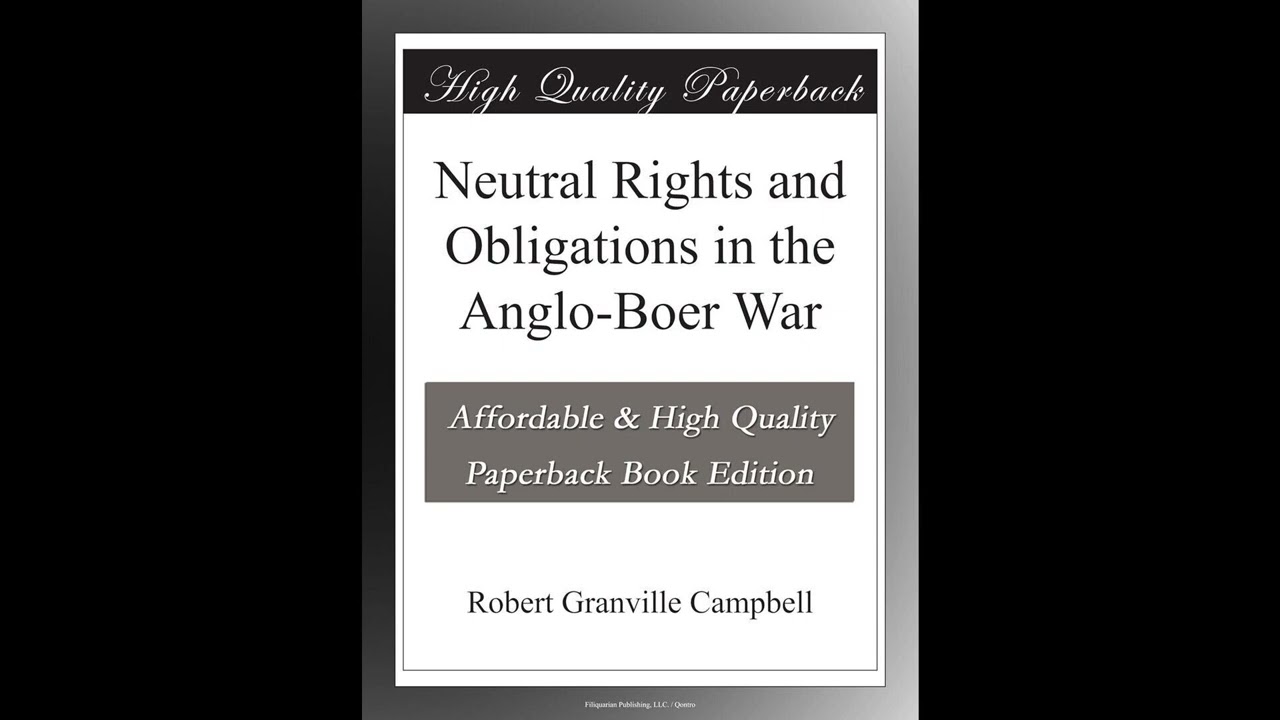
Neutral Rights and Obligations in the Anglo-Boer War
The shadow of conflict often extends far beyond the immediate battlefields, weaving a complex web of legal and moral dilemmas that implicate nations far removed from the direct fighting. Robert Granville Campbell’s "Neutral Rights and Obligations in the Anglo-Boer War" offers a compelling and precise examination of how international law sought to govern—or failed to govern—the conduct of states not directly involved in the hostilities of the late nineteenth and early twentieth centuries. This isn't merely a historical account; it is a foundational text that dissects the enduring tension between national self-interest and the nascent framework of global jurisprudence. For anyone seeking to understand the intricate dance of diplomacy, the enduring relevance of international legal principles, and how past conflicts continue to inform our contemporary geopolitical landscape, Campbell's meticulous analysis remains strikingly pertinent, offering insights into the ever-present challenge of maintaining neutrality in a world perpetually at odds. Campbell's work immerses the listener in the tumultuous period of the Anglo-Boer War (1899-1902), specifically focusing not on the military campaigns in Southern Africa, but on the parallel legal and diplomatic battles waged in the chancelleries and shipping lanes of the world. The "setting" is therefore the international arena, where Great Britain and the two Boer Republics – the South African Republic (Transvaal) and the Orange Free State – were the belligerents, and other major powers like Germany, France, the United States, and the Netherlands wrestled with their respective positions as non-combatants. The central "characters" are less individuals and more the juridical entities of states, their foreign ministries, and the foundational tenets of international law themselves, all operating under immense pressure. The core conflict Campbell elucidates lies in the perennial struggle to define, uphold, and challenge the boundaries of neutrality. The narrative arc follows Campbell's systematic deconstruction of various aspects of this struggle. He begins by laying out the established principles of international law concerning neutrality as they stood at the turn of the century, derived from precedents, treaties, and customary practices. From this theoretical bedrock, he moves to the practical application during the Boer War, dissecting specific incidents that tested these principles. The listener witnesses the careful analysis of situations involving contraband of war, the rights of neutral shipping, the extent of blockades, the contentious issue of asylum for belligerent combatants on neutral territory, and the delicate balance required for neutral citizens residing within belligerent states. Campbell’s measured approach builds a comprehensive picture, moving from general legal philosophy to the granular detail of specific diplomatic exchanges and legal challenges, illustrating how theoretical ideals confronted the messy realities of wartime exigency and national prerogative. The tension throughout remains palpable: how does a global community enforce rules when the most powerful players are engaged in a life-or-death struggle, and how do "neutral" nations protect their own interests without becoming de facto allies of one side or another? Robert Granville Campbell, writing in the early decades of the twentieth century, represents a cadre of scholars dedicated to the rigorous study of international law and its practical application during periods of conflict. Though specific biographical details regarding his exact birth and death dates are not widely publicized, his scholarly output firmly places him within the intellectual ferment following major late-Victorian and Edwardian international incidents. It is reasonable to surmise he was likely a jurist, a legal historian, or a political scientist associated with academic institutions keen on codifying and analyzing the evolving framework of global governance. His choice of the Anglo-Boer War as a case study reflects a then-contemporary urgency to understand the complex legal ramifications of modern warfare and imperialism. Campbell’s contribution to the academic canon comes from his ability to translate abstract legal principles into concrete analysis, dissecting events with a dispassionate, analytical gaze characteristic of serious legal scholarship. His work stands as a testament to an era when international law was transitioning from a collection of customary practices to a more formalized and aspirational system, shaping how subsequent generations of scholars and policymakers would approach questions of state sovereignty and global order. Campbell’s examination of neutrality enacts several profound themes that resonate far beyond the specifics of the Anglo-Boer War. One primary theme is the inherent fragility of international law when confronted by the overwhelming force of national interest and wartime necessity. For instance, the discussion surrounding contraband goods vividly illustrates how definitions and enforcement often shifted under pressure, as belligerents – particularly Great Britain, with its dominant naval power – frequently stretched the interpretation of what constituted legitimate war material, leading to protests from neutral mercantile nations. This tension underscores the practical limitations of legal frameworks without robust enforcement mechanisms. A second, closely related theme is the dynamic and often ambiguous nature of neutrality itself. Campbell meticulously demonstrates that neutrality is not a passive state of inaction, but an active, constantly negotiated position. Consider the complexities surrounding the passage of belligerent warships through neutral waters, or the sale of weapons by neutral manufacturers to warring parties. These scenarios force a re-evaluation of what non-involvement truly means, highlighting the fine line between maintaining impartiality and inadvertently benefiting one side, a dilemma still debated in contemporary conflicts. Furthermore, Campbell’s text implicitly addresses the theme of the evolving character of warfare and its impact on legal traditions. The Anglo-Boer War was, in many respects, a precursor to the global conflicts that would define the twentieth century, introducing elements like widespread guerrilla tactics, civilian internment in concentration camps, and advanced logistics. These innovations continuously challenged existing legal precedents, forcing states and scholars to reconsider how international law applied to circumstances unseen in previous, more conventional wars. Finally, the work also touches upon the aspirational struggle for a coherent global order amidst competing national sovereignties. The very act of analyzing "neutral rights and obligations" is an appeal to a higher, universal standard of conduct, a hopeful attempt to impose rationality and justice onto the chaos of conflict. Campbell presents numerous instances where nations, while defending their own interests, also appealed to principles of international law, illustrating a nascent, shared understanding that there should be rules governing the interactions of states, even in times of war. The historical context for Campbell's work is crucial for appreciating its depth. The Anglo-Boer War itself was a pivotal, yet controversial, conflict. It captured global attention not only for its military developments, which included early examples of modern trench warfare and scorched-earth policies, but also for its moral and legal implications. It was fought at the tail end of the European colonial expansion, raising questions about imperial might versus self-determination, and it served as a stark demonstration of the brutality possible even among so-called "civilized" nations. Campbell’s analysis emerged in an era preceding the two World Wars, a period when international legal thought was rapidly formalizing. Major international conferences, like the Hague Conventions of 1899 and 1907, were actively attempting to codify the laws of war and neutrality. His book thus stands as a contemporary legal assessment of a recent, impactful conflict, serving as both a historical record and a contribution to the ongoing intellectual project of developing and refining international jurisprudence in a world that felt increasingly interconnected yet volatile. It emerged as an intellectual response to the profound ethical and practical questions raised by a conflict that resonated deeply across the international community. Listening to Robert Granville Campbell’s meticulous work as an audiobook offers a singular opportunity to engage with historical legal scholarship on an intimate level. The sustained run length, spanning several hours, is perfectly suited to the density and precision of the arguments presented. A skilled narrator, with a clear, authoritative, and measured voice, becomes essential, acting as a guide through the labyrinthine details of international treaties, diplomatic correspondence, and legal precedents. Such a performance ensures that Campbell’s careful construction of arguments, which often build incrementally through detailed examples, remains lucid and digestible. The listener can absorb the gravity of the subject matter, appreciating the careful pacing that allows for reflection on each point of law and each historical incident. While devoid of traditional "dialogue," the atmosphere created is one of thoughtful inquiry and intellectual rigor, inviting deep contemplation on how legal principles navigate the often-turbulent waters of international relations, a study that remains as pertinent today as it was over a century ago.
Enjoyed Neutral Rights and Obligations in the Anglo-Boer War? A few ways to support us
Audible & Amazon links are affiliate; we may earn a small commission at no extra cost.
About this production
Human narration by a volunteer reader from LibriVox.org, the public-domain audiobook project. LibriVox volunteers record literary works whose copyright has expired in the United States, releasing the resulting recordings into the public domain.
Neutral Rights and Obligations in the Anglo-Boer War by Robert Granville Campbell. The underlying text is in the U.S. public domain. We do not republish any modern copyrighted edition, translation, or commentary.
The 4K cinematic visuals accompanying this audiobook are generated by an AI image model from prompts derived from the source text. No copyrighted photos, paintings, or stock footage are used. AI generation is disclosed on every video on our YouTube channel as required by YouTube's altered/synthetic content policy.
English subtitles are transcribed from the LibriVox recording with OpenAI Whisper. Translations into the 11 other supported languages are produced by Meta's NLLB-200 neural translation model. No human translator's copyrighted translation is used.
Questions about sourcing or rights? See our DMCA & Sourcing policy or contact us.
View 10 famous quotes from this book →
Enjoyed this audiobook?
If you'd like to own a copy of Neutral Rights and Obligations in the Anglo-Boer War or hear a professionally produced edition, the links below help support free audiobook production at no extra cost to you.
As an Amazon Associate we earn from qualifying purchases. Audible / print links are affiliate.