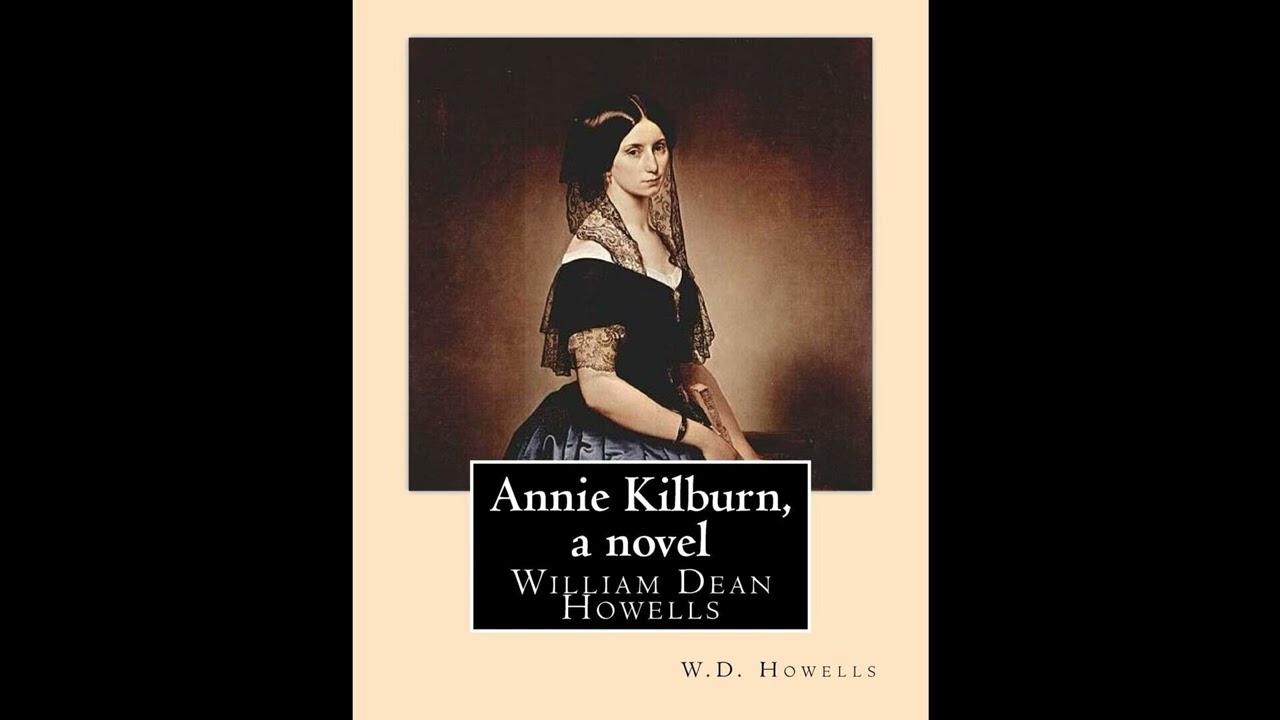
Annie Kilburn, a novel . By: W.D.Howells
What does it truly mean to do good in the world? How do intentions, no matter how pure, navigate the rocky shoals of social convention, ingrained prejudice, and the subtle hypocrisies of a seemingly genteel society? These are the central questions that animate William Dean Howells’s discerning 1889 novel, Annie Kilburn, a penetrating social commentary that resonates with startling clarity even today. This is not a tale of dramatic heroism or grand adventure, but an incisive, often quietly devastating, examination of moral aspiration set against the backdrop of a changing America—a story that challenges our perceptions of charity, community, and personal responsibility, inviting us to look closer at the complexities beneath the surface of well-meaning actions. The story introduces us to Annie Kilburn, a woman of gentle temperament and considerable inherited wealth, who returns to her ancestral New England village of Hatboro after years spent abroad in Italy. She arrives with a sincere desire to make a positive impact on her community, her European sojourn having opened her eyes to the deeper human needs often overlooked in polite society. Hatboro, however, is a microcosm of late nineteenth-century America, a place where social strata are rigidly defined, where old money and inherited status dictate influence, and where the appearance of propriety often overshadows genuine compassion. Annie’s well-intentioned efforts quickly run aground on the formidable obstacles of local custom and the entrenched attitudes of Hatboro’s elite. Her initial vision—to establish a social club where villagers of all classes might mingle and find mutual improvement—is met with a mixture of suspicion, condescension, and outright resistance. Her interactions with various figures in the town, from the well-meaning but ultimately ineffectual Reverend Peck, who champions a more conventional form of charity, to the cynical, worldly Dr. Morrell, who sees through the town’s pretenses, expose the profound chasm between Annie’s idealistic hopes and the practical realities of social reform. As Annie grapples with the inherent difficulties of enacting change, she begins to question not only the effectiveness of her own philanthropy but also the very nature of what constitutes true benevolence, facing the painful realization that doing good is rarely as simple as it seems on the surface. William Dean Howells (1837-1920) was a pivotal figure in American literature, often lauded as "The Dean of American Letters" during his lifetime. Born in Martin’s Ferry, Ohio, Howells’s early life was marked by a commitment to journalism and a restless intellectual curiosity. He honed his writing skills through work at various newspapers before a diplomatic appointment as U.S. consul to Venice provided him with an extended period abroad, enriching his perspective on both European and American society. Upon his return, Howells settled in Boston, a burgeoning literary center, and soon became a leading voice as editor of the prestigious Atlantic Monthly from 1871 to 1881. Howells’s influence extended beyond his own prodigious output of novels, plays, and essays; he was a tireless champion of American realism, advocating for literature that depicted the ordinary lives and moral dilemmas of everyday people with fidelity and psychological nuance. He nurtured the careers of many emerging writers, including Mark Twain and Henry James, and continually argued for a literary art that moved away from romanticized ideals towards an honest portrayal of social experience. His own novels, such as The Rise of Silas Lapham (1885) and A Modern Instance (1882), stand as towering achievements of the realist movement, meticulously detailing the economic anxieties, social pressures, and ethical quandaries of the post-Civil War era. Through his work and his critical pronouncements, Howells effectively redefined the scope and purpose of the American novel for a new generation. At its core, Annie Kilburn thoughtfully interrogates the intricate theme of philanthropy and its inherent complexities. Annie’s attempts to create a social club for Hatboro’s various social strata beautifully illustrate how good intentions can collide with class boundaries and personal pride. The initial enthusiasm for a collaborative effort devolves into infighting and misinterpretations, particularly highlighted by the disagreements among the ladies of the village about who should be admitted and what activities should be offered. This reveals the painful truth that charity, when not carefully conceived and executed, can inadvertently reinforce social divisions rather than bridge them. Howells also examines the hypocrisy and social conservatism prevalent in late nineteenth-century New England communities. The novel subtly exposes the performative nature of certain social gestures and the rigidity with which the established order resists any challenge to its traditions, regardless of the merit of the new ideas. Another significant theme present in the novel is the clash between individual idealism and societal inertia. Annie, with her earnest desire to better her community, repeatedly encounters a pervasive reluctance to change, a deep-seated suspicion of anything that might upset the delicate balance of Hatboro’s social fabric. Her struggles reflect the broader challenges faced by reformers of the era who sought to address burgeoning social problems with new solutions. Furthermore, the narrative subtly addresses the evolving role of women in society, presenting Annie as an independent woman grappling with her purpose outside the confines of traditional domestic roles. Her efforts, though fraught with difficulties, represent a nascent desire among women of her standing to engage meaningfully with the public sphere, seeking personal fulfillment through civic engagement rather than through marriage alone. Annie Kilburn emerged from a period of profound transformation in American society—the Gilded Age. Following the Civil War, the United States experienced rapid industrialization, massive urbanization, and unprecedented economic growth, which, while creating immense wealth for some, also led to stark social inequalities, widespread poverty, and the concentration of power in the hands of a few. These societal shifts prompted intense debates about social responsibility, the role of religion in addressing social ills, and the efficacy of various reform movements. It was a time when the "social gospel" began to take root, urging churches and individuals to actively address social injustices. Literarily, this was the era when American realism was coming into its own, championed by Howells himself, as a reaction against the lingering romanticism of earlier decades. Writers sought to portray life "as it is," focusing on verisimilitude, ordinary characters, and the psychological impact of social and economic conditions. Annie Kilburn is a direct product of this intellectual and cultural ferment, reflecting Howells’s desire to dissect the moral dilemmas arising from a society grappling with its newfound wealth and its persistent inequalities. The novel’s meticulous observation of social interactions, its nuanced characterizations, and its focus on ethical questions make it a quintessential text of its time, capturing the anxieties and aspirations of a nation in flux. To experience Annie Kilburn as an audiobook is to immerse oneself fully in Howells’s finely detailed world, allowing the nuances of his prose and the subtleties of his social critique to unfold at a natural pace. A skilled narrator brings Howells’s characteristic blend of wit and poignant observation to life, giving distinct voices to Annie’s internal struggles and the varied, often contradictory, opinions of the Hatboro townspeople. The run length of several hours makes this an ideal companion for reflective listening, whether during commutes, while tackling household tasks, or simply during dedicated quiet time. The careful pacing of the narrative, which gradually reveals the complexities of human nature and societal pressures, is particularly well-suited to the auditory format, allowing listeners to fully appreciate the delicate rhythms of Howells’s dialogue and the astute psychological insights embedded in the interactions. You will find yourself listening closely to the atmospheric descriptions of the New England village and the deeply human conversations that drive Annie’s evolving understanding of herself and her community.
Enjoyed Annie Kilburn, a novel . By: W.D.Howells? A few ways to support us
Audible & Amazon links are affiliate; we may earn a small commission at no extra cost.
About this production
Human narration by a volunteer reader from LibriVox.org, the public-domain audiobook project. LibriVox volunteers record literary works whose copyright has expired in the United States, releasing the resulting recordings into the public domain.
Annie Kilburn, a novel . By: W.D.Howells by William Dean Howells. The underlying text is in the U.S. public domain. We do not republish any modern copyrighted edition, translation, or commentary.
The 4K cinematic visuals accompanying this audiobook are generated by an AI image model from prompts derived from the source text. No copyrighted photos, paintings, or stock footage are used. AI generation is disclosed on every video on our YouTube channel as required by YouTube's altered/synthetic content policy.
English subtitles are transcribed from the LibriVox recording with OpenAI Whisper. Translations into the 11 other supported languages are produced by Meta's NLLB-200 neural translation model. No human translator's copyrighted translation is used.
Questions about sourcing or rights? See our DMCA & Sourcing policy or contact us.
Enjoyed this audiobook?
If you'd like to own a copy of Annie Kilburn, a novel . By: W.D.Howells or hear a professionally produced edition, the links below help support free audiobook production at no extra cost to you.
As an Amazon Associate we earn from qualifying purchases. Audible / print links are affiliate.